Lipødem og Lymfødem
Why do you get Swollen Legs? Causes and Correlation with Varicose Veins, Lipedema and Lymphedema
Swollen legs (also called edema) are a very common symptom that occurs when excess fluid/fat accumulates in the tissue of the legs. Although it is often harmless and temporary, it can also be a sign of an underlying medical condition that requires attention. Understanding the cause is crucial for proper treatment. Here are the most common reasons why you may experience swollen legs and feet:
1. Poorly functioning veins and varicose veins (Venous Insufficiency)
The most common cause of chronic swelling in the lower legs is problems with the veins, known as venous insufficiency.
-
Varicose veins occur when the small venous valves in the legs are leaky and cannot pump blood efficiently back to the heart.
-
This causes blood to back up in the veins, pressure increases and fluid is forced out into the surrounding tissue.
-
The swelling is typically worst at the end of the day, especially after prolonged standing or sitting, and is often accompanied by symptoms such as heaviness, restless legs and cramps.
-
Untreated varicose veins can cause persistent skin discoloration, eczema, and, in severe cases, venous leg ulcers over time.
2. Lifestyle and Temporary Causes of Swollen Legs
Many cases of swollen legs are caused by factors that can be easily adjusted:
-
Prolonged inactivity: Sitting or standing still for long periods of time (e.g. on a flight or at work) prevents the vein pump (the muscles in the calf) from functioning optimally.
-
Overweight: Increased body weight puts more pressure on the veins in the legs, which impedes blood circulation.
-
Hormonal changes: Pregnancy and premenstrual periods can cause water retention due to changes in hormonal balance.
-
High salt intake: Too much sodium in the diet can cause the body to retain fluid.
3. Underlying Medical Conditions
For persistent or sudden swelling, your doctor should always check for more serious causes:
-
Heart failure: When the heart doesn't pump efficiently, blood can back up into the veins and fluid accumulates in the lower extremities.
-
Kidney problems: Leaky kidneys can cause fluid retention or loss of proteins, leading to general swelling.
-
Medication Side Effects: Certain medications, such as blood pressure medications (calcium blockers) or arthritis medications (NSAIDs), can have swollen legs as a side effect.
-
DVT: Sudden swelling, often in just one leg, can be caused by a deep vein thrombosis and requires urgent medical attention.
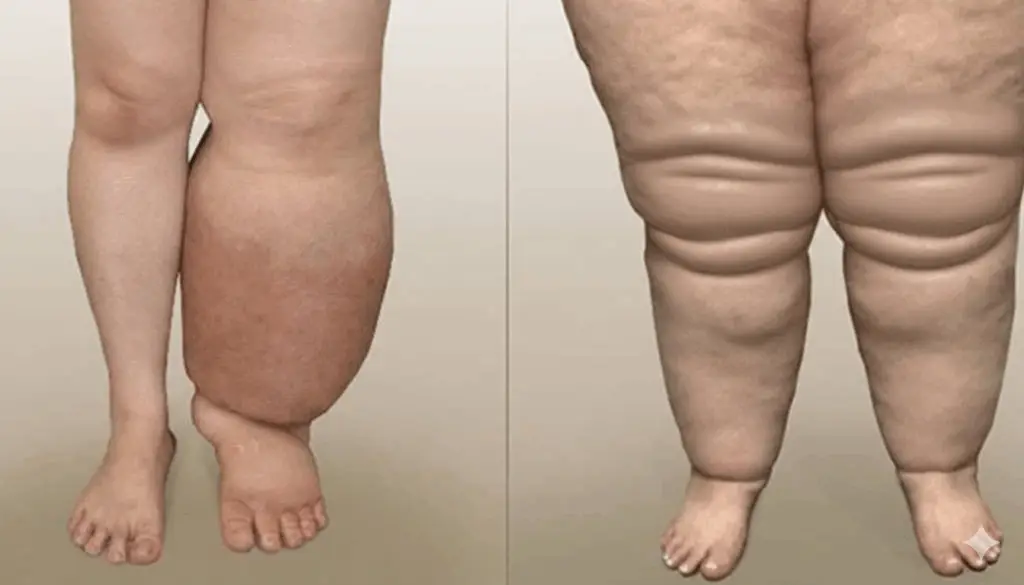
4. Lipedema and Lymphedema: The difference between fat and water retention
Både lipødem og lymfødem er kroniske tilstande, der forårsager volumenøgning i benene, men de kræver meget forskellige behandlingsstrategier. Det er vigtigt at få en præcis diagnose, især hvis din hævelse ikke skyldes åreknuder eller livsstil.
| Feature | Lipedema (Fat disorder) | Lymphedema (Lymphatic/fluid disorder) |
| Cause of the problem | Abnormal accumulation of adipose tissue (fat cells), almost exclusively in women, often triggered by hormonal changes (e.g. puberty, pregnancy). | Impaired function of the lymphatic system that cannot drain the fluid effectively. Can be congenital (primary) or secondary (e.g. after injury, infection or surgery). |
| Symmetry | Always symmetrical (hits both legs or both arms equally). | Can be one-sided (asymmetrical) or affect one side more than the other. |
| Feet and Hands | NOT affected. The swelling stops sharply at the ankles and wrists ("cuff phenomenon"). | Always involve feet and toes (or hands/fingers) in the affected area. |
| Pain | A key symptom: The tissue is often painful to the touch/pressure and bruises easily. | Typically not painful in the early stages. Pain can occur late due to tension or complications. |
| Treatment | Focuses on relieving pain, reducing inflammation and managing fat tissue (e.g. with custom compression stockings) or liposuction in some cases. | Focus on moving fluid (e.g. with manual lymphatic drainage and compression). |
The most important thing to remember
-
Basic difference: Lipedema is a chronic pain condition in the fatty tissue itself. Lymphedema is a disorder of fluid transportation.
-
Lipo-Lymphedema: If lipoedema becomes very advanced, the large fatty tissue can squeeze the lymphatic vessels, creating a combination condition called Lipo-Lymphedema.
-
The Importance of Diagnosis: Because treatment of varicose veins, lipedema, and lymphedema varies greatly, you should always consult a doctor for an accurate diagnosis via an ultrasound examination.
If your swollen legs are persistent, painful, or if you suspect varicose veins, lipedema or lymphedema as the cause, an ultrasound is recommended to determine the problem and start the right treatment.