
Lichen Sclerosus
Written and medically reviewed by Bahir Hadi, specialist in surgery, PhD
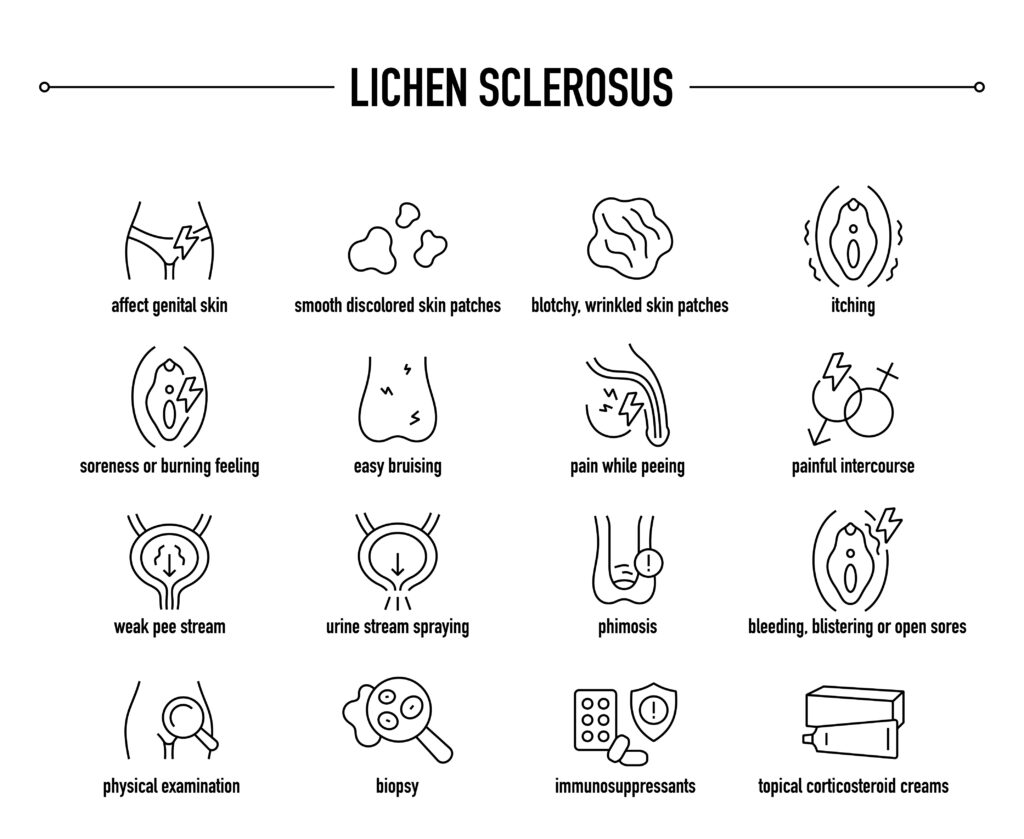
Perianal Lichen Sclerosus (LS)
Lichen Sclerosus (LS) is a chronic inflammatory skin disease that primarily affects the anogenital areas. Disease activity and course vary. Active inflammation can over time lead to scarring and anatomical changes in some patients, but progression is not the same for everyone. LS is best described in women (vulva), but it can also occur in men (penis/foreskin) and in the perianal area. Perianal involvement occurs in both sexes, but its frequency varies considerably: according to British guidelines, isolated perianal LS is rare in adult men.
LS is a benign but chronic condition. Without treatment, there is a risk of scarring and anatomical changes in the affected area. A small increased risk of squamous cell carcinoma has been described in chronically affected tissue, but this risk is best documented for vulval LS and cannot simply be extended to all patients with perianal LS.
What causes Lichen Sclerosus?
The precise cause of Lichen Sclerosus remains unknown. The disease is considered multifactorial, and research points to an interplay of several factors rather than a single triggering mechanism.
- Immunological factors: LS is characterised by chronic inflammation of the skin, and several studies have observed an association with autoimmune diseases (for example thyroid disease) in some patient groups, especially women. This is an observed association, not a proven cause-and-effect relationship, and it is weaker or absent in men with LS.
- Genetic predisposition: Clinical observations show LS sometimes occurring in several members of the same family, raising the hypothesis of a hereditary component. This has not been conclusively established.
- Not contagious: LS is not an infection and is not transmitted sexually or through ordinary contact.
Symptoms of Perianal Lichen Sclerosus
The symptom profile develops gradually. In the perianal area, symptoms can have a significant impact on quality of life.
| Symptom | Description and Consequence |
|---|---|
| Itching (Pruritus) | Often the most bothersome symptom. The itching can be intense and at times worsens at night, which may disrupt sleep. Scratching can worsen the inflammation and cause further skin irritation. |
| Pain and Discomfort | Pain may occur during bowel movements or at rest, often due to tightness in the skin, anal fissures, or secondary infection. |
| Characteristic Skin Changes | The skin typically takes on a whitish, pale, parchment-like appearance and can feel thin and wrinkled (atrophic). In active phases, redness and local irritation may be seen. |
| Scarring and Tightness | Chronic inflammation can lead to fibrous scar tissue. In some patients this causes loss of elasticity, and in rarer cases a narrowing around the anal opening, which can cause difficulty with bowel movements. |
| Fissures and Sores | Atrophic and tight skin can be fragile. Stretching or wiping can cause painful cracks and sores that can be slow to heal. |
Diagnosis and Investigation
- Clinical Examination: LS is generally a clinical diagnosis made by a relevant specialist experienced in anogenital skin disease, based on the history and typical appearance. A biopsy is not necessary in every case.
- Biopsy - for specific indications: The 2018 BAD guideline recommends biopsy in cases of diagnostic uncertainty, atypical changes, lack of response to adequate treatment, or suspicion of precancerous change or cancer (Lewis et al., Br J Dermatol 2018). In these situations, a small piece of tissue is removed under local anaesthetic and examined microscopically.
Treatment of Perianal Lichen Sclerosus
The goal of treatment is to reduce inflammation and relieve symptoms. In genital LS, guidelines associate early effective treatment with preventing disease-related damage, but that evidence cannot be transferred to isolated perianal LS without qualification. A relevant specialist determines treatment and follow-up individually.
1. Topical Steroid Treatment (First-line)
- Medication: A very potent topical steroid, such as clobetasol propionate, is first-line treatment for anogenital LS in the BAD guideline (Lewis et al., 2018).
- Effect: Treatment reduces local inflammation and can reduce itching and active skin changes.
- Treatment Plan: BAD 2018 gives specific initial regimens for vulval LS and male genital LS. These must not be transferred uncritically to isolated perianal disease. A relevant specialist therefore prescribes the preparation, amount, duration and any maintenance individually.
2. Supplementary and Supportive Treatment
- Emollients (Barrier Creams): Fatty creams or plain petroleum jelly can be used as a supplement. They may help keep the skin supple and reduce irritation from stool and friction, but they do not replace anti-inflammatory treatment.
- Calcineurin Inhibitors: Following specialist assessment, tacrolimus or pimecrolimus may be considered as steroid-sparing second-line treatment. Evidence is less direct than for topical steroids, and use in perianal/anogenital LS is off-label.
- Hygiene and Care: Using lukewarm water and mild, unscented cleansing in the area can reduce irritation. Gentle patting rather than rubbing when drying can reduce mechanical stress on the skin.
3. Surgical Intervention (For Specific Complications)
Surgery is not a standard treatment for LS, but may become relevant for specific mechanical complications that cannot be resolved medically.
- Anal stenosis: If scarring has led to a functionally significant narrowing of the anal opening, surgical assessment and a possible widening procedure can be considered by a colorectal surgeon. Such procedures address the mechanical narrowing and do not by themselves prevent the development of squamous cell carcinoma.
- Tissue changes suspicious for cancer: If biopsy shows persistent severe cellular changes or cancer, surgical removal of the affected tissue is relevant. The decision is made together with a colorectal or oncology specialist, and surgery here targets the confirmed change rather than serving as a general prevention of cancer developing in LS tissue.
Long-term Outlook and Follow-up
- Individually tailored course: LS is a chronic condition for many, but the need for ongoing treatment and review varies considerably between patients. The BAD guideline does not require a fixed annual review for all patients, but recommends follow-up tailored to disease severity, treatment response and any previous tissue changes.
- Attention to skin changes: A small increased risk of squamous cell carcinoma has been described in chronically affected LS tissue, documented primarily for vulval LS. Regardless of location, patients should contact their doctor about new sores, lumps, thickening or bleeding that does not heal within a reasonable time.
- Specialist assessment: For persistent or complicated disease, patients should be followed by a specialist in dermatology, gynaecology or urology depending on location. For specific anal complications, such as stenosis or suspicion of malignant change, assessment by a colorectal surgeon is relevant.
Reference List: Perianal Lichen Sclerosus
- Lewis FM, Tatnall FM, Velangi SS, Bunker CB, Kumar A, Brackenbury F, Mohd Mustapa MF, Exton LS. British Association of Dermatologists guidelines for the management of lichen sclerosus, 2018. British Journal of Dermatology. 2018;178(4):839-853. DOI: 10.1111/bjd.16241.
- Supports: Clinical diagnosis as the default, biopsy indications, specific initial regimens for vulval and male genital LS, and individually tailored follow-up. The genital regimens cannot automatically be transferred to isolated perianal LS.
- Kirtschig G. Lichen Sclerosus - Presentation, Diagnosis and Management. Deutsches Ärzteblatt International. 2016;113(19):337-343. DOI: 10.3238/arztebl.2016.0337.
- Supports: The description of LS as a chronic inflammatory skin disease with an unknown, probably multifactorial cause.
- Kirtschig G, Becker K, Günthert A, Jasaitiene D, Cooper S, Chi CC, Kreuter A, Rall KK, Aberer W, Riechardt S, Casabona F, Powell J, Brackenbury F, Erdmann R, Lazzeri M, Barbagli G, Wojnarowska F. Evidence-based (S3) Guideline on (anogenital) Lichen sclerosus. Journal of the European Academy of Dermatology and Venereology. 2015;29(10):e1-e43. DOI: 10.1111/jdv.13136.
- Supports: Calcineurin inhibitors as off-label second-line treatment, and genetic predisposition as a hypothesis.
- Kreuter A, Kryvosheyeva Y, Terras S, Moritz R, Möllenhoff K, Altmeyer P, Scola N, Gambichler T. Association of Autoimmune Diseases with Lichen Sclerosus in 532 Male and Female Patients. Acta Dermato-Venereologica. 2013;93(2):238-241. DOI: 10.2340/00015555-1512.
- Supports: The observed (non-causal) association between LS and autoimmune disease in women, and that this association is weaker in men.
- Kantere D, Alvergren G, Gillstedt M, Pujol-Calderón F, Tunbäck P. Clinical Features, Complications and Autoimmunity in Male Lichen Sclerosus. Acta Dermato-Venereologica. 2017;97(3):365-369. DOI: 10.2340/00015555-2537.
- Supports: That perianal/anogenital LS in adult men presents differently and is rarer as an isolated perianal presentation than in women.
- Day T, Bohl TG, Scurry J. Perianal lichen dermatoses: A review of 60 cases. Australasian Journal of Dermatology. 2016 Aug;57(3):210-215. PMID: 25752318. DOI: 10.1111/ajd.12308.
- Supports: The clinical picture and diagnostic approach specific to perianal lichen sclerosus, and variation in occurrence.
More on this topic at Kirurgen.dk
Category: Anal surgery