
Laser treatment of varicose veins (EVLT)
Laser treatment of varicose veins, also called EVLT or EVLA, seals the leaking main vein from inside with heat. When the ultrasound scan shows a leaking main vein that causes symptoms, the European vascular surgery guideline (ESVS 2022) recommends this type of treatment over stripping and foam. Side branches and thread veins are treated by other methods. The procedure is performed under local anaesthesia and you usually go home the same day. If you are in health insurance group 1 and have a valid referral from your GP, the examinations and treatments covered by the clinic's public health agreement are covered by the Danish public health insurance, so you pay nothing for them yourself. If you are in health insurance group 2, there is usually a small co-payment under the health insurance rules. If you are paying yourself, contact the clinic for a price. As a self-payer, laser treatment of varicose veins costs DKK 12,000 per leg.
Written and medically reviewed by Bahir Hadi, specialist in surgery, PhD
Short answer
Does laser treatment of varicose veins hurt?
Endovenous laser treatment (EVLT/EVLA) is done under local anaesthetic, but pain and discomfort are experienced differently from person to person despite the anaesthetic. You stay awake during the treatment, and when you can go home is agreed with the clinic. Tenderness along the vein afterwards is common, and how long it lasts varies. Which pain relief and which stocking suit you is agreed with the doctor, taking your other medication and conditions into account.
Laser Treatment for Varicose Veins (EVLA or EVLT) - The Gentle Path to Improved Leg Function
Laser treatment for varicose veins (also known as Endovenous Laser Treatment - EVLT) is a form of endovenous thermal ablation. For symptomatic varicose veins where the scan shows a leaking main vein in the leg, the European vascular surgery guideline (ESVS 2022) recommends this heat-based closure over classic surgery (high ligation and stripping) and foam treatment. The recommendation covers this group of patients, not all varicose veins, and not side branches or thread veins. In studies the technique is associated with less pain and discomfort than traditional surgical stripping.
At Kirurgen.dk, we use endovenous laser ablation (EVLA/EVLT) for laser treatment of varices. The choice of method depends on vein anatomy and patient factors, and no single method is best for everyone. Read all about the procedure here, from preparation to follow-up.
What is Laser Treatment for Varicose Veins (EVLT)?
Laser treatment for varicose veins is a minimally invasive procedure that closes the defective vein causing varicose veins. Instead of surgically removing the vein, it is closed from within with heat energy.
- Who it is recommended for: For symptomatic varicose veins with a leaking main vein in the leg, ESVS 2022 recommends this method over classic surgery and foam treatment. The recommendation covers this group of patients, not all varicose veins, and not side branches or thread veins.
- Minimally Invasive: The procedure is performed exclusively under local anesthesia, which reduces risk and the need for hospitalization.
- Assessment: Our surgeons always assess whether the size and anatomy of your varices make laser treatment technically feasible and appropriate. For tortuous, very superficial or previously treated veins another method may suit you better.
Preparation for Your Laser Treatment
Proper preparation is key to a smooth laser treatment for varicose veins.
Before the Procedure
- Medication: Regular medication is taken as usual unless we agree otherwise. For anticoagulants and antiplatelet drugs (for example aspirin, Marevan, Marcoumar, Eliquis, Xarelto) there is no general rule. We set the plan individually at the pre-assessment. Never start, stop or change prescribed medicine without agreeing it with your treating doctor.
- Diet: Eat a light meal on the day of the surgery. Avoid larger, heavy meals.
- Practical Clothing: Wear loose-fitting clothing that is comfortable and easy to wash, as slight leakage from the dressing may occur. Avoid applying cream to the skin on the day of the surgery.
Arrange Transportation
You should arrange for a relative to pick you up, or order a taxi/ambulance (Falck). It is not recommended to drive immediately after laser treatment for varices, as in a few cases, reduced strength in the leg may be experienced on the same day.
Performing Laser Treatment for Varicose Veins
The procedure itself is precise and carefully performed under constant control.
Step 1: Localization and Anesthesia
- Ultrasound Scan: We start by precisely locating and marking the defective varicose veins and veins using an ultrasound scan. Pressure from the probe can be felt, but the scan is not usually associated with significant pain.
- Access: The skin is locally anesthetized, and a microsurgical incision (approximately 5 millimeters) is made - typically near the knee.
- Insertion: A thin, flexible tube (catheter) is inserted into the vein, and the laser fiber is introduced through this tube.
Step 2: Ablation and Closing the Vein
- Precise Placement: The placement of the laser fiber is continuously and accurately monitored with an ultrasound scan.
- Tumescent Anesthesia: The anaesthetic fluid is injected as a series of small injections along the entire course of the vein, not at a single spot. This is essential as it both minimizes discomfort from the laser's heat and protects the surrounding tissue and nerves.
- Closure: The laser fiber is activated and withdrawn very slowly (typically about 2 mm per second). The laser heat causes the vein wall to collapse so the vein closes. Recanalisation and new varicose veins can occur later.
Once the defective vein is closed, blood will automatically be redirected to the healthy venous system. After the completed laser treatment for varicose veins, the small access puncture is closed with a plaster, and the leg is bandaged.
After Laser Treatment for Varicose Veins: Recovery and Follow-up
One of the biggest advantages of laser treatment for varicose veins is the rapid recovery.
The First Period
- Observation: Allow approximately half an hour of observation at the clinic after the procedure.
- Pain: It is common to experience soreness or pain on the inside of the thigh during the first few days.
- Pain Relief: We agree on pain relief that suits you and your other medication, and you are given specific instructions when you leave. Any prescription is sent electronically to your pharmacy.
- Activity: You may walk on the leg immediately. When you can resume strenuous activity such as sport and cycling is agreed individually and stated in the instructions you are given. Elevate your leg when sitting.
Compression Stocking and Swelling
- Usage: Whether you should wear a compression stocking (class 2) after the procedure, and for how long, is decided individually and stated in the instructions you are given. For comparison, the UK NICE guideline CG168 (recommendation 1.3.3) states no more than seven days if compression is offered after an interventional treatment.
- Appearance: Mild swelling and bruising on the leg are common after laser treatment for varices, and how long they last differs from person to person. A little oozing under the plaster can occur; contact the clinic if bleeding continues, if the leg becomes increasingly swollen, red or painful, or if you develop a fever. Call 112 for breathing problems, severe chest pain or chest pain with breathlessness, fainting or reduced consciousness, major bleeding or rapidly worsening general condition. Outside clinic opening hours, contact the out-of-hours service (1813 in the Capital Region, otherwise your local service) or the nearest emergency department. A planned clinic appointment does not replace urgent assessment.
Check-up
- Wound Check: Agreed individually and performed if needed.
- Follow-up scan: Whether and when a follow-up scan is needed is decided individually, based on the procedure, your symptoms and local clinical practice.
Work and Travel
- Work: When you can resume work varies with the extent of the procedure, your symptoms and the type of work. We agree this with you individually.
- Insurance: Be aware of insurance conditions for international travel. Contact SOS (telephone 7010 5055 between 9-16) before departure.
Complications of Laser Treatment for Varicose Veins
We will naturally inform you about the potential risks of laser treatment for varicose veins:
- Bleeding and Discoloration: Most commonly, discoloration (bruising) is seen. Major bleeding can occur; elevate the leg, apply firm pressure to the wound and contact us.
- Nerve Involvement: Temporary involvement of the small nerves that run close to the vein can occur. This can cause temporary numbness in a small area of skin, but how long it lasts varies, and persistent numbness can occur.
- Infection: Can occur. Contact us if you notice increasing redness, warmth, discharge or fever.
Contact us immediately if you experience: Major bleeding, increasing pain, or fever.
Do you have further questions about laser treatment for varicose veins or would you like an assessment of your varices?
You can call the clinic at 39 64 01 25 Monday to Thursday from 9-12 and 13-14, or use e-mail: mail@kirurgen.dk. After the operation, you will be given an emergency number.
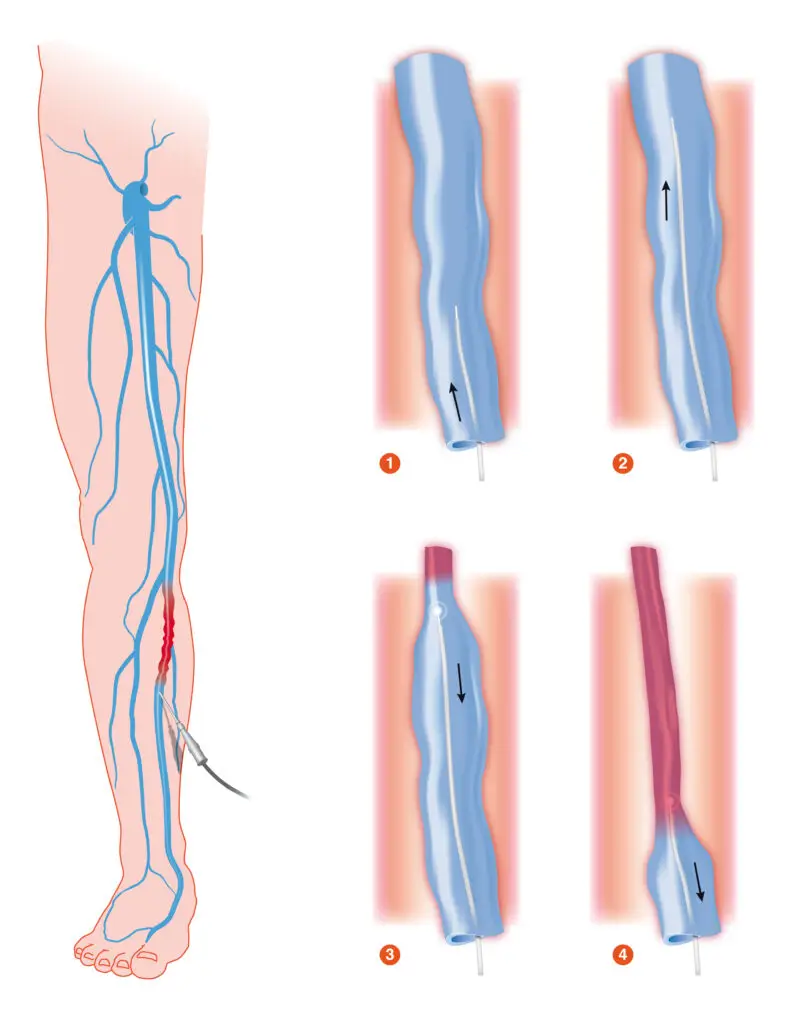
The illustration shows the closing of a vein with laser
Sources
ESVS 2022 Clinical Practice Guidelines on the Management of Chronic Venous Disease of the Lower Limbs, European Journal of Vascular and Endovascular Surgery, 2022 (recommendations 24, 28, 43 and 48).
Contact and appointments
Online booking is not available. Please call the clinic or ask your GP for a referral, so we can find the right appointment.
If you are in health insurance group 1 and have a valid referral from your GP, the examinations and treatments covered by the clinic's public health agreement are covered by the Danish public health insurance, so you pay nothing for them yourself. If you are in health insurance group 2, there is usually a small co-payment under the health insurance rules. If you are paying yourself, contact the clinic for a price.
Call the clinic
+45 39 64 01 25
Phone hours
Phone hours: Mon–Thu 09:00–12:00
Address
Hans Edvard Teglers Vej 9, 1st floor · 2920 Charlottenlund
Frequently asked questions
What does laser treatment of varicose veins cost?+
The clinic holds a provider number under the Danish public health insurance and receives referred patients for services covered by the current agreement; whether a specific service is covered is clarified before the course of treatment. As a self-payer, EVLT/EVLA costs DKK 12,000 per leg. The clinic confirms in writing what the price covers, and whether additional services may apply, before you accept the pathway.
Do I need a GP referral for laser treatment?+
A GP referral is required for the treatment to be covered by the Danish public health insurance. Without a referral you can attend as a self-payer. Contact the clinic to book a time.
How long is the waiting time for laser treatment of varicose veins?+
The current waiting time for non-urgent patients with no suspicion of cancer is approximately 6-8 weeks. Waiting times can vary.
Who is a candidate for laser treatment (EVLT/EVLA)?+
That is decided by an ultrasound scan of the leg veins together with an individual assessment. If the scan shows a leaking main vein that causes symptoms, the European vascular surgery guideline (ESVS 2022) recommends heat treatment from inside the vein, for example laser, as first choice over stripping and foam. For very tortuous or superficial veins another method may suit better.
Is laser treatment of varicose veins painful?+
The procedure is done under local anaesthetic. The anaesthetic is injected as fluid along the whole vein through several small pricks, and for most people that is the most uncomfortable part. Some soreness in the leg afterwards is common, but how pronounced it is and how long it lasts differs from person to person. If you need pain relief we agree what suits you and your other medication.
How long does laser treatment of varicose veins take?+
The duration depends on the extent of treatment. Allow time for preparation and a short observation in addition to the procedure itself. You usually go home the same day.
When can I return to work and exercise?+
It depends on the method, the extent of the procedure and your symptoms. Light walking is often possible soon after treatment, while return to work, heavy training and contact sport is agreed individually. Follow the instructions you are given.
Do I need to wear a compression stocking after treatment?+
Whether a stocking is used, which class and for how long is decided individually. The European guideline (ESVS 2022) leaves the duration to individual judgement, and the British guideline (NICE CG168) mentions at most seven days if a stocking is used after the procedure at all.
Related
Share this page
Contact information
- Hans Edvard Teglers Vej 9, 1st floor · 2920 Charlottenlund
- +45 39 64 01 25
- mail@kirurgen.dk
- Phone hours: Mon–Thu 09:00–12:00
For referring physicians
Provider number: 215430