
Compression stockings for varicose veins
Compression stockings are one of the most important conservative tools in varicose veins and chronic venous insufficiency. For many people they can support the veins and relieve heavy, swollen legs, but the effect varies, and the class and wearing pattern are chosen individually.
Written and medically reviewed by Bahir Hadi, specialist in surgery, PhD
Short answer
How long should compression stockings be worn after treatment?
There is no single duration that suits everyone. Whether you need a compression stocking after treatment, which class and for how long, is decided individually and is set out in the instructions you take home. The assessment takes account of your symptoms, skin condition, arterial status and what you can tolerate wearing.
Varicose Veins: What Can You Do Yourself? Compression and Treatment Choice
Varicose veins (varices) are a chronic venous condition, and many experience a range of uncomfortable symptoms such as heaviness, pain, and swelling in the legs. Self-treatment does not remove the varicose veins themselves. Some people find their symptoms easier to live with, but how much it helps varies from person to person.
Read here how to best manage your varicose veins in everyday life, and when laser treatment for varicose veins is the necessary solution.
Compression Stockings for Varicose Veins: Your First Line of Defense
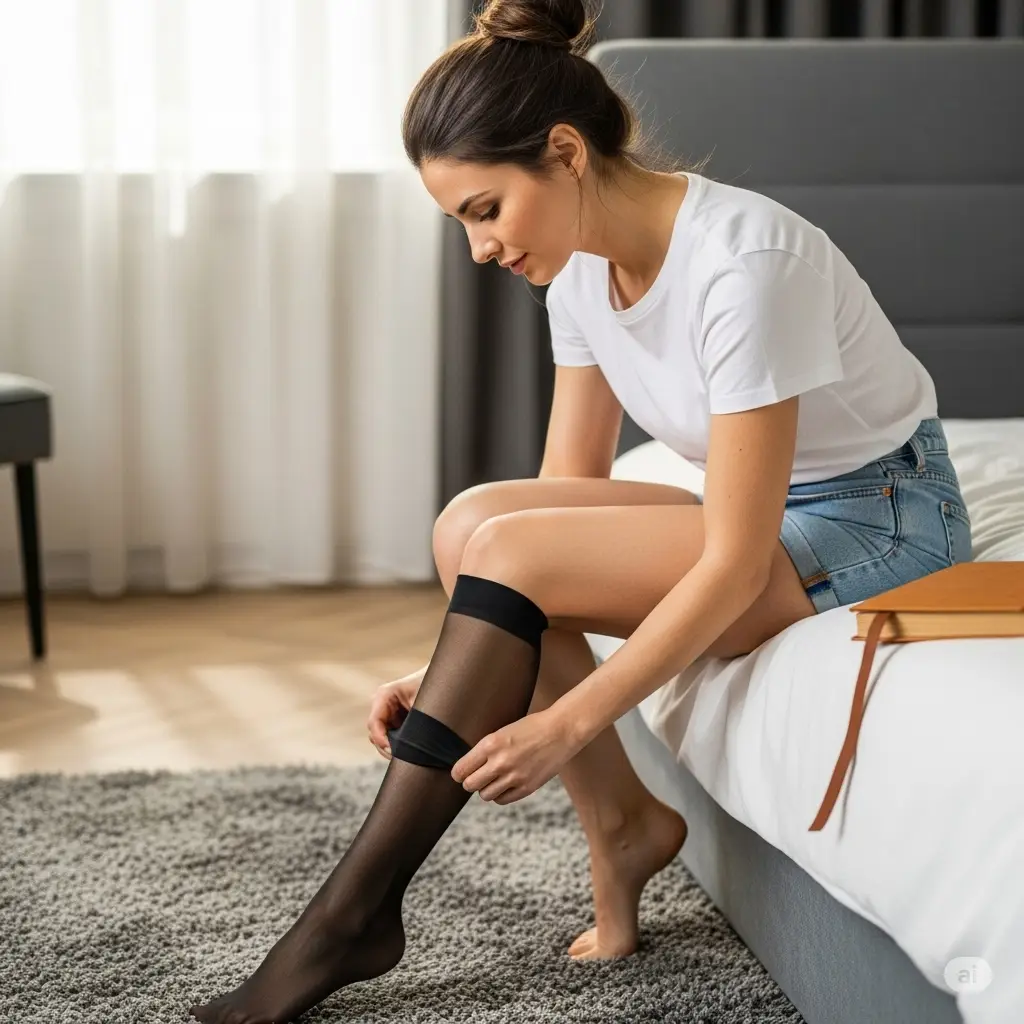
Compression stockings or support stockings for varicose veins are a non-surgical option that can be considered after individual assessment by a doctor or fitter. Some people find that heaviness and swelling improve, but the effect varies from person to person.
How Do Compression Stockings Work?
When you develop varicose veins, the legs' ability to efficiently pump blood back to the heart weakens, creating an overpressure in the veins.
- The function of compression stockings is to apply controlled pressure to the leg. This pressure supports the venous pump function and squeezes blood out of the superficial veins.
- The result is that blood finds its way back to the heart more easily and quickly, which relieves swelling, heaviness, and pain.
Important: Compression does not remove the defective venous valves themselves, which are the cause of varicose veins. Therefore, if you stop using compression stockings, the symptoms will return.
Correct Choice of Compression Stockings
Compression stockings are classified based on the pressure they exert (measured in mmHg). It's always best to consult a doctor or specialist to get the correct strength and type prescribed:
Compression Class
Pressure Strength (mmHg)
Application
Class 1
15-20 mmHg (Light)
Lighter support, often used for travel sickness or mild varicose veins.
Class 2
24-32 mmHg (Medium)
A thick, elastic stocking that provides good support and is the most commonly used for treating established varicose veins.
Class 3
35-45 mmHg (Firm)
A very thick stocking used only for severe cases of varices or serious venous disorders.
Compression stockings can be purchased from medical supply stores, some pharmacies, or online from specialized retailers. For optimal effect, the stocking must be fitted to your leg measurements.
Treating the veins themselves: when a procedure is considered
Compression stockings treat the symptoms, not the leaking vein. If you want to avoid daily compression, a minimally invasive procedure can be considered. The effect on symptoms varies, and recurrence can occur.
At Kirurgen.dk, we choose treatment based on the ultrasound findings, your symptoms and your circumstances.
Laser treatment of varicose veins
We primarily treat varicose veins with laser treatment of varicose veins (EVLA - Endovenous Laser Ablation) or other modern minimally invasive procedures such as radiofrequency treatment.
- Choice of method: The available methods each have advantages and drawbacks, and none of them is better or worse for everyone. The choice depends on the anatomy, which vein is involved, previous treatment, other conditions, your preferences and local experience.
- Technology: We use endovenous laser ablation (EVLA/EVLT). Discomfort during and after treatment varies between patients.
Read more about our specialized laser treatment for varicose veins and varices here.
📞 Contact Kirurgen.dk
Whether you are seeking advice on the correct type of compression stockings for varicose veins, or if you are ready to discuss laser treatment for varicose veins, we are here to help.
Contact Kirurgen.dk for an examination that can precisely clarify your options for varicose vein treatment.
Recommendations for the Use of Compression Stockings for Varicose Veins (Based on the European Society for Vascular Surgery (ESVS) Guidelines)
Compression stockings (also called support stockings) are an important tool to help your veins function better, reduce swelling, and improve symptoms like soreness, heaviness, and cramps caused by venous disorders and varicose veins. They work by gently compressing the leg, which helps push blood back towards the heart, particularly beneficial in the presence of varicose veins.
The European Society for Vascular Surgery (ESVS) provides guiding recommendations on when and how to use them in connection with varicose veins.
1. For Symptoms and Swelling (Before Varicose Vein Treatment)
If you have noticeable symptoms (such as tired, heavy, or sore legs) or visible swelling (edema) in your ankle and foot - often related to venous insufficiency and varicose veins - but before you have received definitive treatment (such as laser, RFA, or surgery) to close the defective vein:
- Recommendation: You should wear medical compression stockings.
- Goal: To relieve your symptoms related to venous problems and varicose veins, and to reduce or prevent swelling.
- What to use: There is no single pressure that suits everyone. The class, the type and how long you wear it are decided individually by the doctor or the fitter, based on your symptoms, your goals, your arterial circulation and what you can manage day to day.
2. After Vein Treatment (Surgery, Laser, Glue, Foam for Varicose Veins)
Compression is often used after varicose vein treatment to help control swelling, reduce pain, and assist the treated vein in closing completely and effectively.
- Recommendation: Compression is generally recommended immediately after varicose vein treatment (whether it's thermal ablation, foam sclerotherapy, or surgery).
- Duration (Post-Procedure):
- The duration after a procedure is decided individually. As a British example, NICE CG168 (recommendation 1.3.3) states no more than seven days if compression is offered after an interventional treatment. That is not a Danish rule, and your own instructions apply.
- For more complicated procedures, or if you have had larger collateral branches (varicose veins) removed, your doctor may recommend wearing the stockings for a slightly longer period (e.g., up to 2-3 weeks).
- Pressure (Post-Procedure): The pressure and the duration are agreed individually and are stated in your own instructions.
3. For Venous Leg Ulcers (Advanced Disease with Varicose Veins)
If you have more advanced venous disease, especially with skin changes (pigmentation, hardening) or an active venous leg ulcer caused by untreated varicose veins and venous insufficiency:
- Recommendation: Compression is a central part of the treatment of venous leg ulcers, both while the ulcer heals and afterwards.
- What to use: The system and the pressure are chosen individually, based on the state of the ulcer, your arterial circulation and what you can use in practice. Continued compression after healing is also agreed individually.
⚠️ Important Safety Check: Arterial Disease
Before using any type of compression stocking for varicose veins or swelling, have your arterial blood flow checked by a doctor.
- Why? If you have poor arterial circulation (Peripheral Arterial Disease), wearing strong compression stockings can be harmful, even if you have varicose veins.
- Rule: Compression stockings must NOT be used if your arterial blood flow is severely impaired.
Simple Summary for Varicose Veins
Situation
Recommendation
Typical Pressure Class (Guidance)
Before Treatment (for symptoms/swelling due to varicose veins)
Wear daily to relieve symptoms.
Decided individually.
After Treatment (Laser, Surgery, etc., for varicose veins)
The duration is agreed individually.
Specified by your surgeon.
For Leg Ulcers/Advanced Disease
A central part of ulcer care; extent and duration are agreed individually.
Stronger compression (Class 3 or special systems).
Always follow your doctor's specific instructions regarding the exact size, pressure, and duration for the use of your stockings for your varicose veins and venous disorders.
- NICE CG168 (recommendation 1.3.3) states no more than seven days
Contact and appointments
Online booking is not available. Please call the clinic or ask your GP for a referral, so we can find the right appointment.
If you are in health insurance group 1 and have a valid referral from your GP, the examinations and treatments covered by the clinic's public health agreement are covered by the Danish public health insurance, so you pay nothing for them yourself. If you are in health insurance group 2, there is usually a small co-payment under the health insurance rules. If you are paying yourself, contact the clinic for a price.
Call the clinic
+45 39 64 01 25
Phone hours
Phone hours: Mon–Thu 09:00–12:00
Address
Hans Edvard Teglers Vej 9, 1st floor · 2920 Charlottenlund
Related
Share this page
Contact information
- Hans Edvard Teglers Vej 9, 1st floor · 2920 Charlottenlund
- +45 39 64 01 25
- mail@kirurgen.dk
- Phone hours: Mon–Thu 09:00–12:00
For referring physicians
Provider number: 215430