
Removal of bowel polyps
Polyps are outgrowths on the bowel lining. Most are harmless, but some may develop into cancer over years, so detected polyps are removed as a rule. Not every polyp can or should be removed the same day.
Written and medically reviewed by Bahir Hadi, specialist in surgery, PhD
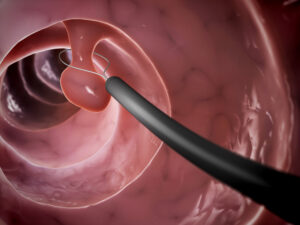
Bowel polyps: treatment and information
What are bowel polyps
Polyps are found in a proportion of people who have a colonoscopy. How often depends among other things on age, the reason for the examination and the quality of the examination. Polyps are growths on the bowel lining. Some sit on a stalk and look like a small mushroom, others are flat or broad-based. They range in size from a few millimetres to several centimetres, but most are small.
There are several types of polyp. The most common are adenomas and serrated polyps. Adenomas and certain serrated polyps are precursors that over time can develop cell changes and eventually become cancer. This development usually takes many years, and the great majority of polyps never get that far. Other types, for example small hyperplastic polyps in the rectum, carry very low risk. You should not count on a polyp disappearing on its own, but small polyps can remain stable for a long time. Whether and how a polyp is removed depends on the findings.
Because it is not possible to tell with certainty by looking at a polyp whether it will progress, polyps that are found are as a rule removed so they can be examined under the microscope. Removal is judged on size, shape, location, the quality of the examination and whether the polyp can be removed completely. Not all polyps can or should be removed the same day: very small polyps in the rectum can in some cases be assessed without removal, and large, broad-based or awkwardly placed polyps are often scheduled for removal at a department with special expertise. If a polyp is found in the rectum or colon, the doctor assesses whether the rest of the colon should be examined. At Kirurgen.dk in Charlottenlund this is done by colonoscopy. If a colonoscopy cannot be completed, CT colonography can be used instead in some cases.
CT colonography cannot remove polyps. If polyps are found, a colonoscopy must therefore follow. Which examination is chosen first depends on symptoms, age and other health conditions.
How a polyp is removed
The colonoscope has a working channel through which instruments are passed. The technique used depends primarily on the size and shape of the polyp (ESGE, colorectal polypectomy and EMR, 2024):
- Small polyps (under about 1 cm, including the very smallest of 5 mm or less) are usually removed with a cold snare, a thin wire loop placed around the polyp that cuts it off without electrical current. Cold snare is typically the first choice for small polyps because it removes the polyp more completely and causes fewer complications than biopsy forceps or a snare with current. Routine removal of small polyps with cold biopsy forceps is advised against (ESGE 2024).
- Stalked polyps and selected larger polyps are removed with a snare using electrical current (diathermy) so that any blood vessels in the stalk are sealed at the same time. Hot snare remains the relevant technique in these situations.
- Large or flat polyps may require fluid to be injected under the polyp first, lifting it from the bowel wall, before it is removed (endoscopic mucosal resection). Whether the polyp is removed in one piece or in several pieces is decided on size, appearance and location. If early cancer is suspected, removal in one piece can be decisive, and this is often planned at a specialised department. Very large or complex polyps are likewise removed at a specialised department.
The removed polyp is suctioned or retrieved with a net or forceps so it can be sent for microscopy.
Microscopy
Removed polyps are examined under the microscope, among other things to determine the type and whether there are cell changes or cancer. Occasionally a polyp cannot be found again in the bowel after it has been cut off, and microscopy then has to be forgone. If a larger polyp has been removed in several pieces, a check of the site is often planned after a few months to make sure all tissue is gone.
Complications
Complications from polyp removal are rare but can be serious. The risk is low for small polyps and higher for large or broad-based polyps (ESGE 2024).
- Bleeding can occur during the procedure or up to one to two weeks afterwards if a scab comes loose. Minor bleeding usually stops by itself. Heavier bleeding may require a repeat endoscopy to stop the bleeding and, in rare cases, hospital admission.
- Perforation (a hole in the bowel wall) is rare. Small holes can often be closed with clips during the examination itself and managed with antibiotics and observation, while larger holes require surgery. After removal with electrical current the bowel wall can be weakened for a period, and a hole can in rare cases appear some days later.
- Post-polypectomy syndrome is a heat injury to the bowel wall after removal with electrical current, without an actual hole. It causes abdominal pain, tenderness and sometimes fever within the first days. It is seen mainly after removal of larger polyps and can resemble a perforation, so you must always be examined if you develop the symptoms. Treatment is decided by the doctor after assessment and may include observation, a temporary break from food and possibly antibiotics. Do not start fasting at home on your own.
Seek assessment the same day if, after polyp removal, you develop:
- heavier or repeated bleeding from the bowel
- increasing or severe abdominal pain, especially if the abdomen becomes hard and distended (see also side effects after colonoscopy)
- fever, chills or general deterioration
Call Kirurgen.dk in Charlottenlund during opening hours. Outside opening hours, do not wait for the clinic to open: contact the emergency line 1813 in the Capital Region or the out-of-hours doctor in your region. Call 112 for heavy bleeding that does not stop, severe abdominal pain, fainting or impaired consciousness.
Surveillance
Once the polyps have been removed, they are examined under the microscope and their size is determined. The surveillance interval depends on number, size and microscopy result, on whether the polyps were completely removed, and on the quality of the examination. Low-risk findings often lead back to the ordinary screening programme, while high-risk findings are checked earlier, typically after three years (ESGE, post-polypectomy surveillance, 2020). There is no single fixed interval that suits everyone. You receive your specific interval in writing together with the biopsy result.
Families at particular risk
Some families have a hereditary increased risk of bowel polyps and bowel cancer. Suspicion arises, among other things, if an unusually large number of polyps is found in one person, if bowel cancer is diagnosed at a young age, or if several close relatives have had bowel cancer or certain other cancers, for example of the womb. In those situations referral to genetic counselling is offered, where the need for genetic testing and a special surveillance programme is assessed. If you have bowel cancer in your close family without suspicion of hereditary disease, surveillance is agreed on the basis of the family's overall risk profile.
Contact and appointments
Online booking is not available. Please call the clinic or ask your GP for a referral, so we can find the right appointment.
If you are in health insurance group 1 and have a valid referral from your GP, the examinations and treatments covered by the clinic's public health agreement are covered by the Danish public health insurance, so you pay nothing for them yourself. If you are in health insurance group 2, there is usually a small co-payment under the health insurance rules. If you are paying yourself, contact the clinic for a price.
Call the clinic
+45 39 64 01 25
Phone hours
Phone hours: Mon–Thu 09:00–12:00
Address
Hans Edvard Teglers Vej 9, 1st floor · 2920 Charlottenlund
Related
Share this page
Contact information
- Hans Edvard Teglers Vej 9, 1st floor · 2920 Charlottenlund
- +45 39 64 01 25
- mail@kirurgen.dk
- Phone hours: Mon–Thu 09:00–12:00
For referring physicians
Provider number: 215430