
Hemorrhoids – symptoms, grades and treatment
Hemorrhoids are dilated vessels in the anal canal and one of the most common reasons for bright red blood on defecation, itching and a lump at the anus. We grade the hemorrhoids (1–4), rule out other causes of blood in the stool and choose the gentlest effective treatment – from lifestyle and McGivney rubber-band ligation to surgical removal.
Written and medically reviewed by Bahir Hadi, specialist in surgery, PhD
Short answer
How are haemorrhoids treated?
For mild symptoms, regulating the stool and short-term symptom relief are often tried first after a clinical assessment; this is not a universal cure. If that is not enough, rubber band ligation may be an option in the clinic. Whether surgery is relevant depends on the symptoms, the type and grade, and the findings at examination. The clinic holds a provider number under the Danish public health insurance and receives referred patients for services covered by the current agreement; whether a specific service is covered is clarified before the course of treatment.
What are haemorrhoids?
Haemorrhoids are swollen blood vessels in the anal canal. Everyone has haemorrhoidal tissue from birth, and it forms a normal part of the closing mechanism. Trouble starts when the connective tissue holding the lining in place weakens. The lining and the vessels underneath slide down, and you get bleeding, itching or a lump you can feel.
The most common triggers are hard stools and straining, chronic constipation, pregnancy and childbirth, sedentary work and heavy lifting.
Symptoms and grades
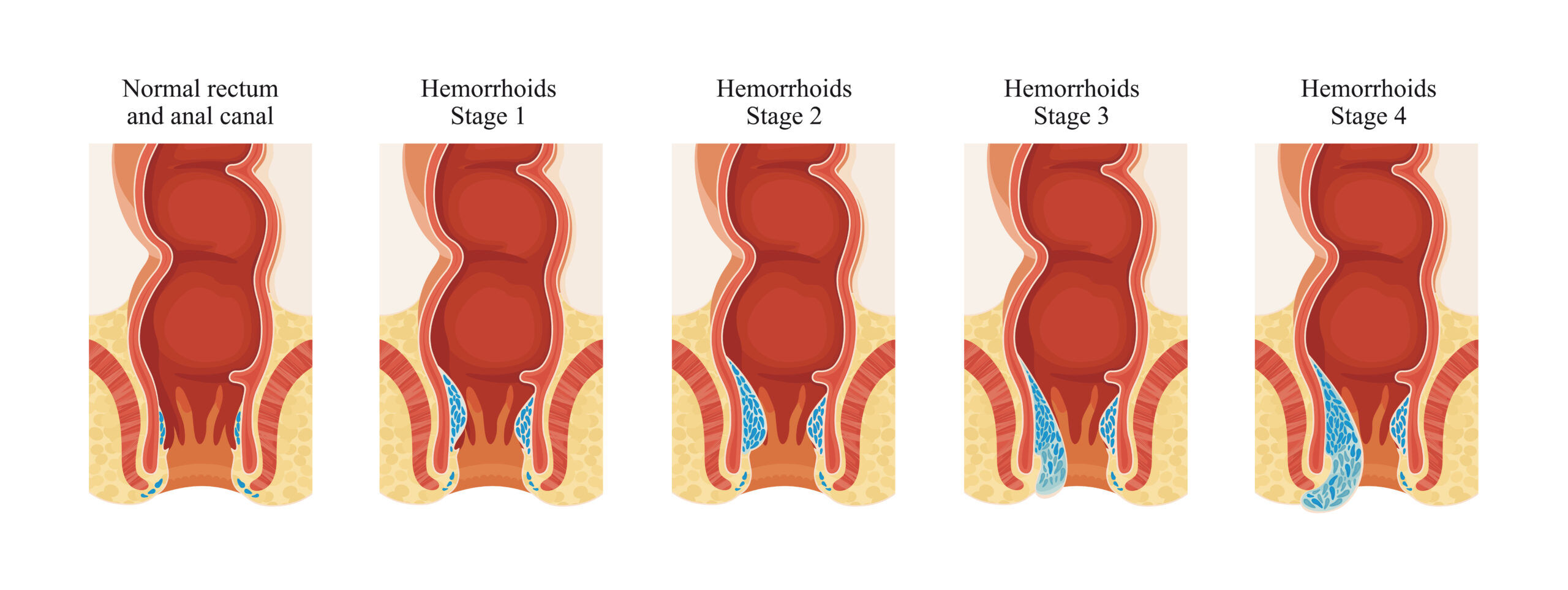
Haemorrhoids are graded from one to four according to how far they prolapse:
- Grade 1: they stay inside the anal canal. Usually bleeding only.
- Grade 2: they come out when you pass stool and slide back on their own.
- Grade 3: they come out and have to be pushed back manually.
- Grade 4: they stay permanently outside the anus.
Classic symptoms are fresh, bright red blood on the paper or in the toilet, itching and moisture around the anus, a feeling that the bowel is not fully emptied, and sometimes a tender, bluish lump if an external haemorrhoid has clotted.
Pain is not typical. If it hurts when you pass stool, an anal fissure is a more likely explanation.
When to see a doctor
Rectal bleeding should always be assessed the first time, even if you are convinced it is haemorrhoids. The symptoms overlap with bowel polyps and bowel cancer. Read more in our guide to rectal bleeding.
Contact a doctor promptly if the blood is dark or mixed into the stool, if your bowel habits have changed for more than four weeks, or if you have unexplained weight loss, fatigue or anaemia.
How we examine you
The extent and duration depend on your symptoms and the findings, and on whether additional anoscopy, sigmoidoscopy or colonoscopy is needed. If any preparation is required before the visit, you will be given specific instructions in advance.
- Conversation about symptoms, bowel habits, medication and family history.
- Clinical examination of the area around the anus, including an examination with a finger inside the rectum (digital rectal examination).
- Anoscopy, where a short scope is passed a little way into the anal canal so we can see the haemorrhoids directly and grade them.
- Sigmoidoscopy or colonoscopy if there is bleeding and the overall assessment supports it. We consider your age, the pattern and duration of the bleeding, anaemia or iron deficiency, accompanying symptoms such as weight loss and changed bowel habit, family history and the Danish fast-track pathways. Age alone does not decide it.
We go through the findings with you at the visit and agree the plan together. If tissue samples are taken, the result follows later.
Treatment without surgery
Most people get there without an operation.
Lifestyle and topical treatment. A high-fibre diet, enough fluid, regular toilet habits and as little time on the toilet as possible without straining. Soluble fibre such as psyllium has been studied in haemorrhoids and can reduce bleeding and discomfort in some people. Anti-itch or anaesthetic creams can be used for short periods after discussing them with your doctor.
McGivney rubber band ligation. Banding suits most grade 1 to 2 haemorrhoids and selected grade 3 haemorrhoids after individual assessment, usually when diet, stool regulation and topical treatment have not been enough. We place a small band around the base of the haemorrhoid. The haemorrhoid then falls off, typically after about 10 to 14 days, a bit sooner or later for some people. A little bleeding when it falls off is common. The treatment takes a few minutes, and the clinic's normal plan is that you go home afterwards, subject to individual assessment. It is not pain-free: pressure, urgency and slight bleeding for a few days are common, and some patients get real pain, particularly if the band sits unfavourably. Some people need more than one treatment. The number of sessions and the interval are agreed with you based on symptoms and findings. See the "After treatment" section below for when to seek help. Read more about McGivney banding.
Sclerotherapy. An injected agent makes the haemorrhoid shrink. Whether the method suits you depends on the findings at examination and on an overall assessment, which includes any blood thinning treatment.
Surgery for haemorrhoids
For grades 3 to 4, for large prolapsing haemorrhoids or when banding is not enough, surgery may be the right choice. The excess tissue is removed, or the blood supply is interrupted so the haemorrhoid shrinks. The procedure is planned individually, and we always go through the pros and cons with you first. Read more about surgical treatment of haemorrhoids.
After treatment
After banding, a pressing sensation and urgency are common for some days, and how long that lasts differs from person to person. Pain relief and how much you should take it easy are agreed with you based on your other conditions and medication. Keep the stool soft.
Serious bleeding and a rare, serious infection in the area around the anus are uncommon after banding (ASCRS 2024), but you should still know the warning signs to watch for.
Contact us or seek help. Contact the clinic the same day if you get heavy or persistent bleeding, increasing severe pain, fever or chills, feel generally unwell, or cannot pass urine. Outside clinic opening hours, contact the out-of-hours service (1813 in the Capital Region, otherwise your local out-of-hours doctor) or the nearest emergency department. Call 112 if you faint, bleed heavily, or show signs of circulatory collapse. A planned clinic appointment does not replace urgent assessment.
Preventing a relapse
- Eat 25 to 30 grams of fibre a day from wholegrains, vegetables, fruit and pulses
- Drink plenty of water
- Go to the toilet when the urge comes, and do not strain
- Move every day
- Do not sit on the toilet with your phone
Sources
- ESCP guideline for haemorrhoidal disease, 2020 (Colorectal Disease, doi:10.1111/codi.14975), escp.eu.com
- ASCRS Clinical Practice Guidelines for the Management of Hemorrhoids, 2024
- Regionshospitalet Viborg, patient guide "Haemorrhoids, rubber band ligation" (in Danish)
Contact and appointments
Online booking is not available. Please call the clinic or ask your GP for a referral, so we can find the right appointment.
If you are in health insurance group 1 and have a valid referral from your GP, the examinations and treatments covered by the clinic's public health agreement are covered by the Danish public health insurance, so you pay nothing for them yourself. If you are in health insurance group 2, there is usually a small co-payment under the health insurance rules. If you are paying yourself, contact the clinic for a price.
Call the clinic
+45 39 64 01 25
Phone hours
Phone hours: Mon–Thu 09:00–12:00
Address
Hans Edvard Teglers Vej 9, 1st floor · 2920 Charlottenlund
Frequently asked questions
What are haemorrhoids?+
Haemorrhoids are dilated vessels in the lining of the anal canal. Internal haemorrhoids sit above the dentate line and tend to bleed painlessly; external haemorrhoids sit below it and cause more soreness and itching. The condition is very common.
How do I know if I have haemorrhoids?+
Bleeding, itching and a soft lump that may prolapse are possible but non-specific symptoms. They do not in themselves diagnose haemorrhoids. Bleeding is assessed by age, extent and duration, and by features such as anaemia, a change in bowel habit, weight loss, family history and other alarm symptoms. The assessment starts with a clinical examination with the specialist. That examination cannot on its own rule out every other cause of bleeding, and depending on age, symptoms and findings a sigmoidoscopy or colonoscopy may be needed.
What do grades 1–4 mean?+
Haemorrhoids are graded by how much they prolapse. Grade 1 bleeds but does not prolapse. Grade 2 prolapses on defecation and reduces by itself. Grade 3 must be pushed back manually. Grade 4 is permanently prolapsed. The grade decides whether McGivney rubber-band ligation is enough or whether surgical removal is needed.
What can I do myself?+
In general, a high-fibre diet, a fluid intake suited to you and avoiding prolonged straining on the toilet can reduce symptoms. There is no fixed amount of fluid or exercise that suits everyone. Topical treatment is chosen individually by a doctor. This is general information, not a self-treatment plan. Bleeding, persistent symptoms or any doubt should be assessed.
What is McGivney rubber-band ligation?+
In the McGivney method a small rubber band is placed around the haemorrhoid above the dentate line. The tissue loses its blood supply and falls off, typically around ten to fourteen days after treatment. Some bleeding can occur when it comes away; heavy or persistent bleeding needs same-day assessment. The procedure takes a few minutes. Most people feel pressure and urgency for a couple of days, but some get real pain. Banding suits most grade 1–2 and selected grade 3 haemorrhoids after individual assessment, usually when diet and topical treatment have not been enough.
When is surgery needed?+
Surgical removal (usually Milligan-Morgan) is considered for grade 3–4 haemorrhoids, repeated bleeding despite rubber-band ligation, or large external haemorrhoids with thrombosis. The procedure is done under anaesthesia, and soreness usually lasts several weeks afterwards.
Can haemorrhoids turn into cancer?+
No. Haemorrhoids are dilated blood vessels and never become cancer. However, blood in the stool may also be caused by polyps, diverticula, an anal fissure or colorectal cancer. Any new rectal bleeding should be assessed by a specialist.
When should I seek urgent help?+
Seek urgent help for heavy or persistent bleeding, dizziness, fainting or circulatory symptoms, severe pain with a hard bluish lump (thrombosis), or fever and increasing redness. Other bleeding should be assessed by a doctor, and how quickly depends on your symptoms and overall situation.
Related
Share this page
Contact information
- Hans Edvard Teglers Vej 9, 1st floor · 2920 Charlottenlund
- +45 39 64 01 25
- mail@kirurgen.dk
- Phone hours: Mon–Thu 09:00–12:00
For referring physicians
Provider number: 215430