
Lipoedema and lymphoedema
Lipoedema and lymphoedema are often confused with varicose veins or ordinary overweight, but they are separate disorders of adipose tissue and lymphatic system respectively. Correct diagnosis is essential.
Written and medically reviewed by Bahir Hadi, specialist in surgery, PhD
Lipedema and Lymphedema: Two Different Causes of Swollen Legs
Both lipedema and lymphedema are chronic conditions that cause an increase in leg volume, but they are biologically very different and therefore require very different treatment strategies. It is important to get an accurate diagnosis - especially if your swelling cannot be explained by varicose veins or lifestyle factors.
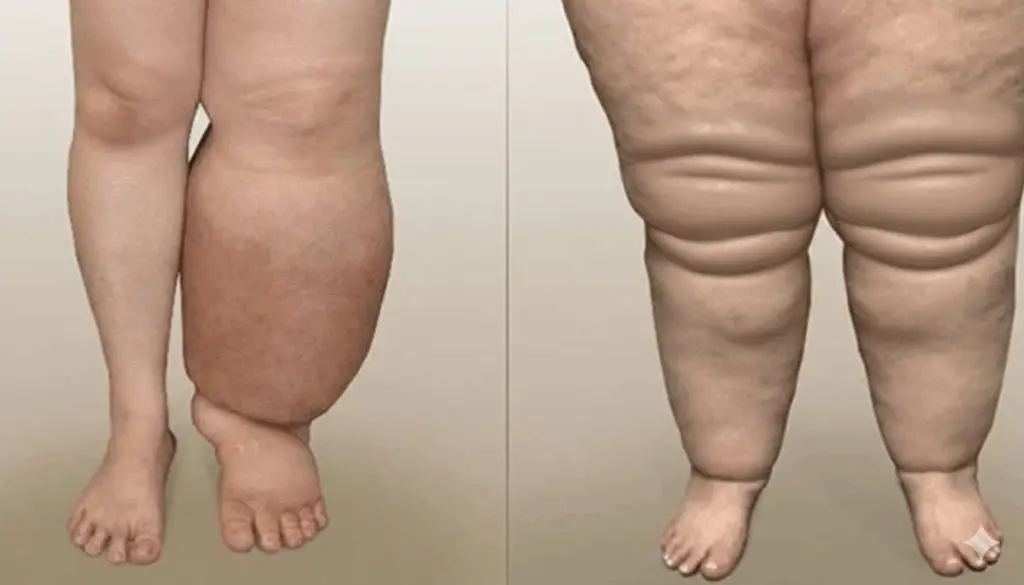
Lipedema in the left leg (left in the image) and lymphedema in both legs (right).
What is Lipedema?
Lipedema is a chronic fat distribution disorder characterized by an abnormal accumulation of adipose tissue - almost exclusively in women. The condition is often triggered in connection with hormonal changes (puberty, pregnancy, menopause).
- Symmetrical distribution: Typically affects both legs to a similar degree, and often the arms as well.
- Often stops at ankles and wrists: A "cuff phenomenon" is often seen, with the feet and hands relatively spared. This is a typical feature, not a mandatory single criterion.
- Pain upon pressure: A key symptom is that the tissue is painful to the touch and easily bruises.
- Resistant to weight loss: The typical fat deposits do not disappear with diet or exercise.
What is Lymphedema?
Lymphedema, on the other hand, is a disorder of fluid transport: the lymphatic system cannot drain fluid effectively, and it accumulates in the tissue.
- Primary lymphedema: Congenital impaired function of the lymphatic vessels.
- Secondary lymphedema: Occurs after injury, infection, radiation, or surgery - for example, after removal of lymph nodes in connection with cancer treatment.
- Often involves feet and toes: Unlike lipedema, the swelling often affects the entire limb, including the toes and fingers.
- Typically not painful in the early stages; late pain may occur due to tension and complications.
The Difference in Brief
| Characteristic | Lipedema (fat disorder) | Lymphedema (fluid disorder) |
|---|---|---|
| Cause | Abnormal fat accumulation, hormonally triggered | Impaired lymphatic drainage, congenital or acquired |
| Symmetry | Typically symmetrical | Often unilateral or asymmetrical |
| Feet/Hands | Often relatively spared - typically stops at ankle/wrist | Often involved |
| Pain | Painful upon pressure, bruises easily | Usually painless in early stage |
| Response to weight loss | Fat deposits remain | Swelling is not reduced by weight loss |
Lipo-lymphedema: The Combination Condition
If lipedema becomes advanced, the large adipose tissue can compress the lymphatic vessels and inhibit their function. The result is a combined condition called lipo-lymphedema, where both mechanisms contribute to the swelling. The condition requires a combined treatment strategy.
Connection with Varicose Veins
Many patients are referred to the clinic with swollen legs suspected of having varicose veins, but where the underlying causes are actually lipedema or lymphedema. It is crucial to distinguish because:
- Varicose veins (venous insufficiency) are treated with laser treatment (EVLT) or phlebectomy.
- Lipedema is not treated with vein surgery - it can even worsen the condition.
- Lymphedema is treated with manual lymphatic drainage, compression bandaging, and custom-made stockings.
A duplex ultrasound examination can clarify whether there is venous insufficiency, and a clinical assessment of the distribution pattern, pain, and skin condition determines whether it is lipedema or lymphedema.
Treatment Principles
Lipedema:
- Custom-made flat-knitted compression stockings (class 2-3)
- Manual lymphatic drainage for relief
- Movement in water (relieves pressure)
- Liposuction in selected patients in late stages
- Pain management and anti-inflammatory diet
Lymphedema:
- Complete decongestive therapy (CDT): manual lymphatic drainage, bandaging, skin care, and movement
- Daily use of custom-made compression stockings
- Early diagnosis can allow earlier support and follow-up. It does not stop documented progression and does not guarantee that skin changes, ulceration or infection can be prevented
When Should You Seek Medical Attention?
Seek medical evaluation if you experience:
- Persistent, symmetrical swelling that does not subside overnight
- Pain or tenderness in fat tissue upon pressure
- Asymmetrical swelling that includes the foot and toes
- Tightness, hardened skin, or repeated skin infections in a swollen leg
- Suspicion that your "varicose veins" are due to another condition
An early and correct diagnosis makes it possible to start treatment and follow-up earlier in the course. The course varies from person to person, and neither early diagnosis nor treatment can guarantee that the condition will not progress.
Contact and appointments
Online booking is not available. Please call the clinic or ask your GP for a referral, so we can find the right appointment.
If you are in health insurance group 1 and have a valid referral from your GP, the examinations and treatments covered by the clinic's public health agreement are covered by the Danish public health insurance, so you pay nothing for them yourself. If you are in health insurance group 2, there is usually a small co-payment under the health insurance rules. If you are paying yourself, contact the clinic for a price.
Call the clinic
+45 39 64 01 25
Phone hours
Phone hours: Mon–Thu 09:00–12:00
Address
Hans Edvard Teglers Vej 9, 1st floor · 2920 Charlottenlund
Related
Share this page
Contact information
- Hans Edvard Teglers Vej 9, 1st floor · 2920 Charlottenlund
- +45 39 64 01 25
- mail@kirurgen.dk
- Phone hours: Mon–Thu 09:00–12:00
For referring physicians
Provider number: 215430