
Colorectal cancer
Colorectal cancer can develop from precursor lesions in the colon or rectum over several years, but not all polyps turn into cancer. The stage at diagnosis matters for prognosis and treatment options, and colonoscopy is a central examination.
Written and medically reviewed by Bahir Hadi, specialist in surgery, PhD
Short answer
What are the early signs of bowel cancer?
Possible signs are blood in the stool, a new or persistent change in bowel habit, unexplained weight loss, iron deficiency and persistent abdominal pain. The symptoms are non-specific and often come from benign conditions, but new or persistent red-flag symptoms should be assessed by a doctor. That assessment may lead to referral to a fast-track cancer pathway under the Danish criteria in force.
The Surgeon's Guide to Bowel Cancer: Diagnosis, Staging and Advanced Treatment
Bowel cancer (also known as colorectal cancer) is the collective term for cancer in the colon and rectum. The diagnosis is serious. Work-up and treatment today are organised in multidisciplinary pathways involving surgery, oncological treatment and assessment of the tumour biology.
The Danish Health Authority's cancer pathway for colorectal cancer (2022) states about 4,000 new cases a year in Denmark (Danish Health Authority). The Danish organised screening programme starts with a FIT stool test every two years for people aged 50-74. If the FIT is positive, colonoscopy is offered, and colonoscopy is also used diagnostically where there is relevant suspicion or symptoms.
FIT is a triage and prioritisation tool, not a diagnosis and not a universal rule-out test. In people with symptoms it helps prioritise investigation, and a low or negative FIT cannot on its own withhold referral. Persistent or unexplained symptoms, ongoing clinical concern, iron deficiency anaemia, persistent or recurrent rectal bleeding, a palpable mass or suspected obstruction all require clinical assessment with safety-netting and referral through the current Danish pathway. The joint ACPGBI and BSG guideline uses a threshold of 10 µg Hb/g faeces in primary care and states that patients should not be excluded from referral on the basis of FIT alone (Gut 2022;71:1939-1962). That threshold comes from a UK context, and local Danish pathways may differ.
Why does bowel cancer occur? From polyp to cancer
Some cases of bowel cancer develop from precursor lesions in the bowel lining, typically polyps such as adenomas or serrated lesions. Not all polyps turn into cancer, and not every cancer follows the same route.
Normally cells only divide when needed, but if the control mechanisms fail, the mucosal cells grow uncontrollably. Over time, some of these polyps (specifically adenomas) can become autonomous and develop into cancer. The process typically takes several years.
Removing precursor lesions at colonoscopy is a well-documented part of prevention. When and how often colonoscopy is relevant depends on the individual findings, age and risk profile.
Symptoms: When should you see a doctor?
The symptoms of colon and rectal cancer vary, but you should always see a doctor as soon as possible if you notice any of the following:
Bleeding and anaemia
- Blood in the stool or on the toilet paper: Bleeding is often mistaken for haemorrhoids but can be a sign of cancer. Read more about rectal bleeding.
- Unexplained anaemia: Prolonged, hidden bleeding from the bowel can lead to anaemia, which shows up as fatigue and pale skin. Minor bleeding can be detected by a stool test for blood.
Changes in bowel function
- Changes in stool: Altered frequency, consistency or noticeably thinner calibre of the stool over weeks.
- A feeling of incomplete emptying after passing stool (typical of rectal cancer).
Bowel obstruction
If the tumour grows large enough, it can fully or partially block the bowel (obstruction), which can cause:
- A distended, bloated abdomen.
- Unexplained weight loss, nausea and vomiting.
- Abdominal pain (rarely in early colon cancer).
- Rectal pain (seen mainly when rectal cancer grows into surrounding tissue).
If bowel obstruction is suspected, contact 1813 in the Capital Region or your local out-of-hours medical service immediately: a severely distended and painful abdomen, complete stop of passing gas or stool, persistent vomiting, or feeling generally unwell. Call 112 in a life-threatening situation, with severely impaired general condition, reduced consciousness, circulatory or breathing problems, or if safe transport is not possible. A scheduled appointment at a specialist clinic is not an alternative.
Diagnosis: How is bowel cancer diagnosed?
To diagnose bowel cancer and plan the right treatment, you go through a series of specialised examinations:
- Initial examination: The doctor inserts a finger into the rectum (digital rectal exam) to feel for lumps in the lower part.
- Endoscopy (colonoscopy): The examination usually chosen for direct assessment of the bowel, because tissue samples can be taken and polyps removed during the same procedure. A flexible tube is passed through the anus. Whether the whole colon and rectum can be assessed depends on the quality of the bowel preparation and on whether the examination can be completed. See the other endoscopic examinations offered at the clinic.
- Microscopy of tissue samples: If cancer is suspected during colonoscopy, tissue samples will be taken for microscopic examination. The samples are examined for cell changes and various markers, including MMR status (Mismatch Repair). MMR status is used among other things to assess possible Lynch syndrome, to provide prognostic information, and as part of the basis for treatment choice in selected disease stages. MMR status alone does not determine the medical treatment.
- CT colonography ("virtual colonoscopy"): According to the 2020 ESGE/ESGAR guideline, CT colonography is the radiological examination of choice for colorectal neoplasia and is recommended after an incomplete colonoscopy, preferably on the same or the next day following multidisciplinary assessment (ESGE/ESGAR 2020). CT colonography and colonoscopy have different capabilities: biopsies cannot be taken and polyps cannot be removed at CT colonography, so a relevant finding may require a subsequent colonoscopy.
- Staging (scans): If cancer is found, it is investigated for possible spread using:
- CT scan of the chest and abdomen.
- MRI and/or ultrasound through the rectum (specifically for rectal cancer, to assess local extent).
Disease stages: TNM classification
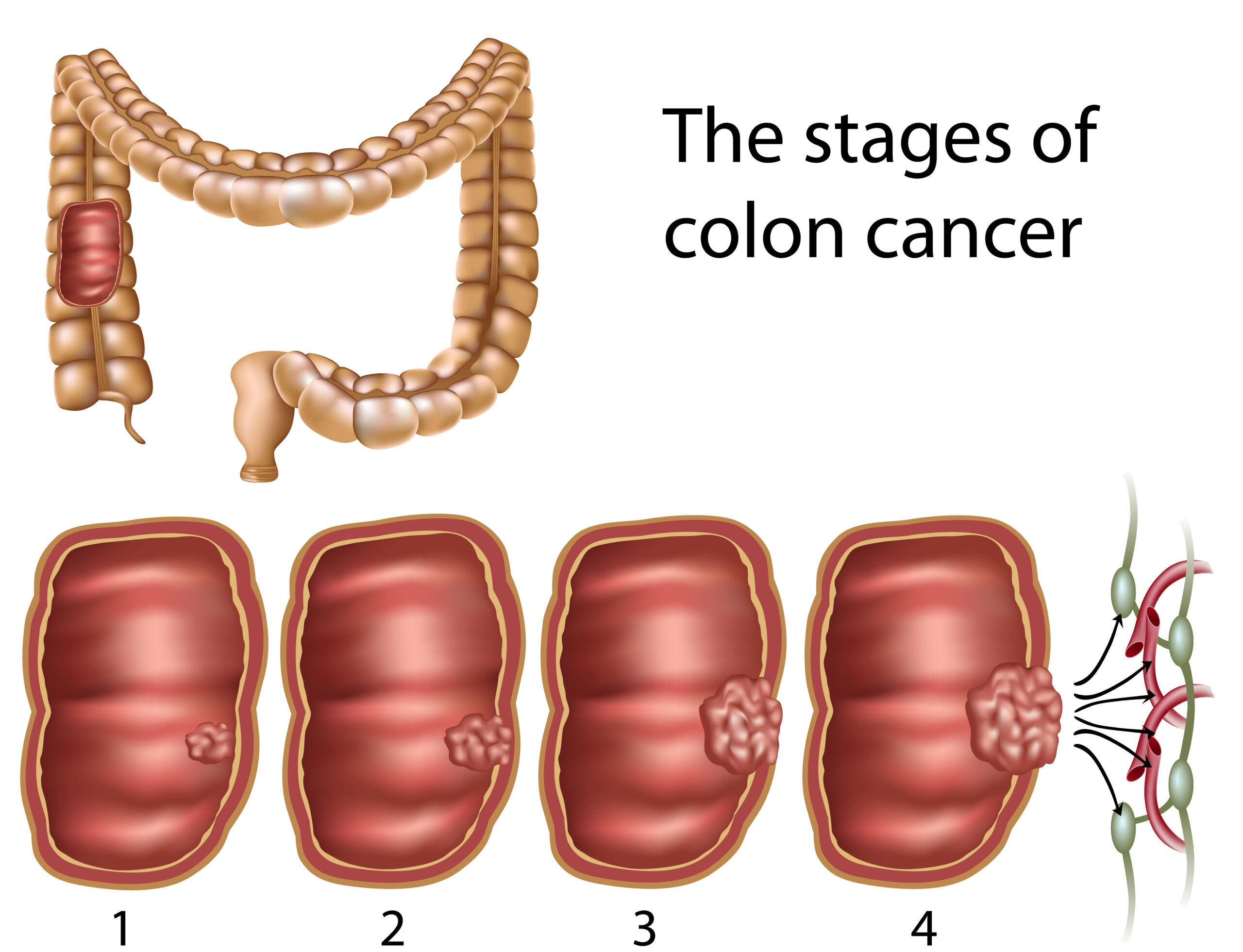
For treatment planning and prognostic assessment, bowel cancer is divided into stages using the international TNM system, which describes the extent of the disease. Staging is one of several factors considered when treatment is decided in a multidisciplinary team:
- T (Tumour): Local growth of the tumour (T1-T2 are limited to the bowel wall; T3-T4 have grown deeper or through the bowel wall).
- N (Node): Whether the cancer has spread to nearby lymph nodes (N0 means no spread; N1-N2 means spread to lymph nodes).
- M (Metastasis): Whether there is spread to other organs, for example the liver or lungs (M0 means no distant spread; M1 means spread).
The four cancer stages
| Stage | TNM criteria | Description and prognosis |
|---|---|---|
| Stage 1 | T1-2, N0, M0 | Small tumour, no spread to lymph nodes or other organs. Stage describes groups, not an individual prognosis. |
| Stage 2 | T3-4, N0, M0 | Larger tumour, but still no spread to lymph nodes or other organs. |
| Stage 3 | T1-4, N1-2, M0 | The cancer has spread to local lymph nodes, but there is no distant spread. |
| Stage 4 | Any T, any N, M1 | Spread to other organs in the body (metastases). |
The aim of treatment depends on the stage. When the disease has not spread, the aim is usually cure, whereas with widespread disease treatment may aim to slow the cancer and relieve symptoms. The aim is set individually at a multidisciplinary team meeting.
Treating bowel cancer: A tailored, multidisciplinary approach
Treatment is highly specialised and adapted to the individual patient in close cooperation between surgeons and oncologists.
Surgical treatment (operation)
Surgery remains the cornerstone of treatment. Most centres now offer keyhole surgery (laparoscopic or robot-assisted), where the surgeon operates through small incisions. This means less pain and faster recovery.
- Surgery for colon cancer: The cancer, a section of healthy bowel on either side and the surrounding fatty tissue with lymph nodes are removed. The bowel is usually joined back together immediately.
- Surgery for rectal cancer: All or large parts of the rectum are removed together with the surrounding fatty tissue (mesorectum) to reduce the risk of local recurrence.
- Temporary stoma: Often created to protect the bowel join and let the bowel rest while it heals.
- Permanent stoma: Necessary if the tumour sits so close to, or involves, the sphincter that the sphincter must be removed.
Medical and oncological treatment (before and after surgery)
Treatment is given either to support surgery, to shrink the tumour beforehand or as palliative care.
- Treatment BEFORE surgery (neoadjuvant treatment):
- For rectal cancer, radiotherapy is used, often combined with chemotherapy, to shrink the tumour before surgery.
- Following the latest guidelines, medical treatment (chemotherapy or targeted immunotherapy) is now also increasingly offered before surgery for colon cancer if the tumour is locally advanced or has specific genetic features (for example dMMR/MSI-high).
- Treatment AFTER surgery (adjuvant treatment): Chemotherapy may be offered after surgery (typically in stage 3 and in selected stage 2 cases after individual assessment at a multidisciplinary team meeting) to remove any microscopic cancer cells and reduce the risk of recurrence.
A modern option: "Watch and Wait" (organ-preserving strategy)
For a selected group of rectal cancer patients who receive intensive radio- and chemotherapy before the planned surgery, the tumour can sometimes disappear completely (complete clinical response). Following the latest guidelines, in these special cases, and under very close follow-up with scans, surgery can be postponed to preserve natural bowel function and avoid a stoma.
Prevention: Can I lower my risk?
Yes, there is a lot you can do yourself.
Taking part in the national screening programme for colon and rectal cancer (ages 50-74) reduces risk and mortality at population level. Investigating symptoms is a separate pathway in which colonoscopy may be relevant, as it may be when there are signs of hidden blood in the stool.
Beyond that, lifestyle plays a significant role:
| Factors that INCREASE risk | Factors that DECREASE risk |
|---|---|
| Overweight and a high calorie intake | Regular physical activity (exercise) |
| High intake of red and processed meat | Plenty of fruit, vegetables and berries |
| High alcohol consumption | A fibre-rich diet (whole grains) |
| Smoking | Intake of fish and low-fat dairy |
The prognosis
Survival for patients with bowel cancer depends among other things on the disease stage at diagnosis and on the biology of the tumour. Treatment is planned individually in a multidisciplinary setting.
Contact and appointments
Online booking is not available. Please call the clinic or ask your GP for a referral, so we can find the right appointment.
If you are in health insurance group 1 and have a valid referral from your GP, the examinations and treatments covered by the clinic's public health agreement are covered by the Danish public health insurance, so you pay nothing for them yourself. If you are in health insurance group 2, there is usually a small co-payment under the health insurance rules. If you are paying yourself, contact the clinic for a price.
Call the clinic
+45 39 64 01 25
Phone hours
Phone hours: Mon–Thu 09:00–12:00
Address
Hans Edvard Teglers Vej 9, 1st floor · 2920 Charlottenlund
Frequently asked questions
What is bowel cancer?+
Bowel cancer (colorectal cancer) is the collective term for cancer in the colon and rectum. Some cases develop over several years from precursor lesions such as adenomas or serrated lesions, but not all polyps turn into cancer. The Danish Health Authority's cancer pathway for colorectal cancer (2022) states about 4,000 new cases a year in Denmark. The stage at diagnosis matters for prognosis and treatment options.
What are the early symptoms of bowel cancer?+
Typical symptoms include blood in the stool, a change in bowel habit (frequency, consistency or thinner calibre) lasting weeks, a feeling of incomplete emptying, unexplained weight loss, fatigue or iron deficiency. Rectal bleeding is often mistaken for haemorrhoids but should always be assessed by a specialist.
How is bowel cancer diagnosed?+
At colonoscopy a flexible scope is passed through the anus so the lining of the colon and rectum can be inspected and biopsies taken. The cancer diagnosis itself is confirmed by microscopic examination of the tissue sample. Selected polyps can be removed during the examination, but not every polyp or lesion is necessarily removed on the same day. The colonoscopy aims to reach the whole colon, but can be incomplete depending on bowel preparation, anatomy, tolerability and technical factors. If colonoscopy is incomplete or not possible, CT colonography can in relevant cases add to the structural assessment of the colon; it cannot take biopsies or remove polyps, so a suspicious finding requires a plan for tissue diagnosis, colonoscopy or other appropriate management. If cancer is found, further work-up depends on the location of the tumour and on the findings: CT is commonly used, and pelvic MRI is particularly relevant in rectal cancer. Any other investigations are chosen individually.
What is MMR status and why does it matter?+
MMR (Mismatch Repair) tests the tumour's ability to repair DNA errors. If MMR is deficient (dMMR/MSI-high), the cancer often responds particularly well to immunotherapy. The test is performed routinely on the biopsy and is decisive for choosing medical treatment and for whether treatment can be offered before surgery.
Can bowel cancer be cured?+
Many people can be. The chance of cure depends above all on how far the cancer has spread at diagnosis, and it is greatest when the cancer is found early. Outlook is good in localised disease, while in metastatic disease treatment aims at cure for some people and at controlling the disease and easing symptoms for others. Registry figures describe groups after diagnosis and cannot be used as a promise about an individual course. Treatment is planned individually by surgeons and oncologists together.
What is "Watch and Wait" for rectal cancer?+
In selected patients with rectal cancer, intensive radio- and chemotherapy before the planned operation can make the tumour disappear completely (complete clinical response). Following the latest guidelines, surgery can in these cases be postponed under close follow-up with scans and colonoscopy, so natural bowel function is preserved and a stoma is avoided.
What can I do myself about bowel cancer?+
The national screening programme offers a stool test every two years to people aged 50 to 74, and a positive test leads to an invitation for colonoscopy. New or persistent symptoms need assessment whatever the screening result says. Weight, physical activity, diet, red and processed meat, alcohol and smoking all feed into overall risk, but no single habit decides the risk for one individual.
Related
Share this page
Contact information
- Hans Edvard Teglers Vej 9, 1st floor · 2920 Charlottenlund
- +45 39 64 01 25
- mail@kirurgen.dk
- Phone hours: Mon–Thu 09:00–12:00
For referring physicians
Provider number: 215430