
Barrett's oesophagus – patient guide
Practical guide for patients with suspected or known Barrett's oesophagus: what the gastroscopy involves, how to prepare, and how the surveillance pathway is organised in line with the Danish clinical guideline for Barrett's oesophagus from 2025.
Written and medically reviewed by Bahir Hadi, specialist in surgery, PhD
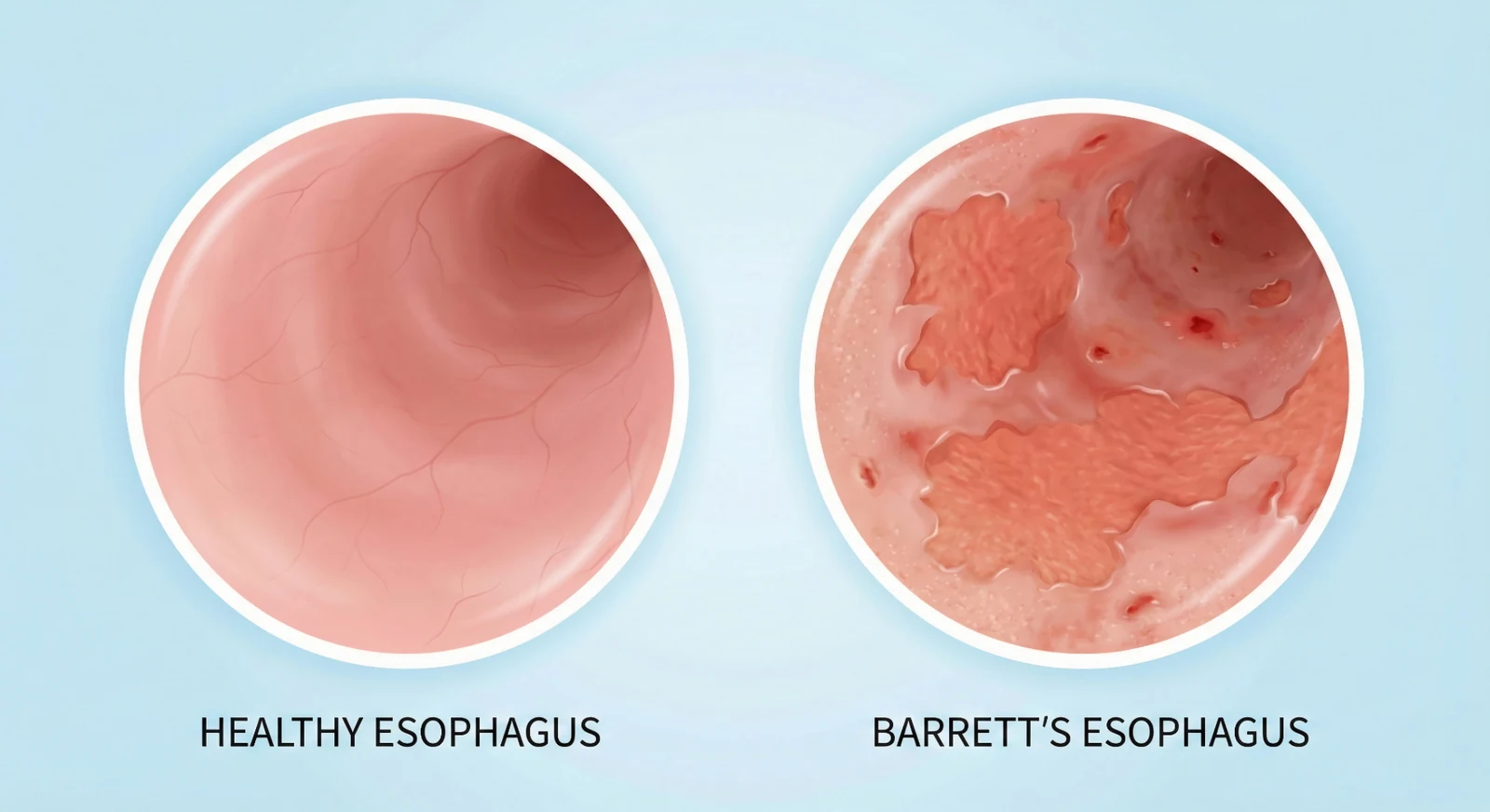
Patient guide: Barrett's oesophagus
This guide is written for patients with known or suspected Barrett's oesophagus. It is based on the Danish clinical guideline for Barrett's oesophagus from 2025, prepared by the Danish cancer specialists' professional group for cancer of the oesophagus and stomach. The guideline's full title and link are listed under references at the bottom of the page.
For a fuller overview of the condition, see our blog article on Barrett's oesophagus.
What is Barrett's oesophagus?
Barrett's oesophagus is a condition in which the normal pale-pink lining of the lower oesophagus is replaced by a salmon-coloured lining resembling that of the stomach or intestine. The change is usually caused by long-standing exposure to stomach acid (chronic reflux). The condition itself causes no symptoms; many people only have the heartburn caused by the reflux.
Barrett's oesophagus is a precursor that, in a small minority, can progress to cancer of the lower oesophagus. The yearly risk for the individual is low, but because the change can be detected and treated in time, many patients are offered surveillance with endoscopy.
How the diagnosis is made: According to the Danish guideline, the changed area in the oesophagus must be visible at gastroscopy and extend at least 1 cm above the junction between oesophagus and stomach, and biopsies from the area must confirm the change. Changes shorter than 1 cm are not classified as Barrett's oesophagus, because the risk of progression to cancer is very low.
When should you be referred?
Denmark has no screening programme for Barrett's oesophagus, but the Danish guideline allows gastroscopy in people with several risk factors. Your GP can refer you for gastroscopy if you have:
- Long-standing reflux symptoms combined with several risk factors, for example age over 50, male sex, abdominal obesity, smoking, or Barrett's oesophagus or oesophageal cancer in a close relative.
- Alarm symptoms: difficulty swallowing, pain on swallowing or unexplained weight loss. These symptoms must always be investigated promptly via your GP.
Emergency symptoms: Vomiting blood or black, tar-like stools are signs of bleeding from the oesophagus or stomach and must be assessed urgently the same day. Do not wait for a planned gastroscopy. Contact your GP or the emergency line 1813 in the Capital Region (the out-of-hours doctor in other regions) immediately. Call 112 for heavy bleeding, fainting, dizziness on standing, a rapid pulse or other signs of circulatory compromise.
The examination (gastroscopy and biopsies)
The diagnosis is confirmed by an endoscopic examination of the oesophagus (gastroscopy) with biopsies:
- The doctor takes time for a thorough inspection of the whole changed area. Equipment that enhances the pattern of the lining may be used when relevant.
- The extent is described using the Prague classification, which records how far the change reaches around the whole circumference (C) and as the longest tongue (M).
- Systematic biopsies are taken according to the Seattle protocol: four biopsies around the circumference for every 2 cm of the changed area, plus targeted biopsies from any visible irregularity.
Gastroscopy can be performed through the mouth or through the nose. Read more in our patient guide to gastroscopy and the article on nasal versus oral gastroscopy. The method is agreed on the basis of what the examination requires: in Barrett's oesophagus, where many and sufficiently large biopsies are needed, examination through the mouth with a standard endoscope is often the right choice. We discuss this with you before the examination.
Preparing for the examination
- Fasting: You will receive specific fasting instructions from the clinic before the examination. Follow them, and ask the clinic if anything is unclear.
- Acid-suppressing medication: Severe inflammation of the oesophagus can make the changes difficult to assess. In that case the guideline recommends a repeat gastroscopy after a period of acid-suppressing treatment. Whether your acid-suppressing treatment should continue unchanged before the examination is decided by the referring or examining doctor. Never stop or change prescribed medication without a specific agreement with the treating doctor.
- Blood-thinning medication: Contact the clinic in good time if you take anticoagulant or antiplatelet medication. The plan is made individually, weighing the bleeding risk from biopsies against your risk of blood clots.
Treatment
Everyone with Barrett's oesophagus without dysplasia is advised effective acid suppression, usually with a proton pump inhibitor. Read more in our guide to proton pump inhibitors. Treatment reduces reflux and inflammation of the lining. If a higher dose is needed, for example in the period up to the first check-up, it is prescribed by the doctor; do not increase the dose yourself. Aspirin is not recommended on its own as cancer prevention in Barrett's oesophagus. If you take it for other reasons, for example for your heart, continue as agreed with your doctor.
If cell changes (dysplasia) are found, treatment takes place at a highly specialised department. Visible lesions are removed endoscopically (endoscopic resection), and the remaining Barrett's tissue can be treated with heat (radiofrequency ablation) so that it is replaced by normal lining. Surgery to remove part of the oesophagus is today reserved for special cases.
Surveillance and intervals
The surveillance pathway depends on the type of lining found in the biopsies, the length of the segment, and whether dysplasia is present. The overview is a simplified summary of the Danish guideline from 2025 (see references). The acid-suppressing treatment before the first check-up is decided by the doctor who examined you; do not change the dose yourself.
| Biopsy finding | Surveillance |
|---|---|
| Barrett's lining of intestinal type (with goblet cells), no dysplasia | Repeat gastroscopy after 6 months on acid-suppressing treatment. If unchanged: surveillance every 3 years for long segments (3 cm or more) and every 5 years for short segments (under 3 cm) |
| Barrett's lining without goblet cells, no dysplasia | Repeat gastroscopy after 6 months to make sure goblet cells have not been missed. If there are still no goblet cells, surveillance can be discontinued |
| Indefinite for dysplasia | Repeat gastroscopy after 6 months on acid-suppressing treatment. Biopsies are reviewed by at least two experienced pathologists |
| Low-grade dysplasia | Confirmed by at least two experienced pathologists and repeat gastroscopy after 6 months. Confirmed changes are treated endoscopically at a highly specialised department. After treatment a check is done at 6 months; only if no dysplasia is found at that check does surveillance continue at the longer intervals of 1, 3 and 5 years. If dysplasia persists, the department makes a new plan |
| High-grade dysplasia | Rapid referral to a highly specialised department. After endoscopic treatment checks are done at 3 and 6 months; only if no dysplasia is found at the 6-month check does surveillance continue at 1, 2, 3, 4, 5, 7 and 10 years. For early cancer the department sets the follow-up individually based on the findings and the treatment |
Whether surveillance remains appropriate in people over 75 is assessed individually based on general health and expected benefit. The intervals assume a technically adequate gastroscopy with sufficient inspection time and systematic biopsies. If the examination is incomplete or the biopsies are not representative, it is repeated earlier.
References
- Danish Multidisciplinary Cancer Groups (DMCG) and Danish Oesophageal, Cardia and Gastric Cancer Group (DEGC). Clinical guideline: Barrett's esophagus: diagnostik, behandling og efterforløb (diagnosis, treatment and follow-up), version 3.0. Clinically approved 28 January 2025, administratively approved 12 March 2025. Guideline page at DMCG and full text PDF
- Sharma P, Dent J, Armstrong D, et al. The development and validation of an endoscopic grading system for Barrett's esophagus: the Prague C&M criteria. Gastroenterology 2006;131(5):1392-1399.
- Levine DS, Haggitt RC, Blount PL, Rabinovitch PS, Rusch VW, Reid BJ. An endoscopic biopsy protocol can differentiate high-grade dysplasia from early adenocarcinoma in Barrett's esophagus. Gastroenterology 1993;105(1):40-50 (Seattle protocol).
Book an appointment
You are welcome to contact the clinic to book an appointment or ask questions. The clinic holds a provider number under the Danish public health insurance and receives referred patients for services covered by the current agreement; whether a specific service is covered is clarified before the course of treatment.
Contact and appointments
Online booking is not available. Please call the clinic or ask your GP for a referral, so we can find the right appointment.
If you are in health insurance group 1 and have a valid referral from your GP, the examinations and treatments covered by the clinic's public health agreement are covered by the Danish public health insurance, so you pay nothing for them yourself. If you are in health insurance group 2, there is usually a small co-payment under the health insurance rules. If you are paying yourself, contact the clinic for a price.
Call the clinic
+45 39 64 01 25
Phone hours
Phone hours: Mon–Thu 09:00–12:00
Address
Hans Edvard Teglers Vej 9, 1st floor · 2920 Charlottenlund
Related
Related articles
Read more on the topic in our blog.
Share this page
Contact information
- Hans Edvard Teglers Vej 9, 1st floor · 2920 Charlottenlund
- +45 39 64 01 25
- mail@kirurgen.dk
- Phone hours: Mon–Thu 09:00–12:00
For referring physicians
Provider number: 215430