
Hiatus hernia: symptoms, diagnosis and treatment
Written and medically reviewed by Bahir Hadi, specialist in surgery, PhD
Published: 1 September 2026
A hiatus hernia occurs when the upper part of the stomach moves through the natural opening in the diaphragm through which the oesophagus passes. It is common and often harmless. Many people have no symptoms, while others experience heartburn, acid reflux or related discomfort.
What is a hiatus hernia?
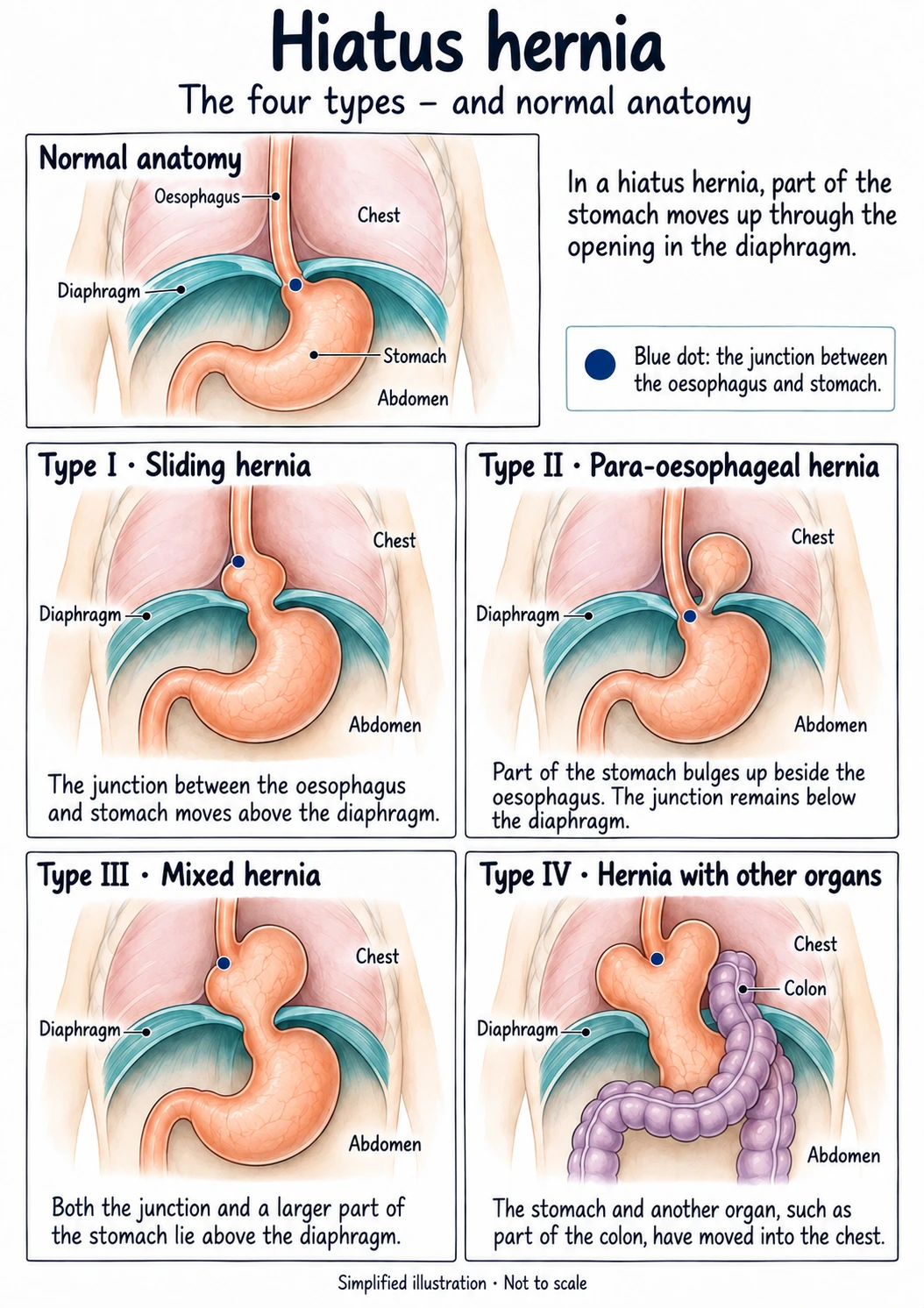
The diaphragm separates the chest from the abdomen. The oesophagus passes through a small opening in the diaphragm before joining the stomach. In a hiatus hernia, part of the stomach lies higher than usual.
The four anatomical types are described in more detail below. The type and size influence whether further assessment is needed.
The four types of hiatus hernia
Hiatus hernias are classified as types 1–4 according to which structures lie above the diaphragm. These numbers describe the anatomy; they are not four stages that everyone progresses through.
| Type | What happens? | Possible symptoms |
|---|---|---|
| Type 1 – sliding hernia | The junction between the oesophagus and stomach, together with the upper stomach, moves above the diaphragm. | Often none. Associated reflux may cause heartburn and acid regurgitation. |
| Type 2 – para-oesophageal hernia | Part of the stomach bulges up beside the oesophagus, while the junction stays below the diaphragm. | Feeling full early, pressure after meals or difficulty swallowing. |
| Type 3 – mixed hernia | Both the junction and a larger part of the stomach lie above the diaphragm, combining features of types 1 and 2. | Reflux symptoms and discomfort related to the altered position of the stomach, such as early fullness or difficulty swallowing. |
| Type 4 – hernia involving other organs | Another organ, such as part of the colon, passes through the opening along with the stomach. | Symptoms similar to a large type 3 hernia; some people also experience breathlessness. Symptoms depend on the size and contents of the hernia. |
Symptoms overlap and may have other causes, so they cannot establish the hernia type on their own. Large hernias can also cause iron deficiency or anaemia through small ulcers in the stomach lining. Less commonly, the stomach can twist or become trapped.
This classification follows the SAGES guidelines.
How common is each type?
Type 1 accounts for around 95% or more of all hiatus hernias in commonly cited estimates. Types 2, 3 and 4 together make up the small remainder, often quoted as around 5%. These are approximate literature figures that depend on the method of investigation and the patients studied, rather than precise statistics for the Danish population.
The sources used do not provide a consistent percentage for each of the three less common types. We therefore present them as a group rather than assigning apparently precise individual percentages. Source: Hiatal Hernia, NCBI Bookshelf.
Type 1 – the common sliding hernia
Normally, the junction between the oesophagus and stomach lies just below the diaphragm. The lower oesophageal sphincter and the diaphragm muscles work together to help prevent stomach contents flowing upwards. In a sliding hernia, the junction moves upwards and these structures may work less effectively together, making reflux more likely.
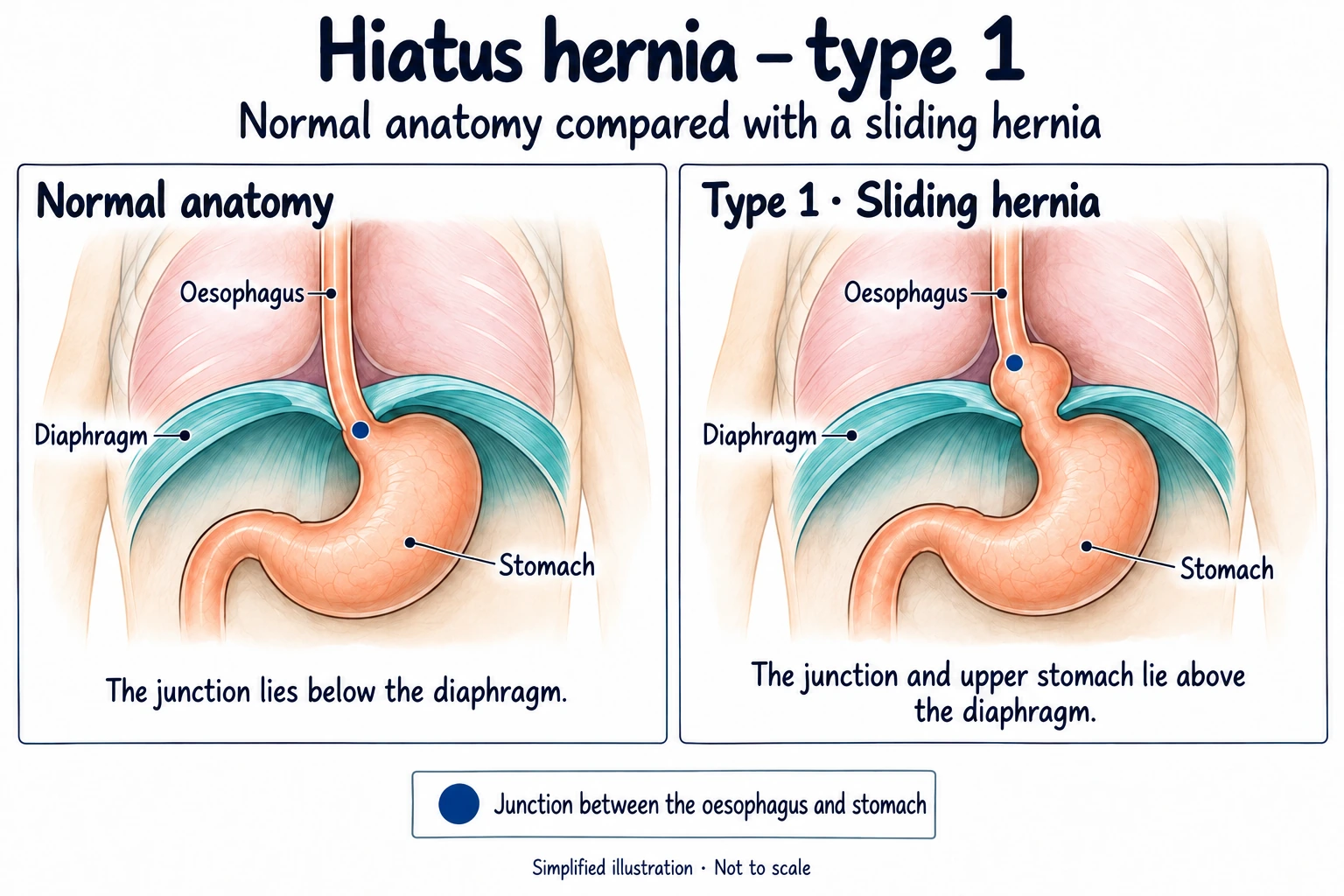
A sliding hernia is often found incidentally during gastroscopy. A small hernia does not automatically explain pain, cough or other symptoms. Many people have no symptoms, and treatment, when needed, usually focuses on confirmed or likely reflux. Medicine can reduce acid exposure but does not move the stomach back into place. Patienthåndbogen: Hiatus hernia (Danish).
What symptoms can it cause?
A hiatus hernia does not necessarily cause symptoms. When symptoms occur, they are often related to reflux of stomach contents into the oesophagus.
Possible symptoms include:
- heartburn or a burning discomfort behind the breastbone
- acid or bitter-tasting regurgitation
- discomfort after meals
- symptoms that worsen when lying down or bending forwards
- difficulty swallowing or a feeling that food passes slowly
- cough, hoarseness or throat irritation in some people
Symptoms alone cannot confirm a hiatus hernia. Reflux may occur without a hernia, and a hernia may be present without reflux symptoms. Cough and hoarseness are non-specific and should not automatically be attributed to reflux or a small hernia.
Why does it develop?
The opening in the diaphragm and its supporting tissues may become more lax over time. Increasing age, excess weight and conditions that increase pressure within the abdomen may contribute. In many people, there is no single identifiable cause.
Is a hiatus hernia hereditary?
Hiatus hernia occurs more often in some families, and research suggests that inherited factors can contribute to susceptibility. A small number of families have been described in which the hernia follows a clear inherited pattern, but this is unusual.
In most people, there is no single gene defect or simple pattern of inheritance. Larger genetic studies of several hernia types, including hiatus hernia, instead point to multiple genetic regions involved in connective tissue and elastic fibre biology. Inherited differences in tissue strength and in the anatomy around the opening in the diaphragm may therefore form part of the explanation.
Genes alone do not determine whether a hiatus hernia develops. Age, excess weight, increased pressure within the abdomen and other acquired changes may also contribute. Routine genetic testing or examination of healthy relatives is not recommended. If several close relatives have developed a large hernia or were affected at a young age, this can be mentioned during medical assessment, but the need for investigation is determined primarily by symptoms.
How is a hiatus hernia diagnosed?
Gastroscopy can identify a hiatus hernia and examine the lining of the oesophagus and stomach at the same time. It may reveal inflammation, ulcers or changes associated with longstanding reflux.
A hiatus hernia may also be detected by a contrast X-ray examination. If surgery is being considered, or if the symptoms do not correspond with the findings, further tests such as oesophageal pH monitoring and manometry may be appropriate.
How is it treated?
A small sliding hernia without symptoms usually needs no treatment. When a sliding hernia causes discomfort, treatment usually focuses on associated reflux:
- smaller meals may reduce discomfort
- avoid lying down soon after eating
- weight loss may help if you are overweight
- limit foods and drinks that clearly trigger your own symptoms
- antacids or acid-suppressing medicines may be used after individual assessment
Acid-suppressing medicine treats acid exposure and symptoms but does not remove the hernia itself.
Surgery is appropriate only for selected patients, for example those with severe persistent symptoms despite treatment, certain large hernias or complications. A more detailed assessment is normally required before surgery.
Types 2–4, especially large or symptomatic hernias, warrant individual specialist assessment. Whether surgery or observation is appropriate depends on symptoms, anatomy, overall health and preferences. An asymptomatic para-oesophageal hernia does not automatically mandate surgery. The 2024 SAGES guidelines support individualized decision making.
When should you seek medical advice?
Contact a doctor if symptoms persist, change or affect your daily life. More prompt assessment is needed for progressive difficulty swallowing, unintended weight loss, repeated vomiting, vomiting blood, black stools or signs of anaemia.
Sudden severe pain in the chest or upper abdomen, especially with repeated retching or an inability to swallow fluids, requires urgent assessment. Chest pain should not automatically be attributed to a hiatus hernia or reflux, as it may have other, more serious causes.
Assessment at the clinic
For symptoms arising from the oesophagus or stomach, the need for gastroscopy is assessed according to the symptoms, age, medication and any warning signs. The purpose is not only to look for a hiatus hernia, but also to examine the lining and exclude other explanations for the symptoms.
Frequently asked questions
Is a hiatus hernia dangerous?
A common sliding hiatus hernia is usually harmless and only needs treatment if it causes symptoms. Large or para-oesophageal hernias may require separate assessment.
Is a hiatus hernia the same as acid reflux?
No. A hiatus hernia may increase the tendency to reflux, but reflux can occur without a hernia, and many people with a hernia have no reflux symptoms.
Can gastroscopy detect a hiatus hernia?
Yes. Gastroscopy can often identify the hernia and assess the lining of the oesophagus and stomach at the same time.
Can medicine make a hiatus hernia disappear?
No. Acid-suppressing medicine can reduce reflux symptoms and acid exposure, but it does not remove the hernia itself.
Does a hiatus hernia need surgery?
Usually not. Surgery is considered only for selected patients after a complete assessment.
Is a hiatus hernia hereditary?
Hiatus hernia may occur more often in some families, and genetic factors can contribute. In most people, however, it does not follow a simple pattern of inheritance, and routine genetic testing or examination of relatives without symptoms is not recommended.
More on this topic at Kirurgen.dk
Category: Gastrointestinal