
Causes of varicose veins – and how to prevent them
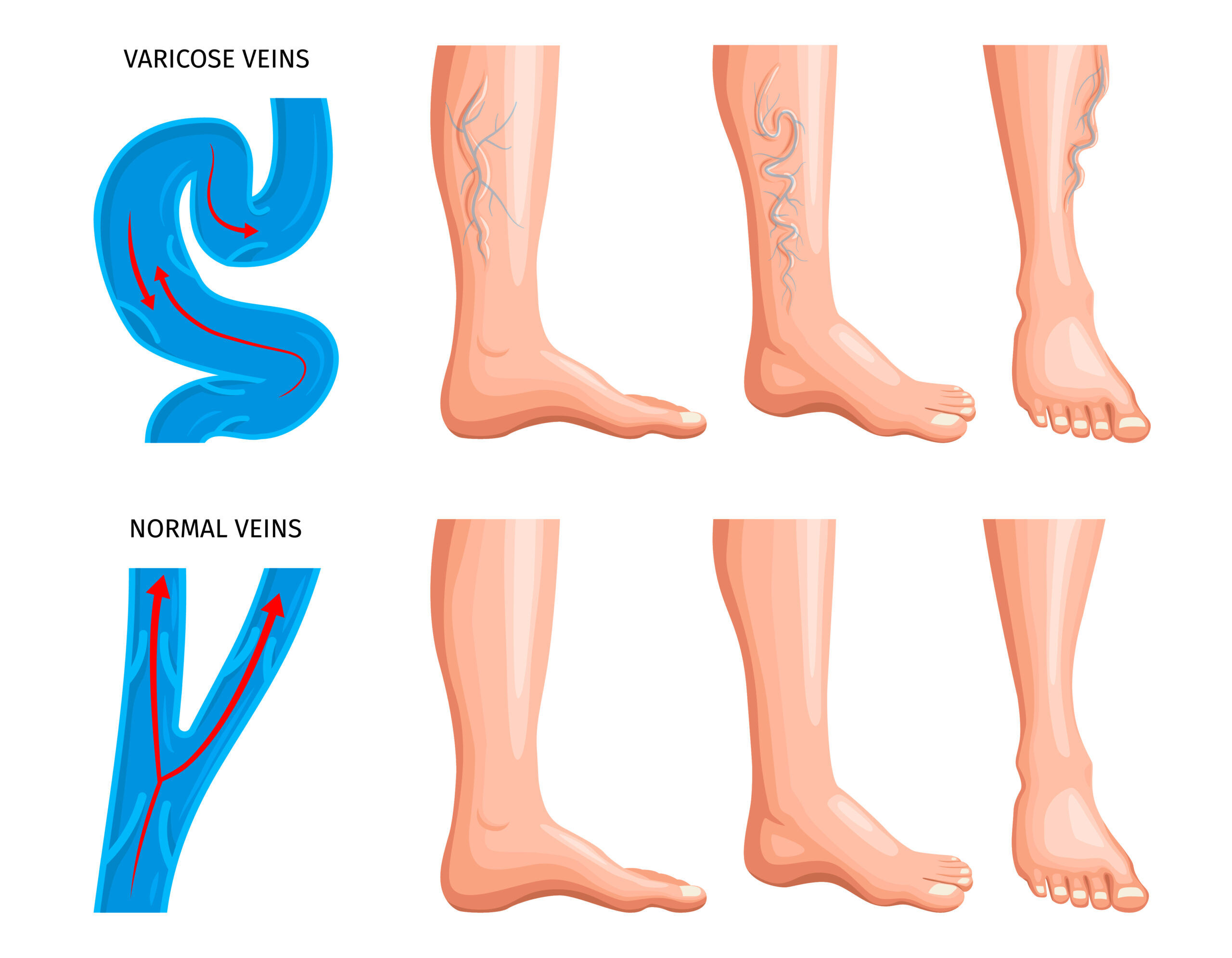
Varicose veins develop when the small valves inside the leg veins no longer close tightly. Blood leaks downward instead of being pushed up toward the heart, pressure rises and the vein slowly enlarges into a varix.
Written and medically reviewed by Bahir Hadi, specialist in surgery, PhD
Short answer
Why do people get varicose veins?
Varicose veins develop when the vein valves in the leg fail, so blood flows backwards and widens the vein. Familial clustering is well documented, and heredity is one of several risk factors alongside age, pregnancy, excess weight and standing work. Women are affected slightly more often than men. Valves cannot be trained back, and movement or compression may ease symptoms in some people without any promise that the condition stops progressing.
Causes of Varicose Veins in the Legs: Why Do They Occur, and What Treatment Works?
Varicose veins (varices) are a widespread condition affecting a large portion of the adult population. Understanding the causes of varicose veins is fundamental to choosing the treatment that suits the individual patient. In this post, we look at why veins weaken and how methods such as laser treatment for varicose veins are used today.
Basic Physiology: Why Do You Get Varicose Veins?
Varicose veins occur in the body's venous system, whose primary function is to return oxygen-poor blood from the tissues up to the heart. Unlike arteries, which transport blood away from the heart under high pressure, veins have thinner walls and operate under lower pressure.
The biggest challenge for the veins in the legs is gravity. To counteract the downward flow, veins are equipped with venous valves - small, crescent-shaped structures that act as one-way valves.
Venous Insufficiency - The Key to Varicose Veins
The cause of varicose veins is primarily a phenomenon called venous insufficiency (venous valve failure), which creates abnormally high pressure in the venous system:
- Valves Weaken: For unknown (often genetic) reasons, the structure of the venous valves weakens.
- Backflow (Reflux): When the valves cannot close tightly, blood flows back down into the leg with each heartbeat.
- Pressure and Dilation: This backflow creates an overpressure in the superficial veins. The pressure dilates the veins, causing them to bulge out and become visible under the skin as varicose veins.
The Most Common Causes of Varicose Veins (Risk Factors)
Although the precise mechanism behind the weakening of venous valves is still being researched, there are a number of well-known factors that increase the risk of developing varices (varicose veins).
Heredity and Genetics (Primary Varicose Veins)
This is by far the most important risk factor. Primary varicose veins occur without a known external trigger and are due to veins having a genetic predisposition to degenerate. If your parents or siblings have varicose veins, your risk is significantly higher. This genetic predisposition is the most common cause of varicose veins.
Gender and Age
- Gender: Varicose veins are seen more often in women than in men.
- Age: Varicose veins are seen more often with increasing age, and symptoms usually appear in adulthood.
Hormonal and Physical Pressure (Pregnancy)
Pregnancy is a frequent cause of varicose veins in women:
- Hormonal Changes: Increased levels of progesterone early in pregnancy relax the walls of blood vessels, which can lead to dilation.
- Increased Pressure: In the later stages of pregnancy, the growing uterus puts direct physical pressure on the large veins in the pelvis, preventing blood from flowing efficiently back to the heart.
Note: Varicose veins are seen more often in connection with pregnancy. In some women the veins become less prominent after birth, in others they persist, and the course is individual.
Lifestyle and Secondary Varicose Veins
- Obesity: Increased body weight puts greater pressure on the veins in the legs and pelvis, contributing to valve failure and being a contributing cause of varicose veins.
- Prolonged Standing/Standing Still:
- People with jobs requiring long periods in stationary positions constantly strain venous valves (e.g., surgeons, hairdressers, retail employees).
- Previous Blood Clots (Secondary Varicose Veins): If a previous blood clot in the leg (deep vein thrombosis) does not dissolve properly, it can permanently damage the venous valves. This increases pressure in the venous system and forms secondary varicose veins.
Treatment of Varicose Veins: From Surgery to Laser Technology
Today, treatment for varicose veins is minimally invasive and usually performed under local anaesthesia. At kirurgen.dk, we use endovenous methods, which today are used instead of open stripping in many patients.
Focus on Minimally Invasive Treatment
Treatment of varicose veins involves closing the diseased vein so that the body itself absorbs it, and blood flow is automatically redirected to the healthy, deep veins.
Laser Treatment of Varicose Veins (EVLA)
Endovenous Laser Ablation (EVLA) is a form of endovenous thermal ablation. For symptomatic, duplex-documented reflux in the great or small saphenous vein where treatment is indicated, ESVS 2022 recommends endovenous thermal ablation in preference to stripping and ultrasound-guided foam sclerotherapy (recommendations 28 and 43, class I A). Other vein types are treated by other methods, and the choice is made individually.
- Advantages of Laser Treatment:
- Minimally invasive: Performed under local anesthesia.
- Recovery: How quickly you can resume work varies with the method, the extent of treatment and the type of work.
- Effect: Closure rates in studies are high, but they vary with method and anatomy, and recurrence can occur.
- How does it work? With laser treatment of varicose veins, a thin laser fiber is guided by ultrasound into the diseased vein. The laser's heat energy effectively closes the vein from the inside, removing the source of high pressure and thus the varicose veins.
Supplementary Treatments
- Foam Sclerotherapy (Ultrasound-Guided): Often used to treat smaller varicose veins or side branches not directly treated with laser. A sclerosing foam is injected to close the vein.
- Microphlebectomy: Minor surgical removal of very large, bulging varices through microscopic incisions for a better cosmetic result.
Conclusion
Understanding the complex causes of varicose veins - especially the genetically determined weakening of venous valves - is crucial. Fortunately, advances in varicose vein treatment have made it possible to treat the condition effectively and gently.
At kirurgen.dk we plan treatment individually from the scan findings, your symptoms and your own goals. No single method is best for everyone, and the result cannot be guaranteed in advance.
Contact and appointments
Online booking is not available. Please call the clinic or ask your GP for a referral, so we can find the right appointment.
If you are in health insurance group 1 and have a valid referral from your GP, the examinations and treatments covered by the clinic's public health agreement are covered by the Danish public health insurance, so you pay nothing for them yourself. If you are in health insurance group 2, there is usually a small co-payment under the health insurance rules. If you are paying yourself, contact the clinic for a price.
Call the clinic
+45 39 64 01 25
Phone hours
Phone hours: Mon–Thu 09:00–12:00
Address
Hans Edvard Teglers Vej 9, 1st floor · 2920 Charlottenlund
Frequently asked questions
What is the main cause of varicose veins?+
Heredity is the single most important factor. Twin and family studies show a clear hereditary component in the weakness of the venous valves, but heredity does not explain everything. If one or both parents have varicose veins, your risk is significantly increased.
Can standing work cause varicose veins?+
Prolonged standing or sitting can aggravate symptoms, but the causes of varicose veins are multifactorial. Heredity, age, pregnancy and excess weight also contribute, and in an individual case no single cause can be identified.
Can varicose veins be prevented?+
There is no documented way to reliably prevent varicose veins, and the hereditary component cannot be changed. General advice about a healthy weight, physical activity, avoiding long stretches without movement and elevating your legs at rest is sensible and may ease symptoms in some people. Whether a compression stocking is relevant for you, and which one, is assessed individually.
Does pregnancy cause varicose veins?+
Varicose veins are seen more often in connection with pregnancy. Several factors may contribute, including increased blood volume, hormonal changes and increased pressure in the abdomen. In some women the veins become less prominent after delivery, while in others they persist. The course is individual.
Related
Share this page
Contact information
- Hans Edvard Teglers Vej 9, 1st floor · 2920 Charlottenlund
- +45 39 64 01 25
- mail@kirurgen.dk
- Phone hours: Mon–Thu 09:00–12:00
For referring physicians
Provider number: 215430