
Pudendal Neuralgia
Written and medically reviewed by Bahir Hadi, specialist in surgery, PhD
Pudendal Neuralgia: Nerve pain in the pelvis
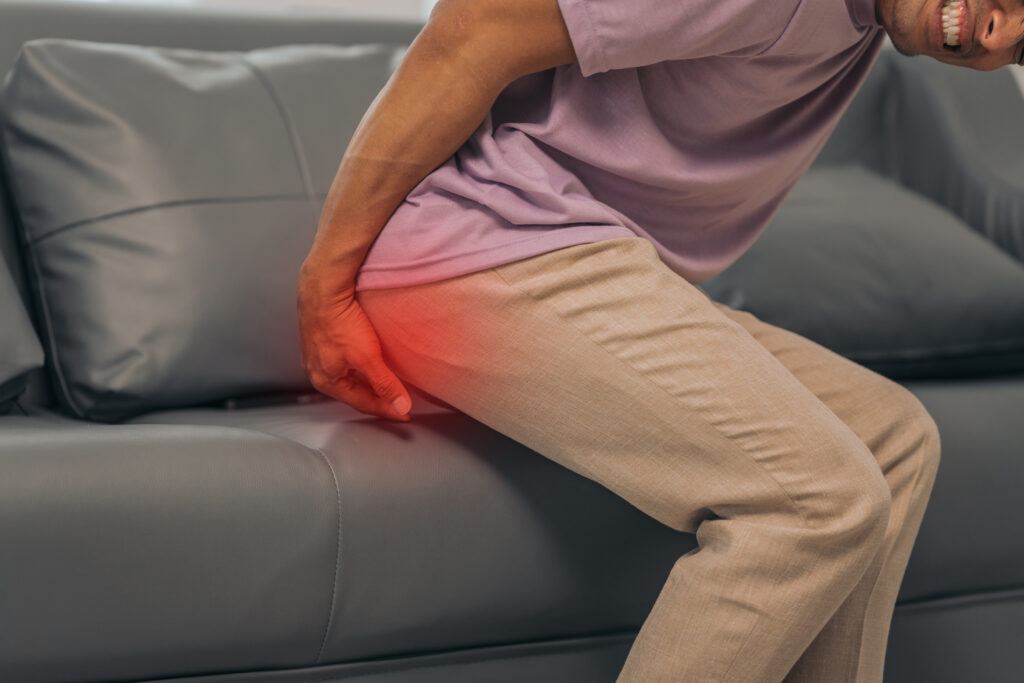 pain near the rectum
Are you experiencing burning or electric pain near the rectum that worsens when you sit down? If so, the cause may be pudendal neuralgia. This condition involves irritation or compression of the pudendal nerve - one of the most important nerves in the pelvic floor.
At Kirurgen.dk, we often see patients who fear serious illness due to these symptoms. Through a thorough clinical evaluation and potentially a bowel examination, we can provide clarity and establish a plan for your treatment.
What is pudendal neuralgia?
Pudendal neuralgia (PN) is a chronic pain condition that occurs when the pudendal nerve becomes irritated or compressed. The nerve runs through a narrow canal in the pelvis (Alcock's canal), and if it is subjected to pressure, it sends pain signals to the brain from the areas it supplies: the rectum, the perineum, and the genitals.
Typical symptoms
The symptoms of pudendal neuralgia are often very characteristic and differ from ordinary muscle pain:
- Burning or electric pain: Often feels like "fire" or electric shocks.
- Worsening when seated: Pain is typically at its worst during the day when sitting on a chair.
- Relief on the toilet seat: Since the perineum itself "hovers" freely on a toilet seat, many experience temporary relief there.
- Foreign body sensation: Many patients describe a feeling of having a golf ball or a lump stuck in the rectum.
How is the diagnosis made? (The Nantes criteria)
The diagnosis is clinical. MRI cannot confirm pudendal neuralgia but is used to rule out other causes. To support the diagnosis we use the internationally recognised Nantes criteria, which were developed for nerve entrapment and do not cover all forms of pelvic pain:
- Pain is localised to the anatomical territory of the pudendal nerve (from the clitoris/penis to the anus).
- Pain is significantly worse when sitting.
- Pain does not wake the patient at night.
- There is no sensory loss during objective examination (only pain).
- Pain is relieved by a diagnostic pudendal nerve block.
The importance of a bowel examination
Even if the symptoms point to a nerve, it is crucial to rule out other causes of pain near the rectum. A local examination with a short instrument (anoscopy) is performed to rule out:
- Anal fissures (tears).
- Haemorrhoids.
- Inflammatory processes or tissue changes.
In certain cases, we may supplement this with a colonoscopy if there are symptoms such as bleeding or changed bowel habits, to ensure there is no underlying serious disease.
Treatment options
The treatment of pudendal neuralgia is often multidisciplinary and may include:
- Pressure relief when sitting: A cushion that offloads the perineum (for example a cushion with a central cut-out, or two separate pads under the thighs) can reduce pressure on the nerve. Ring-shaped cushions do not suit everyone, as they can increase pressure on the perineum.
- Specialised physiotherapy: Relaxation of the pelvic floor, as muscle tension often exacerbates nerve irritation.
- Medical treatment: Nerve medication or local anaesthetic blocks.
- Surgery: In rare cases where the nerve is physically trapped (entrapment), surgery may be considered.
Scientific references (PubMed format)
- Labat JJ, Riant T, Robert R, Amarenco G, Lefaucheur JP, Rigaud J. Diagnostic criteria for pudendal neuralgia by pudendal nerve entrapment (Nantes criteria). Neurourol Urodyn. 2008;27(4):306-10. PMID: 17828787
- Kaur J, Leslie SW, Singh P. Pudendal Nerve Entrapment Syndrome. In: StatPearls [Internet]. Treasure Island (FL): StatPearls Publishing. PMID: 31334992
- Beco J, Climov D, Bex M. Pudendal nerve decompression in perineology: a case series. BMC Surg. 2004;4:15. PMID: 15516268
- Antolak SJ Jr, Hough DM, Pawlina W, Spinner RJ. Anatomical basis of chronic pelvic pain syndrome: the ischial spine and pudendal nerve entrapment. Med Hypotheses. 2002;59(3):349-53. PMID: 12208168
- Ploteau S, Cardaillac C, Perrouin-Verbe MA, Riant T, Labat JJ. Pudendal Neuralgia Due to Pudendal Nerve Entrapment: Warning Signs Observed in Two Cases and Review of the Literature. Pain Physician. 2016;19(3):E449-54. PMID: 27008300
More on this topic at Kirurgen.dk
Category: Anal surgery