
Varicose veins and heredity
Written and medically reviewed by Bahir Hadi, specialist in surgery, PhD
Published: 15 August 2026
Varicose Veins and Heredity: Is Your Family to Blame?
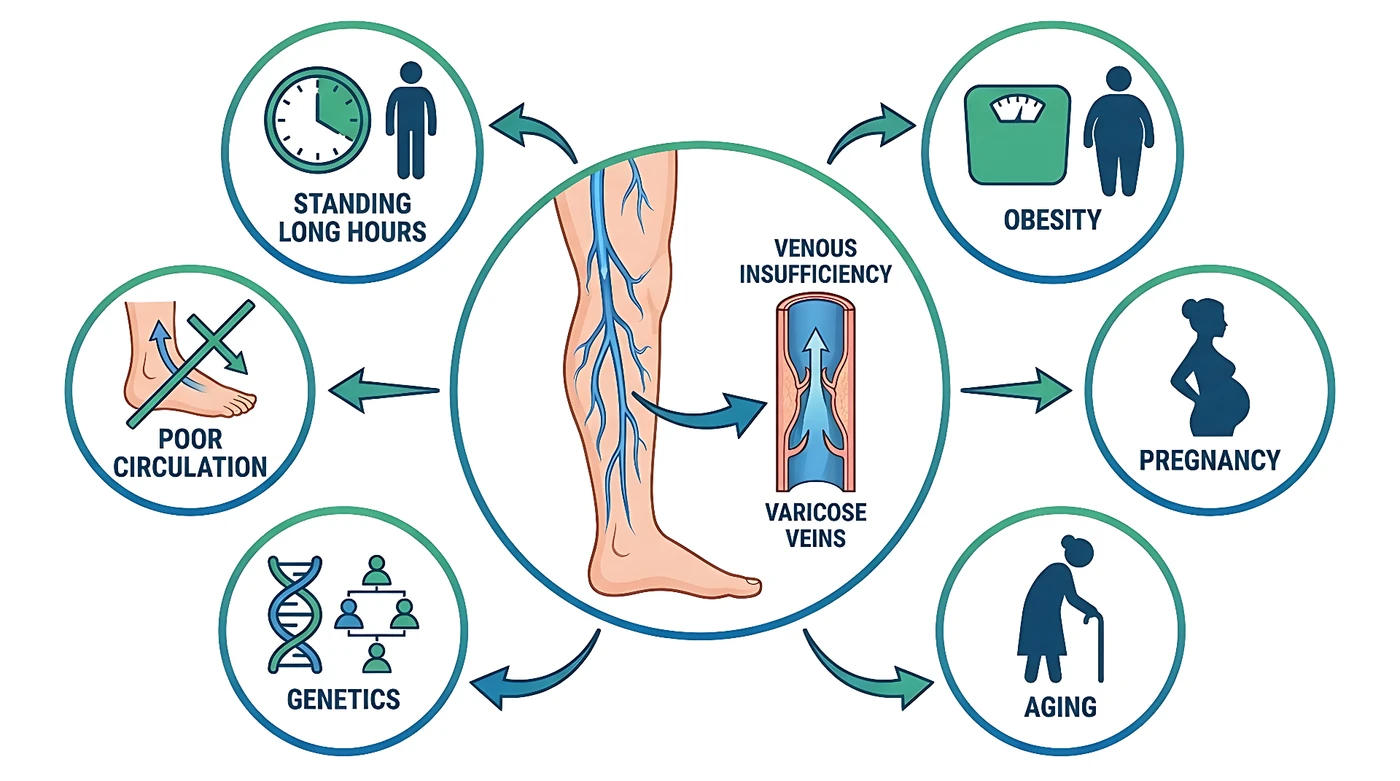
Many patients with varicose veins say that "it runs in the family", and research backs them up. Genetics is a well documented risk factor for varices (varicose veins), but it rarely stands alone. Familial clustering is well documented: if one or both parents have varicose veins, the likelihood of developing them yourself is higher, and it is highest when both parents are affected [1]. There is no single figure that describes the inherited risk for an individual.
How Significant Is the Hereditary Component?
Twin studies and large cohort studies have shown that:
- Inherited factors matter a great deal for venous function. In a twin study of 46 twin pairs, heritability was estimated at 0.6 for venous capacity and 0.9 for venous compliance, and the estimate for venous capacity fell to 0.3 after adjustment for age, body mass index and body fat [2]. These are measures of variation in venous function at group level, not a risk for the individual
- If one parent has varicose veins, prevalence in the children is higher than in children with no affected parent [1]
- If both parents have varicose veins, prevalence is highest [1]
- If neither parent has varicose veins, prevalence is lowest, but varicose veins can still develop [1]
Source note: this ranking comes from a French clinic-based family study from 1994 covering 134 families [1]. It is a selected clinic population, the study is small and old, the figures are not an estimate for the general population, and they cannot be converted into an individual inherited risk. The twin study of venous function [2] included 46 twin pairs and measured venous capacity and compliance with impedance plethysmography. It describes variation in venous function at group level and cannot be converted into a percentage risk for an individual.
A recent large-scale genomic study (UK Biobank, 493,000 participants) identified 30+ genetic loci associated with varicose veins - many of them related to the collagen and elastin in the vein wall, valve function, and venous development [3].
Which Genes Are Involved?
Researchers have demonstrated a link with:
- CASZ1 - a transcription factor in venous development
- PIEZO1 - a mechanosensory ion channel in the vessel wall
- FOXC2 - known from hereditary venous diseases
- HFE and haemochromatosis genes
- MTHFR - related to homocysteine and venous thrombosis
These genes affect the strength of the vein wall, the function of the valve system, and the composition of the connective tissue [3,4].
Heredity vs. Environment
Genetics determine your vulnerability - but not whether you will actually develop varicose veins. Modifiable risk factors play a major role:
- Sedentary or standing work
- Being overweight
- Pregnancies (see varicose veins during pregnancy)
- Lack of exercise
- Smoking
- Age (varicose veins become more common the older you get)
Heredity cannot be changed, but weight, physical activity and standing work affect how troublesome the symptoms become. Whether lifestyle in itself can delay the onset of the disease has not been settled.
Should You Be Screened if It Runs in Your Family?
Routine screening is not recommended, but it is sensible to be aware of early symptoms:
- Heavy, tired legs at the end of the day
- Swelling around the ankles
- Night cramps
- Visible, winding veins on the thigh or calf
- Spider veins (telangiectasias) - often the first clinical sign
- Itching, brownish discolouration or eczema in the ankle area
If symptoms are present, a duplex ultrasound of the leg veins is performed. It maps valve function and reflux in the individual veins and is used in the vascular assessment to confirm anatomy and reflux and to plan treatment in relevant patients (NICE CG168, assessment in a vascular service). The scan does not by itself make leg symptoms venous. It is non-invasive, and how it feels, including pressure or discomfort from the probe, varies from person to person [4].
Prevention if It Runs in the Family
- Exercise: 30 minutes daily - walking, cycling, and swimming activate the "muscle pump" in the calf
- Weight management: Every extra kilo increases the pressure in the leg veins
- Avoid prolonged static positions: Alternate between standing and sitting; do heel raises at your workplace
- Elevate your legs above heart level for 15-20 minutes daily
- Wear graduated compression stockings for standing work or long-haul flights [5]
- Stop smoking - nicotine weakens the vessel wall
- Take the first symptoms seriously - you cannot change an inherited predisposition, but symptoms and skin changes should be assessed so that any reflux can be treated. Treatment can reduce symptoms and venous pressure; that it reliably prevents ulcers in the individual is not documented
If You Do Develop Varicose Veins
Endovenous laser treatment (EVLT) is one of the methods used for duplex-documented reflux. The choice of method is individual, and studies report:
- A high closure rate of the trunk vein after 5 years, with about 7 per cent recanalised in a Danish randomised trial, although new visible varicose veins appear in a proportion of patients within the same period [6]
- Treatment under local anaesthetic; when you can go home depends on the procedure and your condition
- Often a faster return to work than after open vein surgery; the timing depends on treatment extent, symptoms and type of work
At the clinic we offer assessment with Doppler ultrasound and endovenous laser treatment after a GP referral. Questions about referral, cover and price are clarified with the clinic or your GP before treatment; see contact. You can also read our article on varices.
References
- Cornu-Thénard A, et al. Importance of the familial factor in varicose disease. J Dermatol Surg Oncol 1994;20(5):318-26.
- Brinsuk M, et al. Heritability of venous function. Arterioscler Thromb Vasc Biol 2004;24(1):207-10.
- Fukaya E, et al. Clinical and genetic determinants of varicose veins: prospective, community-based study of ~500,000 individuals. Circulation 2018;138(25):2869-80.
- Gloviczki P, Lawrence PF, Wasan SM, et al. The 2022 SVS/AVF/AVLS clinical practice guidelines for the management of varicose veins of the lower extremities. Part I. Duplex scanning and treatment of superficial truncal reflux. J Vasc Surg Venous Lymphat Disord 2023;11(2):231-261.e6. DOI: 10.1016/j.jvsv.2022.09.004. PubMed
- Lim CS, Davies AH. Graduated compression stockings. CMAJ 2014;186(10):E391-8.
- Rasmussen LH, et al. Randomized clinical trial comparing endovenous laser ablation, radiofrequency ablation, foam sclerotherapy and surgical stripping for great saphenous varicose veins. Br J Surg 2011;98(8):1079-87. PubMed (1-year results). Five-year follow-up: Lawaetz M, Serup J, Lawaetz B, et al. Comparison of endovenous ablation techniques, foam sclerotherapy and surgical stripping for great saphenous varicose veins. Extended 5-year follow-up of a RCT. Int Angiol 2017;36(3):281-8. PubMed
- Hamann SAS, et al. Five-year results of great saphenous vein treatment: a meta-analysis. Eur J Vasc Endovasc Surg 2017;54(6):760-70.
More on this topic at Kirurgen.dk
Category: Varicose veins