
Varicose veins during pregnancy
Written and medically reviewed by Bahir Hadi, specialist in surgery, PhD
Published: 15 August 2026
Varicose Veins in Pregnancy: Why they occur and what you can do
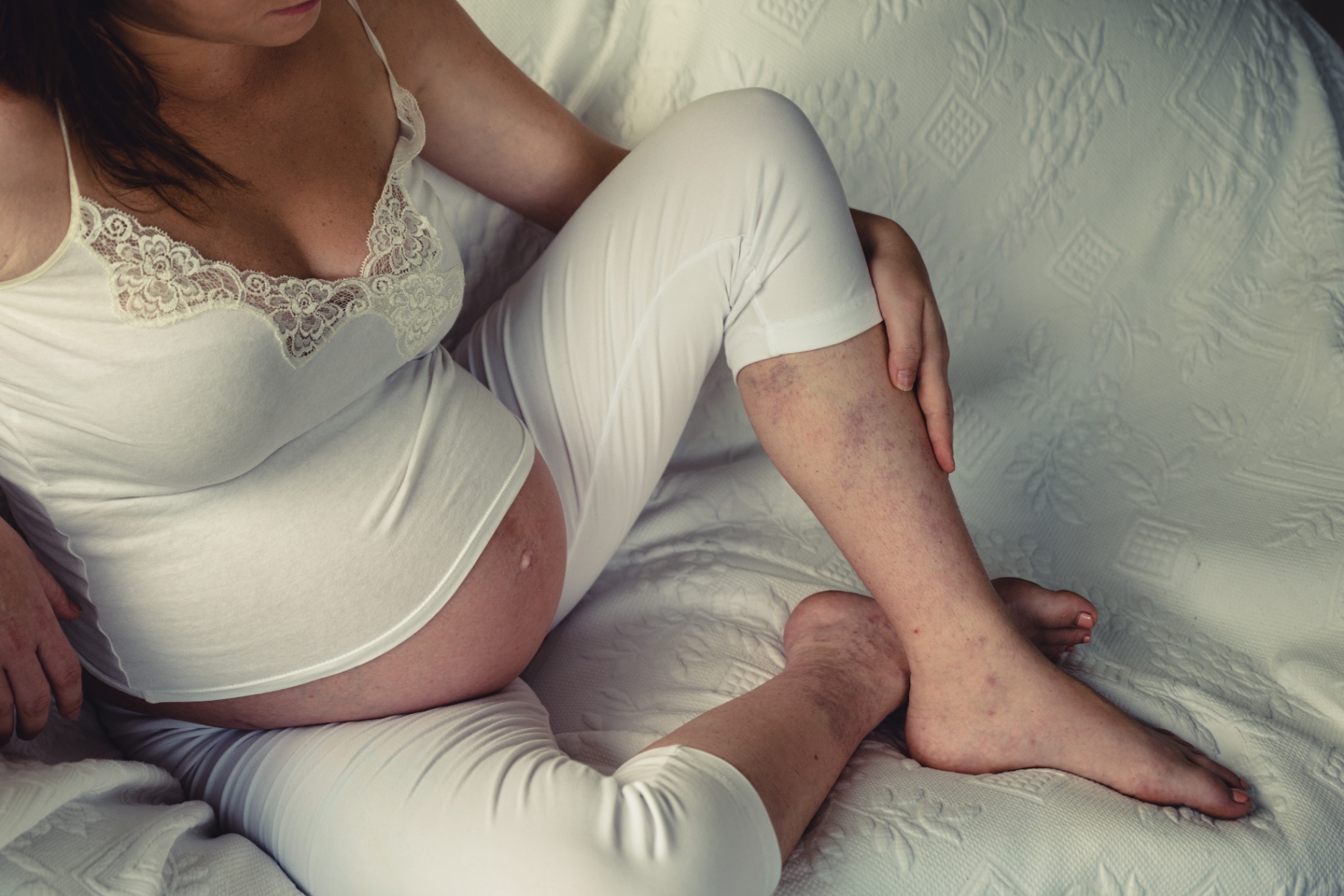
Visible varicose veins (varices) are common in pregnancy, and surveys report figures around a third of pregnant women. The numbers vary considerably between studies because populations and the way varicose veins are recorded differ, so they should be read as an order of magnitude rather than an individual risk [1,2]. For many, the condition worsens with subsequent pregnancies. The good news is that a large proportion of these changes disappear again after giving birth, and that both prevention and treatment are safe and effective.
Why do pregnant women get varicose veins more often?
Three factors work together:
- Increased blood volume. Blood volume rises considerably during a normal pregnancy, and that raises the pressure in the leg veins [3].
- Hormonal and circulatory changes. Changes in leg circulation can already be measured in the first trimester in healthy pregnant women [4]. Progesterone and oestrogen are assumed to make the vein wall more distensible, but the exact mechanism is not settled.
- Mechanical pressure. The growing uterus presses on the vena cava and pelvic veins, particularly on the right side, and impedes the return of blood from the legs [5].
In addition, there is a hereditary predisposition - if your mother or sister has varicose veins, your own risk increases significantly. Read more in Varicose veins and heredity.
Typical symptoms
- Heavy, tired legs at the end of the day
- Swelling around the ankles and feet
- Night cramps and restless legs
- Visible, winding veins on the thighs, calves and behind the knees
- Spider veins
- Vulval varicosities (varicose veins on the labia) - seen in a minority of pregnant women; the available series are small and uncertain [6]
- In rare cases: superficial blood clots (thrombophlebitis)
Please note: haemorrhoids are actually varicose veins in the blood vessels of the rectum - the same mechanism applies during pregnancy. Also read Haemorrhoids during pregnancy.
Prevention and relief
Almost everything can be done without medication or procedures:
- Compression stockings (Class 1-2) can be considered for symptom relief and are fitted individually. A Cochrane review of small pregnancy trials found no clear effect of external pneumatic compression on leg volume, and there is no good evidence that compression prevents new varicose veins in pregnancy [1]. An observational study in pregnant women found less pain and better quality of life with daily use [7]. Put them on in the morning before you get out of bed.
- Exercise: 30 minutes of walking daily activates the calf muscle pump.
- Elevate your legs above heart level for 15-20 minutes several times a day.
- Lie on your left side when you sleep - this relieves pressure on the vena cava.
- Avoid standing or sitting still for long periods without moving your feet.
- Weight management and a high-fibre diet help prevent both varicose veins and haemorrhoids.
What about medication? Phlebotonics (e.g. micronised diosmin/hesperidin) are used in chronic venous disease [8]. They have not been adequately studied in pregnancy, so we do not recommend them routinely while you are pregnant. Ask your doctor before taking any over-the-counter remedy for varicose veins during pregnancy.
When to contact a doctor
See a doctor if you have:
- A tender, red, and hard vein (possible superficial thrombophlebitis)
- A swollen, warm and painful leg can be a sign of deep vein thrombosis (DVT). In an older population-based study from Olmsted County, Minnesota, the overall incidence of venous thromboembolism (deep vein thrombosis or pulmonary embolism) during pregnancy or the first three months after delivery was about 2 per 1,000 woman-years. The risk was highest after delivery. The figure comes from the period 1966-1995 in a predominantly white US population and cannot be applied directly as a Danish or individual risk [9]
- Skin changes at the ankle (brownish discolouration, eczema or ulcers)
- Sudden heavy bleeding from a ruptured superficial vein
Acute shortness of breath or chest pain → call 112 (on suspicion of a pulmonary embolism).
Treatment after childbirth
Pregnancy-related varicose veins may lessen after delivery. The timing of assessment for possible treatment depends on when the changes have stabilised, the symptoms and the overall clinical assessment [10].
- A specialist can assess when the persistent need for treatment can be judged after delivery
- Breastfeeding, symptoms and the choice of method form part of the individual assessment before treatment
If symptoms or visible varicose veins persist, the following are offered:
- Doppler ultrasound to map valve function and reflux
- Endovenous Laser Treatment (EVLT) - a minimally invasive treatment with a high closure rate of the trunk vein after 5 years, with about 7 per cent recanalised in a Danish randomised trial, although new visible varicose veins appear in a proportion of patients within the same period [11]
- Sclerotherapy for smaller varicose veins and spider veins
- Only rarely, classic surgery
Will they return in a future pregnancy?
Yes, there is a risk. The risk of new varicose veins increases with the number of pregnancies, and some women with previous pregnancy-related varicose veins experience worsening in a subsequent pregnancy [12]. Treatment before a new pregnancy can therefore be a sensible option if symptoms are pronounced.
At our clinic, we are happy to see women who have been through a pregnancy for an ultrasound assessment and possible laser treatment after a GP referral. Questions about referral, cover and price are clarified with the clinic or your GP before treatment; see contact.
References
- Smyth RM, et al. Interventions for varicose veins and leg oedema in pregnancy. Cochrane Database Syst Rev 2015;(10):CD001066.
- Bamigboye AA, Smyth R. Interventions for varicose veins and leg oedema in pregnancy. Cochrane Database Syst Rev 2007;(1):CD001066.
- Hytten F. Blood volume changes in normal pregnancy. Clin Haematol 1985;14(3):601-12.
- Edouard DA, Pannier BM, London GM, Cuche JL, Safar ME. Venous and arterial behavior during normal pregnancy. Am J Physiol 1998;274(5):H1605-12. DOI: 10.1152/ajpheart.1998.274.5.H1605. PubMed
- Ikard RW, et al. The aetiology of varicose veins of pregnancy. Obstet Gynecol Surv 1972;27(11):753-63.
- Van Cleef JF. Pelvic and vulvar varicosities in pregnancy. Phlebolymphology 2011;18(3):126-32.
- Allegra C, Antignani PL, Will K, Allaert F. Acceptance, compliance and effects of compression stockings on venous functional symptoms and quality of life of Italian pregnant women. Int Angiol 2014;33(4):357-64. PMID: 25056167
- Mansilha A, Sousa J. Pathophysiological mechanisms of chronic venous disease and implications for venoactive drug therapy. Int J Mol Sci 2018;19(6):1669.
- Heit JA, et al. Trends in the incidence of venous thromboembolism during pregnancy or postpartum. Ann Intern Med 2005;143(10):697-706.
- Sparey C, et al. The effect of pregnancy on the lower-limb venous system of women with varicose veins. Eur J Vasc Endovasc Surg 1999;18(4):294-9.
- Rasmussen LH, et al. Randomized clinical trial comparing endovenous laser ablation, radiofrequency ablation, foam sclerotherapy and surgical stripping for great saphenous varicose veins. Br J Surg 2011;98(8):1079-87. PubMed (1-year results). Five-year follow-up: Lawaetz M, Serup J, Lawaetz B, et al. Comparison of endovenous ablation techniques, foam sclerotherapy and surgical stripping for great saphenous varicose veins. Extended 5-year follow-up of a RCT. Int Angiol 2017;36(3):281-8. PubMed
- Beebe-Dimmer JL, et al. The epidemiology of chronic venous insufficiency and varicose veins. Ann Epidemiol 2005;15(3):175-84.
More on this topic at Kirurgen.dk
Category: Varicose veins