
Anal fistula and abscess
Written and medically reviewed by Bahir Hadi, specialist in surgery, PhD
Published: 30 June 2026
Anal Fistula and Anal Abscess: When an Abscess Becomes Chronic
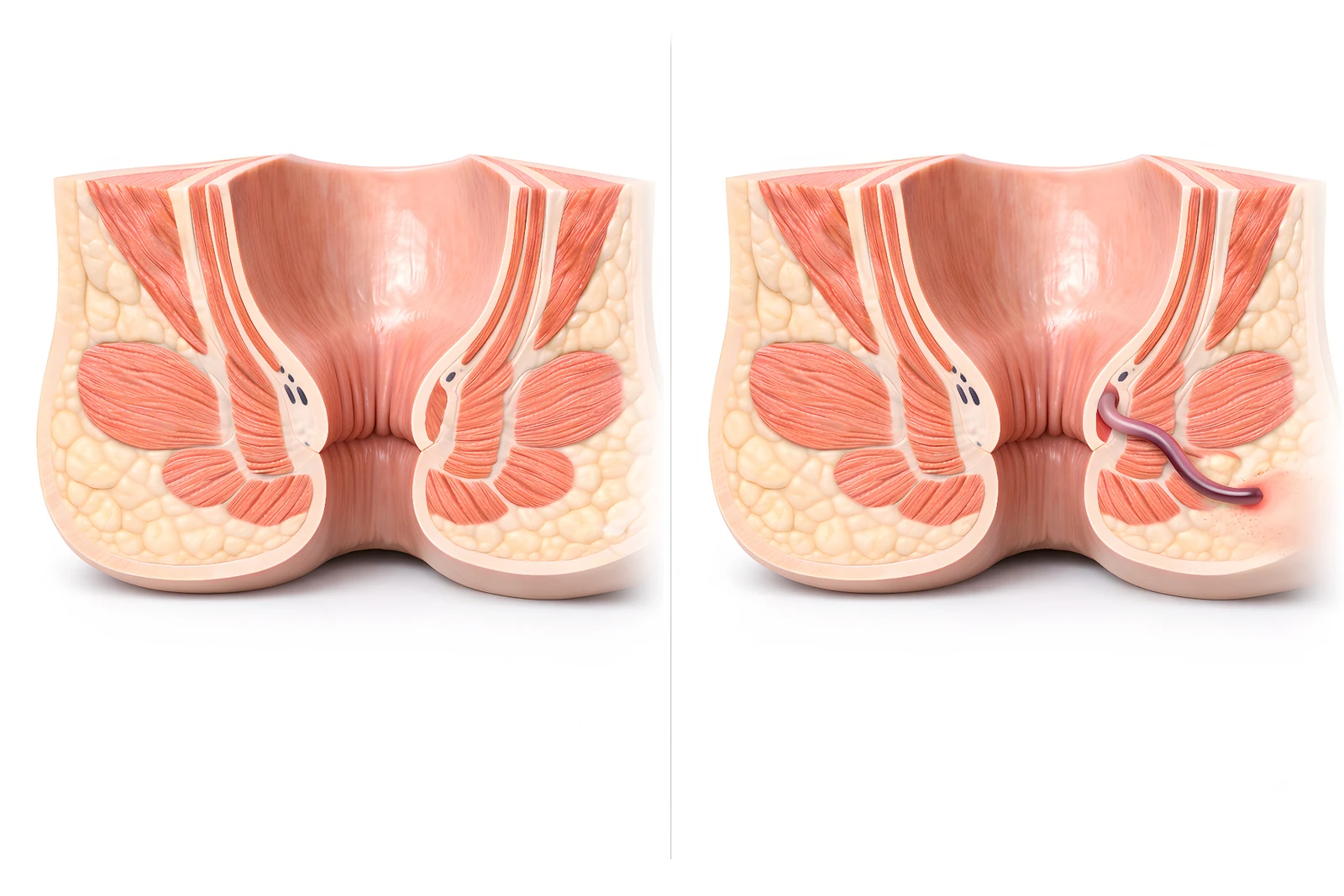
A perianal abscess (an abscess near the back passage) is one of the most painful acute conditions in the anal area. In a proportion of patients it subsequently develops into an anal fistula, a small chronic tunnel between the bowel and the skin [1,2]. The reported proportion varies between series because follow-up time, drainage technique and case mix differ. Early and correct treatment is crucial to avoid complications and preserve the function of the sphincter muscle.
What is an anal abscess?
An anal abscess occurs when one of the small glands in the anal canal (the glands of Hermann and Desfosses) becomes blocked and infected. Pus collects and forces its way through the surrounding tissue [3]. The result is a sudden, throbbing pain near the back passage, often accompanied by:
- A visible red and tender swelling near the anal opening
- Fever and generally feeling unwell
- Pain that worsens when sitting, coughing, or having a bowel movement
As a rule, perianal abscesses require surgical assessment and drainage [1,11]. Antibiotics alone are not recommended as the sole treatment; ASCRS states that adjunctive antibiotics may be considered in selected patients, for example with extensive cellulitis, immunosuppression or relevant cardiac disease [11]. The procedure is performed under a local or short general anaesthetic and provides almost immediate pain relief.
When does it become a fistula?
Even after successful drainage, the channel does not always heal. If the connection between the anal gland and the skin persists, an anal fistula is formed. Typical signs include:
- Persistent or recurrent discharge of pus/blood from the back passage
- A small opening in the skin (the fistula opening) that weeps
- Repeated abscesses in the same place
Fistulas are classified according to their path in relation to the sphincter muscle (the Parks classification: intersphincteric, transsphincteric, suprasphincteric, and extrasphincteric) [5]. This classification is crucial for choosing the correct treatment.
Investigation
The diagnosis is made by a clinical examination, often supplemented with:
- Endoanal ultrasound - quick and accurate in the hands of an experienced practitioner
- Pelvic MRI scan - the most important imaging test for complex, recurrent or Crohn's-related fistulas [6]
- Examination Under Anaesthetic (EUA) using methylene blue or hydrogen peroxide
It is important to rule out underlying conditions such as Crohn's disease, as the treatment strategy is different [7].
Surgical treatment
The treatment is chosen based on the fistula's path and the amount of sphincter muscle it crosses:
- Fistulotomy (laying open): One of the surgical techniques with the highest healing rates, but it is only used for low fistulas where a minimal amount of sphincter muscle is involved, as reported in long-term follow-up of patients operated on for low perianal fistulas [8].
- Seton (silicone drain): A draining seton keeps the fistula open so pus can escape. It is used for active infection or complex fistulas, often as a first step before definitive surgery, and does not damage the sphincter. A cutting seton is tightened gradually and slowly divides the sphincter; it is used more cautiously today because it can affect continence.
- LIFT procedure (Ligation of Intersphincteric Fistula Tract): A sphincter-preserving option for trans-sphincteric fistulas; healing rates vary considerably between studies, and the method is one of several sphincter-preserving options in the American ASCRS guidelines [11].
- Advancement flap: Closes the internal opening with a flap of bowel lining; used for high fistulas.
- Fibrin glue and fistula plug: Healing rates vary widely between small studies and are lower overall than with surgery [10]. On the other hand the sphincter is not divided, so the risk of incontinence is limited.
The choice of method is a balance between the chance of healing and the risk of incontinence - and should always be made by a colorectal surgeon with experience in treating anal fistulas.
What you can do
- See a doctor for any persistent pain, swelling, or discharge of pus from the back passage
- Avoid home treatment with warm compresses if you suspect an abscess - this will delay drainage
- Attend a follow-up appointment after an abscess has been drained, so that any potential fistula is detected early
At the clinic we offer examination, ultrasound and surgical treatment of anal fistulas after a GP referral. Questions about referral, cover and price are clarified with the clinic or your GP before treatment; see contact.
References
- Sahnan K, et al. Perianal abscess. BMJ 2017;356:j475 (clinical review, not a guideline). doi:10.1136/bmj.j475
- Vasilevsky CA, Gordon PH. The incidence of recurrent abscesses or fistula-in-ano following anorectal suppuration. Dis Colon Rectum 1984;27(2):126-30.
- Parks AG. Pathogenesis and treatment of fistula-in-ano. BMJ 1961;1(5224):463-9.
- Sözener U, et al. Does adjuvant antibiotic treatment after drainage of anorectal abscess prevent development of anal fistulas? Dis Colon Rectum 2011;54(8):923-9.
- Parks AG, Gordon PH, Hardcastle JD. A classification of fistula-in-ano. Br J Surg 1976;63(1):1-12.
- Halligan S, Stoker J. Imaging of fistula in ano. Radiology 2006;239(1):18-33. PubMed
- Schwartz DA, Lightner AL, Aswani-Omprakash T, Kotze PG, McCurdy JD. Better Together: Implementing a Multidisciplinary Approach to Optimizing Diagnosis and Management of Crohn's Perianal Fistulas. Gastroenterology 2025;168(4):640-644. PubMed
- Göttgens KW, et al. Long-term outcome of low perianal fistulas treated by fistulotomy. Int J Colorectal Dis 2015;30(2):213-9.
- Emile SH, et al. A systematic review and meta-analysis of the LIFT procedure. Int J Surg 2018;52:191-202.
- Cirocchi R, et al. Fibrin glue in the treatment of anal fistula: a systematic review. Ann Surg Innov Res 2009;3:12.
- Gaertner WB, et al. The American Society of Colon and Rectal Surgeons Clinical Practice Guidelines for the Management of Anorectal Abscess, Fistula-in-Ano, and Rectovaginal Fistula. Dis Colon Rectum 2022;65(8):964-985. doi:10.1097/DCR.0000000000002473
More on this topic at Kirurgen.dk
Category: Anal surgery