
Pancreatitis
Written and medically reviewed by Bahir Hadi, specialist in surgery, PhD
Pancreatitis: acute and chronic - symptoms, causes and treatment
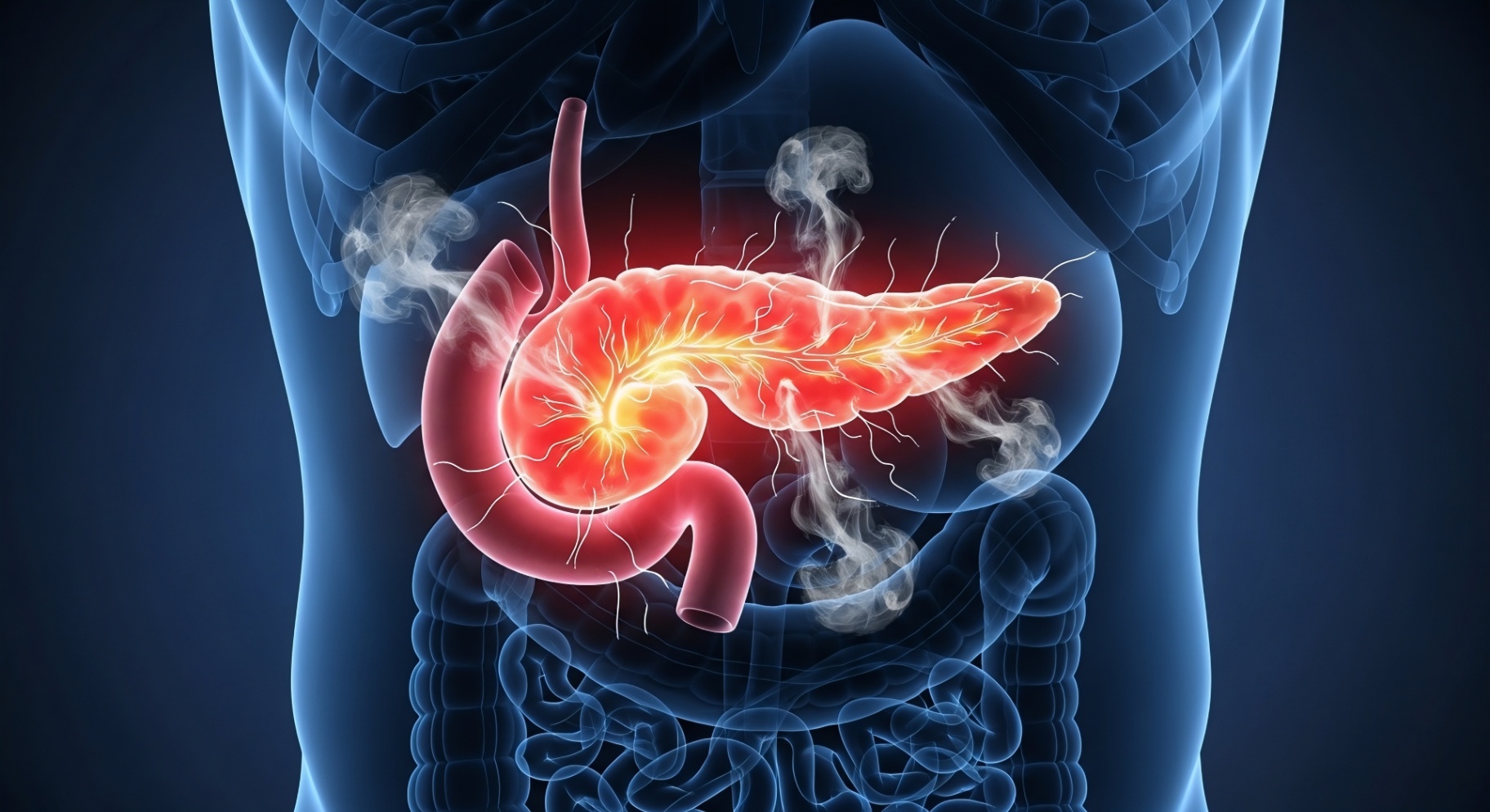
Pancreatitis is an inflammatory condition of the pancreas, in which the gland's own digestive enzymes are activated prematurely and begin to digest the pancreatic tissue itself. The condition exists in two forms with very different courses and prognoses, and they are treated differently. This article covers them separately.
- Acute pancreatitis - typically starts suddenly and can be life-threatening in the most severe cases, but most cases are mild and resolve without complications. In a Welsh (UK) cohort of 10,589 hospitalised cases from 1999-2010, the overall incidence was 30.0 per 100,000 per year, rising from 27.6 to 36.4 per 100,000 over the period [1]
- Chronic pancreatitis - persistent damage with gradual loss of function over time
The two main causes - "I GET SMASHED"
| Cause | Share | Note |
|---|---|---|
| Gallstones | the most common cause [4] | More frequent in women |
| Alcohol | second most common cause [4] | Most common cause of chronic pancreatitis |
| Hypertriglyceridaemia | less common cause [4] | Markedly raised triglycerides; the cut-off is assessed by the treating doctor |
| ERCP-related | uncommon, more frequent with known risk factors [4] | Procedure complication |
| Medication | uncommon cause | In rare cases medication can be part of a possible explanation. The doctor assesses the specific medicine and the timing. Never stop your medicine on your own without discussing it with your doctor first |
| Autoimmune | rare cause | IgG4-related disease |
| Genetic | rare cause | PRSS1, SPINK1, CFTR mutations. Mainly considered with recurrent episodes or early-onset disease |
| Idiopathic | a smaller but not negligible share [4] | No identifiable cause despite investigation |
| Cancer | uncommon but important cause | Pancreatic cancer can present as pancreatitis, especially in adults over 40 with no other explanation |
Acute pancreatitis
Symptoms
- Sudden, severe pain in the upper abdomen (epigastrium), often radiating to the back
- The pain often worsens with meals. Some patients find that leaning forward brings slight relief, but this is far from universal and is not a reliable sign for deciding whether you have pancreatitis
- Nausea and vomiting
- Fever, palpitations, rapid breathing
- The course varies. Some people have an uncomplicated course, while others develop severe disease with circulatory compromise or organ failure, which requires urgent hospital treatment
Diagnosis
The diagnosis is made by a doctor and requires at least 2 of 3 criteria in the international Atlanta classification [2]:
- Characteristic abdominal pain in the upper abdomen, often radiating to the back
- Serum lipase or amylase at least 3 times the upper limit of normal
- Characteristic imaging findings (CT, MRI or ultrasound)
The criteria are a tool for healthcare professionals during the acute assessment, not a self-test. With sudden, severe abdominal pain, call 112 if there are signs of a life-threatening condition (for example fainting, persistent vomiting, a very rapid pulse or breathing rate, or marked paleness and cold sweats). In other cases, contact the acute helpline (1813 in the Capital Region of Denmark, otherwise your local out-of-hours GP service) rather than waiting for test results or trying to classify yourself.
CT or MRI is not used routinely at the first assessment if the diagnosis is already clear clinically and biochemically. Imaging is reserved for, among other things, diagnostic uncertainty, suspected complications or lack of clinical improvement after about 48-72 hours [4].
Severity according to Atlanta [2]:
- Mild: no organ failure and no local or systemic complications
- Moderately severe: transient organ failure lasting less than 48 hours and/or local or systemic complications
- Severe: persistent organ failure lasting more than 48 hours
Severity can only be finally determined once the course is known, because it depends on how long any organ failure lasts. Organ failure is defined in Atlanta using the modified Marshall score for the respiratory, circulatory and renal systems. That score belongs to the classification itself and should not be confused with BISAP or APACHE-II.
Atlanta also distinguishes between two forms: interstitial oedematous pancreatitis, where the gland is swollen and inflamed without tissue death, and necrotising pancreatitis, where there is necrosis in the pancreatic tissue and/or the surrounding fat. The two forms are kept separate because the course and complications differ.
Atlanta is an international consensus classification of diagnosis, severity and complications. It is not in itself a treatment guideline, and treatment decisions are based on separate guidelines [3,4,5]. BISAP and APACHE-II are independent risk scores used in hospital settings for early risk assessment; they are not part of the Atlanta classification.
Treatment
Treatment of acute pancreatitis takes place in hospital, and the specific choices (fluids, pain relief, nutrition, possible antibiotics and timing of procedures) are decided individually by the treating team based on severity and course. The overall principles are described below, not a fixed recipe.
In mild acute pancreatitis, hospital admission is normally required, even if brief. An outpatient course occurs rarely and only in clearly mild disease.
- Fluid therapy. The patient receives intravenous fluids, and the amount is adjusted on an ongoing basis based on pulse, blood pressure, urine output and oxygen requirement. The WATERFALL trial (NEJM 2022) compared a more aggressive and a more moderate fluid strategy in acute pancreatitis and found more cases of fluid overload with the aggressive approach without any improvement in outcome. This has contributed to many departments today emphasising ongoing, individual adjustment rather than a fixed, large fluid volume, but the specific strategy is assessed by the treating doctor from hour to hour [3,4,5]
- Pain management is given as needed and adjusted along the way. Pain relief during admission is given individually and adjusted continuously by the treating team based on the severity of pain and the patient's response
- Nutrition is typically resumed early, as soon as the patient can tolerate it. Strict fasting "to rest the gland" is no longer routine, but the pace is agreed individually [3,4]
- Antibiotics are not given routinely to prevent infection in dead tissue (necrosis) without signs of infection. Antibiotics are used when infection is proven or strongly suspected [4,5]
When the cause is known, this is factored into the overall plan, but this too is decided individually:
- Gallstones: in mild gallstone-related pancreatitis, guidelines generally recommend that removal of the gallbladder (cholecystectomy) is performed during the same admission, when the condition allows it, to reduce the risk of new episodes. Urgent ERCP (endoscopic examination of the bile ducts) is not used routinely without signs of infection in the bile ducts or persistent blockage, but is relevant in those cases [4]
- Alcohol: if alcohol is assessed to be the cause, guidelines recommend complete abstinence from alcohol to reduce the risk of new episodes. The treating team will typically discuss this with the patient and offer referral to cessation support or other relevant help
- Hypertriglyceridaemia: with severely raised triglycerides, treatment is assessed individually by hospital specialists based on severity. This is not standard treatment for milder elevations [4]
In severe pancreatitis, the patient is monitored closely, often in an intensive care unit. If a larger collection of dead tissue (necrosis) develops that needs draining, this happens at a time assessed individually by the treating team. As a general rule, the collection is allowed to mature and become walled off, which typically takes some weeks, but this is a clinical judgement, not a fixed calendar date.
Complications
Atlanta defines four distinct types of collection, which must not be confused [2]:
- Acute peripancreatic fluid collection (APFC) - fluid around the gland within the first 4 weeks in interstitial oedematous pancreatitis, without necrosis and without its own wall
- Pseudocyst - a mature, encapsulated collection with a well-defined wall, containing fluid without solid necrotic material. It usually develops after about four weeks; this describes maturation, not a fixed calendar cut-off
- Acute necrotic collection (ANC) - within the first 4 weeks in necrotising pancreatitis; contains both fluid and necrotic tissue
- Walled-off necrosis (WON) - a mature, encapsulated collection with a defined wall, containing necrotic material and associated with necrotising pancreatitis. It usually develops after about four weeks, without this being a fixed calendar cut-off
Other complications:
- Infection in the necrosis - can cause sepsis and requires urgent hospital treatment
- Splanchnic vein thrombosis
- Organ failure affecting circulation, lungs or kidneys
Chronic pancreatitis
Chronic pancreatitis is a different disease from acute pancreatitis, even though the names are similar. It is a long-term, gradual injury to the gland, and it is not treated according to the same plan as an acute episode. The two conditions are therefore covered completely separately here.
Symptoms
- Recurrent or persistent abdominal pain. In some patients, the pain decreases over many years while the disease and loss of gland function continue; this does not apply to everyone, and the pain pattern varies greatly between individuals
- Weight loss
- Steatorrhoea (fatty, foul-smelling stools) - can be a sign of exocrine insufficiency (reduced production of digestive enzymes)
- Type 3c diabetes mellitus - can develop when the gland's insulin-producing cells are also affected
- Signs of fat-soluble vitamin deficiency (A, D, E, K) can occur with marked exocrine insufficiency
Diagnosis
The work-up is arranged individually by the treating department and may include:
- Imaging: CT, MRCP or endoscopic ultrasound (EUS). The three methods each have their strengths, and the choice depends on the question to be answered; EUS can in some contexts detect early changes that CT and MRI miss, but it is not unequivocally "most sensitive" in every respect and is not used instead of the other methods
- Assessment of exocrine function, for example faecal elastase-1. A low value supports suspicion of exocrine insufficiency, but the result must always be interpreted together with symptoms and other findings, and a single cut-off value does not decide the diagnosis alone
- Blood tests, which may include HbA1c (diabetes screening) and assessment of nutritional status when clinically relevant
Treatment
Treatment of chronic pancreatitis is arranged individually and on an ongoing basis by the treating department, often in collaboration between several specialties. There is no single fixed algorithm that fits everyone, and the following is therefore a description of the types of measures that may come into play, not an instruction [6].
- Pain management is tailored to the individual patient and may include several different types of pain medication, chosen and adjusted over time by the doctor. In some patients, where the pain has a nerve-related component, certain medications for nerve pain may be considered; this is an individual medical judgement
- Endoscopy or surgery may be relevant if there is narrowing of the pancreatic duct or stones in the duct contributing to the pain. Whether and when this is offered is decided by specialists based on imaging and the symptom picture
- Treatment of exocrine insufficiency: if a deficiency in digestive enzymes is proven or clinically likely, enzyme supplementation may be considered. Dosing is set individually by the treating doctor. This is not a routine treatment given to everyone after an episode of acute pancreatitis or without evidence of insufficiency
- Vitamin status is monitored in patients with signs of exocrine insufficiency, and any supplementation of fat-soluble vitamins is assessed individually
- Diabetes, if it develops, is treated according to the same principles as other forms of diabetes, and the choice of treatment, including possible insulin, is decided by the treating doctor based on blood sugar levels and other illness
On lifestyle: Alcohol and smoking are both associated with the development and worsening of chronic pancreatitis, and advice on stopping is a standard part of treatment. If alcohol is the cause, the guidelines recommend complete abstinence, as after alcohol-induced acute pancreatitis. How much this matters for an individual's course, and what is realistic to achieve, varies from patient to patient, and this is something to discuss with your doctor rather than a fixed rule. Observational studies suggest that continued smoking is associated with faster disease progression in some patients, but the association is not the same for everyone [6]. Diet is adjusted individually, often in consultation with a dietitian, rather than a fixed diet plan for everyone.
When should you seek medical care immediately?
Acute pancreatitis can become severe. Call 112 if there are signs of severe illness or altered consciousness. In other cases, contact the acute helpline (1813 in the Capital Region of Denmark, otherwise your local out-of-hours GP service) for:
- Sudden, severe abdominal pain radiating to the back
- Persistent vomiting plus abdominal pain
- Pale, cold and sweaty patient (shock)
- Jaundice plus abdominal pain (suspected cholangitis)
Investigation at Kirurgen.dk
We investigate unexplained chronic upper abdominal pain with oral or nasal gastroscopy and refer for imaging (CT/MRCP/EUS) when there is clinical or biochemical suspicion of pancreatitis. Acute pancreatitis is treated in hospital, and an appointment with us is not an alternative: with sudden, severe abdominal pain, call 112 for life-threatening symptoms, otherwise the acute helpline (1813 in the Capital Region of Denmark or your local out-of-hours service). See also: Peptic ulcer, GERD, Bile acid malabsorption, Chronic abdominal pain.
References
- Roberts SE, Akbari A, Thorne K, Atkinson M, Evans PA. The incidence of acute pancreatitis: impact of social deprivation, alcohol consumption, seasonal and demographic factors. Aliment Pharmacol Ther 2013;38(5):539-48. DOI: 10.1111/apt.12408. PubMed
- Banks PA, Bollen TL, Dervenis C, et al. Classification of acute pancreatitis - 2012: revision of the Atlanta classification and definitions by international consensus. Gut 2013;62(1):102-111. DOI: 10.1136/gutjnl-2012-302779. PubMed International consensus classification of diagnosis, severity, disease forms and collection types. Not a treatment guideline.
- Crockett SD, Wani S, Gardner TB, Falck-Ytter Y, Barkun AN. American Gastroenterological Association Institute guideline on initial management of acute pancreatitis. Gastroenterology 2018;154(4):1096-101. DOI: 10.1053/j.gastro.2018.01.032. PubMed
- Tenner S, Vege SS, Sheth SG, et al. ACG clinical guideline: management of acute pancreatitis. Am J Gastroenterol 2024;119(3):419-437. doi:10.14309/ajg.0000000000002645
- de-Madaria E, Buxbaum JL, Maisonneuve P, et al. Aggressive or moderate fluid resuscitation in acute pancreatitis (WATERFALL). N Engl J Med 2022;387(11):989-1000. doi:10.1056/NEJMoa2202884
- Löhr JM, Dominguez-Munoz E, Rosendahl J, et al. United European Gastroenterology evidence-based guidelines for the diagnosis and therapy of chronic pancreatitis (HaPanEU). United European Gastroenterol J 2017;5(2):153-199. DOI: 10.1177/2050640616684695. PubMed
More on this topic at Kirurgen.dk
Category: Gastrointestinal