
Acid Reflux (GERD)
Written and medically reviewed by Bahir Hadi, specialist in surgery, PhD
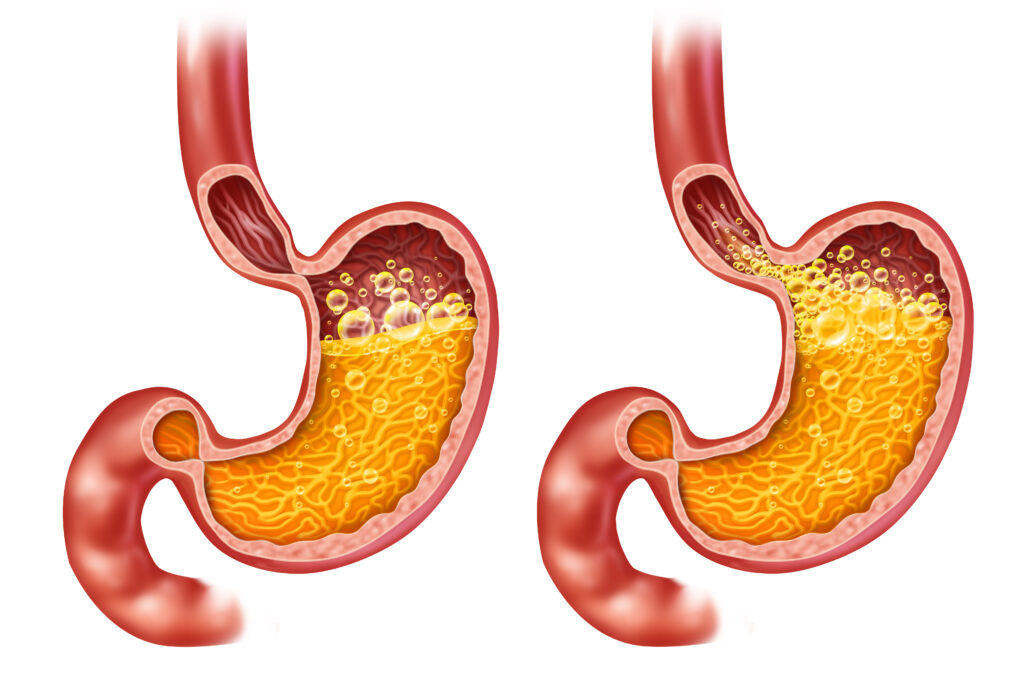
🔥 When Stomach Acid Travels the Wrong Way: A Guide to GERD (Reflux)
Do you often have a burning sensation in your chest after a meal? Do you experience acid regurgitation or an unpleasant taste in your mouth, especially when lying down? You are not alone. These symptoms can be signs of Gastro-oesophageal Reflux Disease (GERD) - one of the most common digestive disorders in the Western world.
GERD is more than just common occasional heartburn. It is a chronic condition that occurs when stomach acid repeatedly flows back from the stomach into the food pipe (oesophagus).
What is GERD, and Why Does It Happen?
Between your oesophagus and your stomach sits a ring-shaped muscle called the lower oesophageal sphincter (LOS).
The LOS acts as a one-way valve:
- Normally: It relaxes to let food pass into the stomach and closes immediately and tightly to prevent stomach contents from flowing back.
- In GERD: The LOS muscle becomes weak or opens inappropriately, allowing stomach acid to flow up into the oesophagus.
The lining of the oesophagus is not designed to withstand strong stomach acid. When this happens frequently, irritation and inflammation can develop in the lining, and this is thought to contribute to the symptoms. Symptoms and mucosal findings do not always match: many people have troublesome reflux without visible changes, and some have changes with few symptoms [1].
🛑 The Most Common Symptoms of GERD
The classic symptoms of GERD are primarily digestive-related, but the condition can also cause atypical symptoms:
Classic Symptoms
- Heartburn (pyrosis): A burning sensation behind the breastbone that often radiates up towards the throat. Symptoms typically worsen after meals, during heavy lifting, or when lying down.
- Acid regurgitation: The backflow of acid fluid or undigested food into the throat or mouth.
Atypical/Extra-oesophageal Symptoms
- Chronic cough or hoarseness.
- Feeling of a lump in the throat (globus sensation).
- Chest pain, which can be mistaken for heart pain - NB: If you have sudden chest pain with shortness of breath, radiating pain, or feel seriously unwell, call emergency services (112).
- Difficulty swallowing (dysphagia) or pain when swallowing (odynophagia).
When should you see a doctor?
Call 112, the Danish emergency number, for sudden chest pain with breathlessness, pain radiating to the arm or jaw, or if you feel seriously unwell. This can be a heart problem and should not be worked out as reflux on your own.
Vomiting blood and black, tarry stools are not something to wait out. Seek urgent medical help straight away. Call the emergency number (112 in Denmark) for heavy bleeding or signs of circulatory compromise such as faintness, pallor, palpitations or collapse. Smaller amounts of blood in vomit, or black, tarry stools without those signs, still require urgent medical assessment the same day.
See a doctor within a short time for difficulty swallowing, pain on swallowing, unintended weight loss or anaemia. New and persistent reflux symptoms should also be assessed, particularly if you are over 45, or if a familiar symptom pattern has clearly changed.
🔎 Which Factors Increase the Risk?
Several factors are associated with GERD, typically because they increase pressure in the abdomen or affect LOS function. It is rarely possible to identify a single cause in an individual.
| Associated Factors | Explanation |
|---|---|
| Overweight/Obesity | Increased fatty tissue on the abdomen puts constant pressure on the stomach and the sphincter. |
| Hiatus Hernia | Part of the stomach slides up through an opening in the diaphragm, which can affect the LOS. A hiatus hernia is a finding, not in itself the explanation for all symptoms. |
| Pregnancy | Hormonal changes and increased pressure from the foetus. |
| Smoking | The ACG guideline makes a conditional recommendation to avoid tobacco in people with reflux symptoms. Nicotine weakening the lower oesophageal sphincter is a mechanistic hypothesis, not an established explanation. |
| Alcohol | The benefit of avoiding alcohol is weakly documented and the mechanism is not settled. There is no basis for a universal claim about alcohol. |
| Certain foods or drinks | These can trigger symptoms in some people, but there is no universal list of banned foods. It is reasonable to limit what reproducibly causes symptoms for the individual and to avoid unnecessarily broad dietary restrictions. |
| Late/Large Meals | Eating close to bedtime or consuming very large quantities of food can lead to more reflux in some people. |
Work-up: which test answers which question?
GERD is often a clinical diagnosis, and the different tests each answer their own question [1]:
- Gastroscopy shows whether there is oesophagitis, a stricture or Barrett's oesophagus, and allows biopsies. A normal gastroscopy does not rule out GERD - most people with reflux have a normal-looking lining.
- 24-hour pH or pH-impedance monitoring documents how much acid and non-acid reflux occurs and whether your symptoms coincide with reflux episodes. This is the test that objectively confirms reflux when the diagnosis is uncertain or treatment is not working.
- High-resolution manometry assesses oesophageal muscle function and is used to exclude motility disorders such as achalasia before any surgery.
The meta-analysis of 34 studies with 6,659 patients compared technical feasibility and patient tolerance, not diagnostic accuracy. For the thinnest transnasal scopes below 5.9 mm the technical success rate was on a par with conventional gastroscopy, and more patients preferred the nasal route. The study therefore does not show that the two routes give the same diagnostic yield. What can be seen, biopsied and treated depends on scope diameter and working channel, on the indication and on the individual patient, and the choice is made together with the doctor.
Surgical or endoscopic anti-reflux treatment (fundoplication and similar) is only considered once reflux is objectively documented, and patients are selected individually after manometry and an overall assessment at a specialist centre [1].
Source: Katz PO, et al. ACG Clinical Guideline for the Diagnosis and Management of Gastroesophageal Reflux Disease. Am J Gastroenterol 2022;117(1):27-56. PubMed · full text
Treatment and lifestyle
In GERD, treatment can aim to reduce acid reflux and to soothe the irritation of the oesophageal lining. Which measures are relevant is assessed individually.
- Lifestyle measures
According to the ACG clinical guideline (Katz et al., 2022), individual lifestyle measures have varying and often low levels of evidence, and there is no single measure that works for everyone. The choice depends on the individual's symptom pattern:
- Weight loss: In people who are overweight, weight loss is the lifestyle measure with the strongest evidence according to the ACG guideline and can reduce symptoms.
- Elevating the head of the bed and avoiding late meals: For nocturnal symptoms, the ACG makes a conditional recommendation to raise the head of the bed and to avoid meals within 2-3 hours of bedtime. The level of evidence is low, and the explanation is not increased acid production.
- Diet: Certain foods or drinks can trigger symptoms in some people, but there is no universal list of banned foods. The ACG makes a conditional, low-evidence recommendation to avoid the trigger foods an individual can recognise for themselves. It is reasonable to limit what reproducibly causes symptoms and to avoid unnecessarily broad dietary restrictions.
- Smoking cessation: The ACG makes a conditional recommendation to avoid tobacco in people with reflux symptoms. The evidence is low, and the benefit is not the same for everyone.
- Medical Treatment
Depending on the severity and frequency of symptoms, your doctor may recommend:
- Antacids and barrier agents: May be used for mild and sporadic heartburn. They neutralise stomach acid or form a barrier on top of the stomach contents (e.g., alginates). Use should be discussed with a doctor or pharmacist.
- Acid suppressants (PPIs - proton pump inhibitors): This drug class reduces acid production. The choice of drug, dose and length of treatment is a medical decision based on findings and symptoms; there is no single fixed course that suits everyone. Prescribed medication should not be changed or stopped without agreement with your doctor.
Key Takeaways
- GERD (Gastro-oesophageal Reflux Disease) is a chronic condition where stomach acid flows back into the oesophagus and can cause unpleasant symptoms.
- Classic symptoms include heartburn and acid regurgitation, while atypical symptoms can include chronic cough, chest pain, and difficulty swallowing.
- Factors such as obesity, pregnancy, and certain foods can increase the risk of GERD.
- Specific lifestyle measures, particularly weight loss for those who are overweight, have the strongest evidence, while elevating the head of the bed for nocturnal symptoms can also be considered; diet is adjusted individually to the trigger foods a person can recognise for themselves, and there is no universal list of banned foods.
- Medical treatment options include antacids and acid suppressants, which may reduce acid production; the choice and duration are agreed with a doctor.
Estimated reading time: 4 Minutes
Table of Contents
Reflux and related conditions
Reflux symptoms overlap with several other conditions of the oesophagus and stomach. What is relevant to look into depends on the symptom pattern and an overall medical assessment.
- Difficulty swallowing - when food or drink sticks, or swallowing hurts.
- Peptic ulcer and Helicobacter pylori - pain in the upper abdomen.
- Barrett's oesophagus - a change in the lining of the oesophagus that can be seen at gastroscopy.
- Eosinophilic oesophagitis - allergy-related inflammation of the oesophagus.
- Proton pump inhibitors (PPI) - how the medicines work and what is worth knowing about their use.
When can an examination be relevant?
With long-lasting or treatment-resistant reflux symptoms, further investigation may come into the picture. What is relevant depends on the symptom pattern, any alarm features and an overall medical assessment. Gastroscopy is not a routine examination for reflux symptoms alone.
See also
Eosinophilic oesophagitis (EoE) · Helicobacter pylori breath test · Peptic ulcer
More on this topic at Kirurgen.dk
Category: Gastrointestinal