
Diverticula of the bowel
Written and medically reviewed by Bahir Hadi, specialist in surgery, PhD
Diverticula of the bowel: what they are, when they become dangerous, and how to investigate them
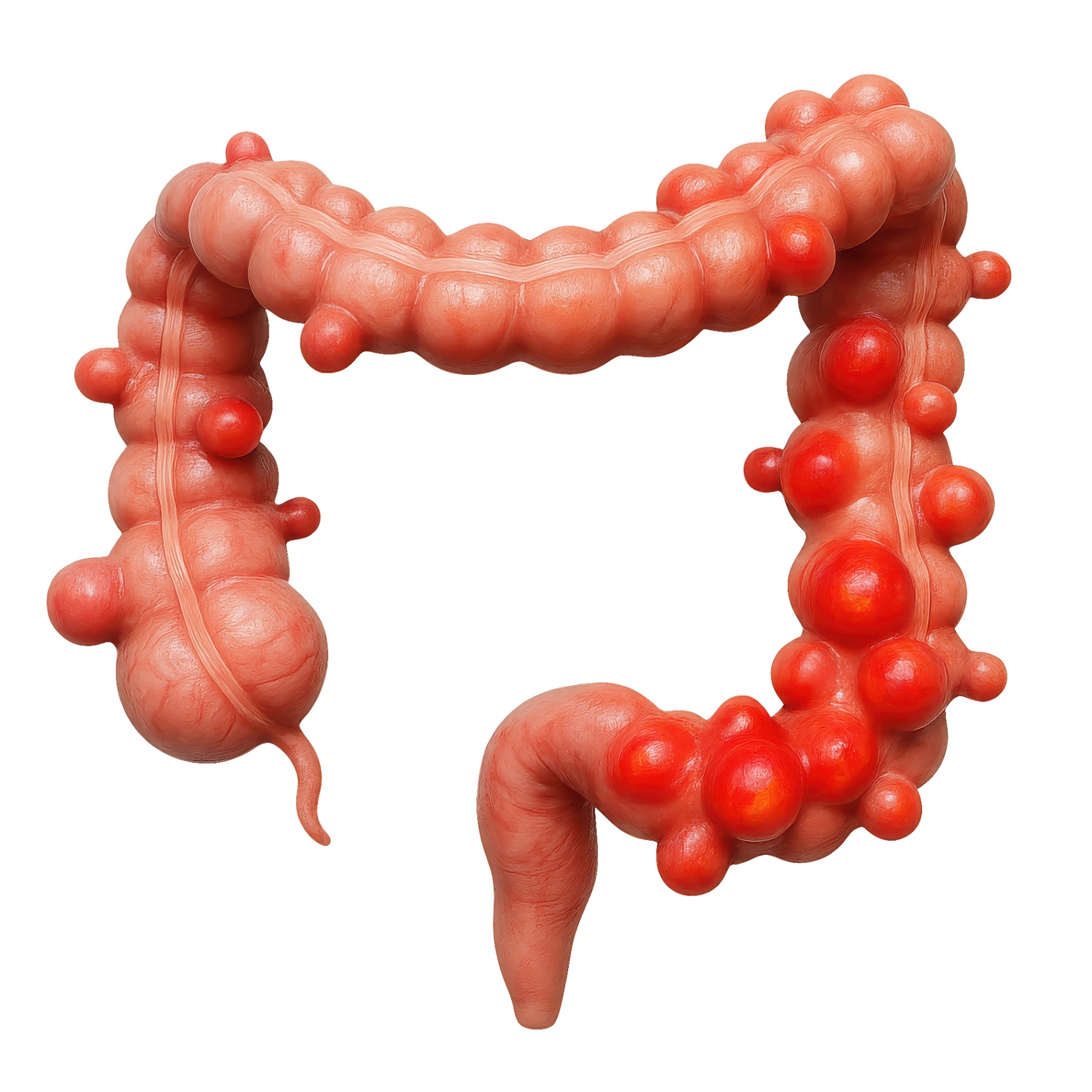
Diverticula (or "pouches on the bowel") are small sacs in the intestinal wall that bulge outward through weak spots - typically in the left side of the colon (sigmoid colon). Prevalence increases sharply with age: diverticula are uncommon before the age of 40 and very common in older people in Western countries. Reported proportions vary considerably between studies and detection methods [1]. Most people with diverticula are unaware - the condition is asymptomatic and called diverticulosis. Only when a diverticulum becomes inflamed do we speak of diverticulitis.
Three stages - important distinction
| Stage | Description | Symptoms | Treatment |
|---|---|---|---|
| Diverticulosis | Diverticula present, no inflammation | None, or mild bloating | High-fibre diet |
| Symptomatic uncomplicated diverticular disease (SUDD) | Persistent abdominal symptoms in a person with diverticula, without objective signs of inflammation. The concept is debated because the border with irritable bowel syndrome is blurred | Left lower quadrant pain, altered bowel habit | Diet; drug treatment is not standard |
| Diverticulitis | Acute inflammation of one or more diverticula | Pain, fever, tenderness, raised CRP | Antibiotics, possibly surgery |
Why do diverticula form?
Classical theory: low fibre intake → hard stool → raised intraluminal pressure → outpouching through weak points where blood vessels perforate the muscle layer. Newer research also points to:
- Genetics: In a Swedish twin study of patients hospitalised with diverticular disease, heritability was estimated at 40 % [2].
- Altered gut flora: differences in bacterial composition around diverticula have been described, but this is a research association rather than a proven cause in the individual patient.
- Connective tissue weakness: more frequent in Ehlers-Danlos, Marfan.
- Medication: NSAIDs and opioids raise the risk of complications.
Symptoms
Uncomplicated diverticulosis often produces no symptoms. When symptoms occur:
- Abdominal pain - typically left lower quadrant, intermittent, often worse after meals, relieved by defecation.
- Altered bowel habit - alternating constipation and diarrhoea.
- Bloating and flatulence.
- Rectal bleeding - sudden, painless, red blood (diverticular bleed).
Alarm symptoms requiring urgent assessment:
- Persistent fever above 38.5 °C
- Severe, worsening abdominal pain
- Board-like abdomen (peritonitis from perforation)
- Major rectal blood loss
- Sudden cessation of gas/stool passage (suspected obstruction)
Work-up
- History and clinical examination - palpation, rectal exam, temperature.
- Blood tests - white cell count, CRP, haemoglobin.
- Colonoscopy - not performed in the acute phase. After CT-proven uncomplicated diverticulitis, managed non-operatively, WSES 2020 does not recommend routine early colonic evaluation (weak recommendation, 2B). This applies to that specific group only. After a diverticular abscess managed non-operatively, early colonic evaluation at 4-6 weeks is suggested (2C), and colonoscopy is also performed when the diagnosis is uncertain or there are other clinical signs of colorectal cancer [7].
- CT abdomen with contrast - primary imaging for suspected acute diverticulitis. Assesses complications (abscess, fistula, perforation).
- Sigmoidoscopy - alternative for focal sigmoid symptoms.
Treatment
Asymptomatic diverticulosis:
- No active treatment.
- Whole grains, vegetables and legumes may form part of general dietary advice. Evidence does not show that one fixed daily fibre target prevents complications in everyone with asymptomatic diverticulosis.
- Adequate fluid intake and regular exercise.
Symptomatic without inflammation (SUDD):
SUDD describes persistent abdominal symptoms in a person with known diverticula, without objective signs of inflammation. It is a debated concept: the criteria are not uniform and the symptoms overlap with irritable bowel syndrome. There is no established standard treatment.
- Dietary modification - fibre, reduce red meat.
- Mesalazine (oral 5-ASA modified-release preparations) has been studied for persistent symptoms. Evidence: the trials are small and conflicting, no reliable effect has been shown, and mesalazine is not standard treatment for SUDD. Danish approval status (separate from the evidence): mesalazine is approved for ulcerative colitis, and for some preparations Crohn's disease, but not for diverticular disease, so use here falls outside the approved indication and is decided by the treating doctor.
- Rifaximin in cyclical courses has been studied in symptomatic uncomplicated diverticular disease with a moderate effect on symptoms. In Denmark rifaximin is marketed as Xifaxan film-coated tablets in two strengths with separate approved indications: 550 mg for reducing recurrence of overt hepatic encephalopathy in patients aged 18 and over, and 200 mg for treating adults with travellers' diarrhoea caused by non-invasive enteric pathogens. The 200 mg product summary also states that it must not be used in travellers' diarrhoea complicated by fever or bloody stools. The indications cannot be transferred between the two strengths. Use in symptomatic diverticular disease is therefore off-label, and dose and duration are decided by the treating doctor. The effect on symptoms rests on a meta-analysis of 4 randomised trials (n=1660) of rifaximin combined with fibre supplementation vs. fibre alone, with 1-year complete symptom relief as the outcome (Bianchi et al.) [4]. Never start, stop or change prescribed medicine without agreeing it with your treating doctor.
Acute diverticulitis:
- Uncomplicated (Hinchey 0-Ia): antibiotics are no longer routinely recommended for mild cases in immunocompetent patients - symptomatic treatment, clear fluids, close observation [5].
- Complicated (abscess >4 cm, perforation, peritonitis): IV antibiotics, drainage or emergency surgery.
Surgery is considered for:
- Recurrent episodes with significant quality-of-life impact
- Complications (fistula, stricture, chronic abscess)
- Suspected malignancy
Prevention of recurrence
- Fibre-containing foods - whole grains, vegetables and legumes can form part of a varied diet; advice should be adapted to symptoms and tolerance.
- Smoking cessation - smoking doubles the risk of complications.
- Weight loss if BMI >30.
- Red meat - higher intake has been associated with a greater risk of diverticulitis in observational studies, but these studies do not establish a universal threshold for an individual patient.
- Avoid NSAIDs if previous complications.
- Nuts and seeds are NOT forbidden - the old dietary ban has been scientifically abandoned [6].
Treatment at Kirurgen.dk
We provide colonoscopy and sigmoidoscopy for work-up of diverticular disease, follow-up after diverticulitis and exclusion of cancer. See also: Diverticulosis, Diverticulitis vs. diverticulosis, Rectal bleeding, Colorectal cancer.
References
- Strate LL, Morris AM. Epidemiology, pathophysiology, and treatment of diverticulitis. Gastroenterology 2019;156(5):1282-98.
- Granlund J, Svensson T, Olén O, et al. The genetic influence on diverticular disease - a twin study. Aliment Pharmacol Ther 2012;35(9):1103-7.
- Stollman N, Smalley W, Hirano I. AGA institute guideline on the management of acute diverticulitis. Gastroenterology 2015;149(7):1944-9.
- Bianchi M, Festa V, Moretti A, et al. Meta-analysis: long-term therapy with rifaximin in the management of uncomplicated diverticular disease. Aliment Pharmacol Ther 2011;33(8):902-10.
- Daniels L, Ünlü Ç, de Korte N, et al. Randomized clinical trial of observational versus antibiotic treatment for a first episode of CT-proven uncomplicated acute diverticulitis. Br J Surg 2017;104(1):52-61.
- Strate LL, Liu YL, Syngal S, Aldoori WH, Giovannucci EL. Nut, corn, and popcorn consumption and the incidence of diverticular disease. JAMA 2008;300(8):907-14.
- Sartelli M, Weber DG, Kluger Y, et al. 2020 update of the WSES guidelines for the management of acute colonic diverticulitis in the emergency setting. World J Emerg Surg 2020;15:32. DOI: 10.1186/s13017-020-00313-4. PubMed
More on this topic at Kirurgen.dk
Category: Gastrointestinal