
Surgical treatment of hemorrhoids
Written and medically reviewed by Bahir Hadi, specialist in surgery, PhD
Surgical Treatment of Haemorrhoids: From Milligan-Morgan to Modern Techniques
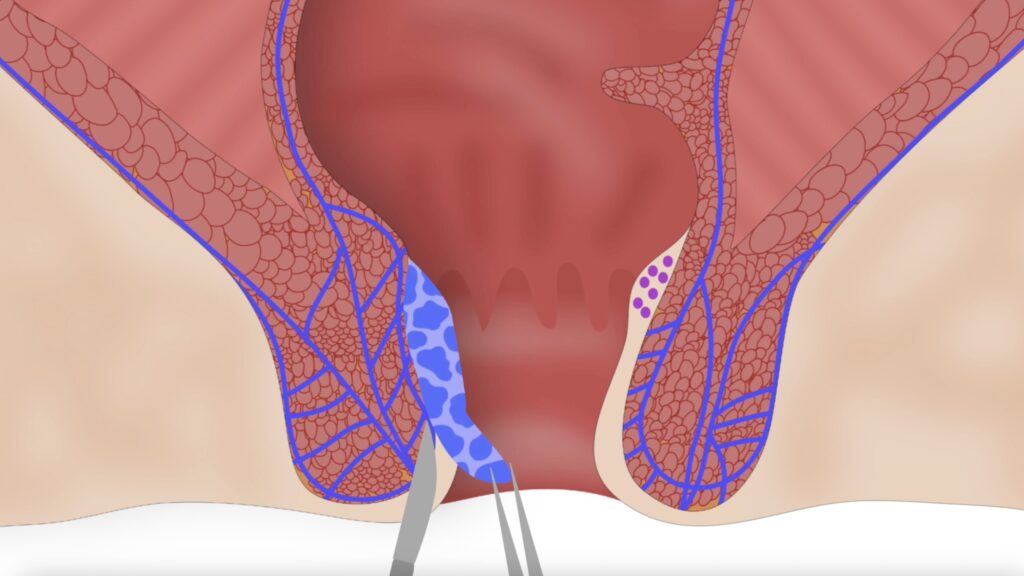 surgical treatment of haemorrhoids
Surgical treatment of haemorrhoids - Milligan-Morgan
When conservative treatments such as fibre supplements, laxatives and local anaesthetic ointments are no longer sufficient, or if the patient has recurrent rectal bleeding and prolapse, surgery is not the automatic next step. Between conservative treatment and an operation sit the outpatient procedures, above all rubber band ligation. Banding can be used for grade I-II and also for selected grade III haemorrhoids after conservative treatment has proved insufficient.
Grade alone does not determine treatment. Grade III means prolapse that can be pushed back manually, while grade IV is a persistent prolapse that cannot be reduced. Surgery is considered individually for marked symptoms, large prolapse, a substantial external component or failure of outpatient treatment, and the choice also depends on anatomy, previous treatment and the patient's wider circumstances.
Small haemorrhoids can be treated using the Milligan-Morgan technique under local anaesthesia
Indications for surgery
Surgical treatment of haemorrhoids is primarily considered in the case of:
- Grade III and IV haemorrhoids: Where the tissue prolapses (falls out) and must either be manually pushed back into place or is permanently fixed outside the anal canal.
- Refractory bleeding: Persistent bleeding from the rectum leading to anaemia or significantly reduced quality of life, where other treatments have not yielded the desired results.
The most widely used operation: Milligan-Morgan (open haemorrhoidectomy)
The Milligan-Morgan technique, developed in 1937, is still described in the literature as a reference standard against which newer methods are compared. It is effective in advanced haemorrhoidal disease and recurrence is less frequent than after the less invasive methods, but it causes more post-operative pain [3].
The Procedure
Kirurgen.dk dissects the three primary haemorrhoidal cushions and ligates the feeding arteries. Subsequently, the diseased tissue is removed, and the wound is left open (excision according to Milligan-Morgan). This ensures drainage and minimises the risk of deep infections.
Advantages:
- Recurrence is less frequent than after the less invasive methods.
- Highly effective for both internal and external components.
Disadvantages:
- Significant postoperative pain (due to wounds in the pain-sensitive part of the anal canal).
- Longer healing time (typically 4-6 weeks).
Alternative Surgical Methods
To reduce postoperative pain, techniques have been developed that operate above the "dentate line" (linea dentata), where the nerve supply is less sensitive.
1. Ferguson (Closed Haemorrhoidectomy)
Similar to Milligan-Morgan, but the mucosa is sutured closed after removal of the tissue.
- Advantage: Faster wound healing, less pain and less postoperative bleeding in the pooled evidence from the American Society of Colon and Rectal Surgeons (ASCRS), 2024.
- Disadvantage: The wound edges can open again. Infectious complications are comparable to the open technique in the same synthesis, so the closed technique does not in itself carry a higher infection risk (ASCRS 2024, Management of Hemorrhoids).
2. Stapled Haemorrhoidopexy (Longo Procedure)
A circular stapler is used to remove a ring of mucosa above the haemorrhoids themselves, which "lifts" them back into place and interrupts the blood supply.
- Advantage: Significantly less pain and a quick return to work.
- Disadvantage: Higher risk of recurrent prolapse and of needing a further procedure. In a systematic review of 27 randomised trials with 2,279 patients, prolapse was more common after stapled haemorrhoidopexy in the longer term (OR 4.34; 95% CI 1.67-11.28), as was reintervention for prolapse (OR 6.78; 95% CI 2.00-23.00) [5].
3. THD / HAL (Transanal Haemorrhoidal Dearterialisation)
An ultrasound-guided technique where the arteries supplying the haemorrhoids are located and ligated.
- Advantage: Minimally invasive, no skin wounds, very little pain.
- Disadvantage: Less effective for very large, fixed Grade IV haemorrhoids.
Comparison of Advantages and Disadvantages
| Method | Pain Level | Recurrence Risk | Healing Time |
|---|---|---|---|
| Milligan-Morgan | High | Very Low | 4-6 weeks |
| Longo (Stapler) | Low/Medium | Medium | 1-2 weeks |
| THD/HAL | Low | Medium | < 1 week |
Postoperative care after Milligan-Morgan surgery
Following an open haemorrhoidectomy, the goals are to ensure pain control, keep stools soft, and promote wound healing in the open area.
1. Pain Management (Analgesics)
Pain is the greatest challenge after open haemorrhoidectomy.
- Combination therapy: Pain relief is planned by the treating doctor and may combine more than one drug. What suits you depends on your other conditions and medication.
- Stronger Painkillers: For the first 3-5 days, opioids (e.g., Tramadol or Oxycodone) may be necessary.
- Caution: Opioids cause constipation, which can make the first bowel movement very painful.
- Local Anaesthetic Ointment: Application of lidocaine gel before and after bowel movements can provide short-term relief.
2. Bowel Regulation and Diet
It is crucial that the first bowel movement (typically 1-3 days after surgery) is soft.
- Laxatives: Patients are routinely prescribed osmotic laxatives (e.g., Magnesium Hydroxide or Macrogol) to avoid hard stools and straining.
- Diet: A high-fibre diet (vegetables, whole grains) combined with plenty of fluid intake (2-3 litres daily) is essential.
- Habit: Avoid sitting too long on the toilet as this increases pressure on the operated areas.
3. Hygiene and Wound Care
Since wounds in Milligan-Morgan surgery are left open, cleanliness is important to prevent infection.
- Sitz Baths: It is often recommended to take lukewarm sitz baths (or rinse with a shower head) 2-3 times daily and always after bowel movements. This cleanses the wound and can have a relaxing effect on the sphincter muscle, reducing spasms and pain.
- Dressing: A simple absorbent dressing (gauze swab) is used to absorb wound fluid, which is normal during the first few weeks.
4. When to Seek Medical Advice?
Although a small amount of fresh rectal bleeding is normal during the first bowel movements, the patient should react if they experience:
- Heavy or persistent bleeding.
- Fever or increasing swelling and redness around the operated area (signs of infection).
- Inability to pass urine (urinary retention is a known, though temporary, side effect).
Sources (PubMed-based)
- Brown S.R. (2017). Haemorrhoids: An update on management. Therapeutic Advances in Chronic Disease.
- Lohsiriwat V. (2012). Hemorrhoids: From basic pathophysiology to clinical management. World Journal of Gastroenterology.
- Salfi R., et al. (2020). Milligan-Morgan hemorrhoidectomy: still the reference standard? Reviews on Recent Clinical Trials.
- Watson A.J., et al. (2016). Hemorrhoidal artery ligation versus rubber band ligation for the management of third-degree hemorrhoids (HubBLe): a multicentre, open-label, randomised controlled trial. The Lancet.
- Burch J, Epstein D, Sari AB, et al. (2009). Stapled haemorrhoidopexy for the treatment of haemorrhoids: a systematic review. Colorectal Dis 2009;11(3):233-43. PubMed
- · Joshi G.P., et al. (2010). Techniques for managing postoperative pain after hemorrhoidectomy. Current Opinion in Anaesthesiology.
- · Gallo G., et al. (2020). Consensus statement of the Italian society of colorectal surgery (SICCR): management and treatment of hemorrhoidal disease. Techniques in Coloproctology.
- · Moesgaard F, Nielsen ML, Hansen JB, Knudsen JT. (1982). High-fiber diet reduces bleeding and pain in patients with hemorrhoids: a double-blind trial of Vi-Siblin. Diseases of the Colon & Rectum 1982;25(5):454-6. PubMed
- Kunitake H, et al. Parameters predicting postoperative pain and quality of life after hemorrhoidectomy: follow-up results from a prospective study. Int J Colorectal Dis 2023;38(1):262. PubMed
More on this topic at Kirurgen.dk
Category: Anal surgery