
McGivney Banding
Written and medically reviewed by Bahir Hadi, specialist in surgery, PhD
Treatment of haemorrhoids with the McGivney method (rubber band ligation): A guide for you
 Rubber band treatment of haemorrhoids
Are you experiencing fresh rectal bleeding, or do you have bothersome swellings at the anal opening? You are not alone. Haemorrhoids are one of the most common reasons people seek medical advice for anorectal discomfort. Several methods exist for the treatment of haemorrhoids. What is suitable, and how the treatment is experienced, depends on the individual assessment.
A widely used method is McGivney ligation of haemorrhoids, also known as rubber band ligation of haemorrhoids. In this post, we will go through everything you need to know about the procedure.
What is the McGivney method?
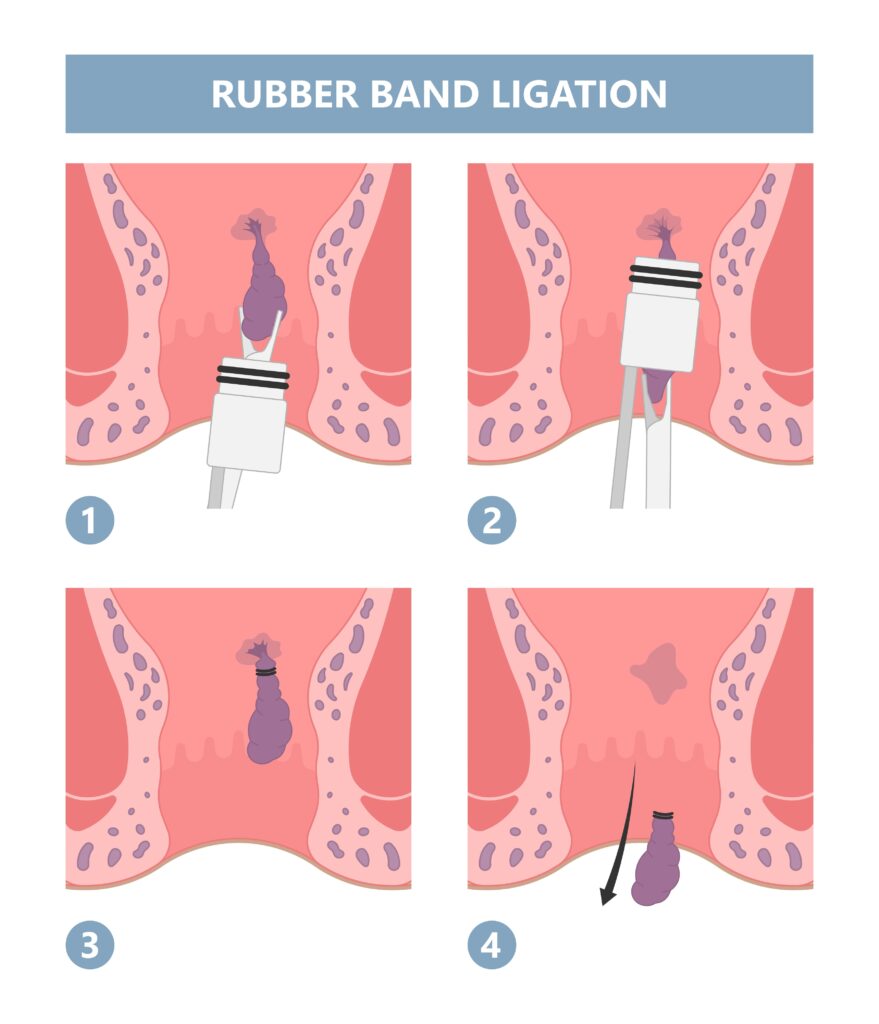
The McGivney method is a refinement of classic rubber band ligation. It is a non-surgical treatment where a small, tight elastic band is placed around the base of the haemorrhoid. This cuts off the blood supply to the tissue, so the haemorrhoid shrinks and falls off. When that happens varies from person to person over a number of days, and it is not something you need to watch or check yourself.
Indications: When is the treatment relevant?
The treatment is particularly suitable for internal haemorrhoids (Grade 1, 2, and selected Grade 3). Typical signs that you may benefit from the treatment include:
- Fresh rectal bleeding: Typically bright red blood on the toilet paper or in the bowl after a bowel movement.
- Prolapse: The sensation of something "falling out" during defecation.
- Itching and irritation: Resulting from mucosal involvement.
How is the procedure performed?
Many fear pain during procedures in the rectum. The band is placed above the dentate line (linea dentata), where the mucosa is far less pain-sensitive than the skin below the line. The area is not entirely without nerve supply, but sensitivity to sharp pain is different, and anaesthesia is therefore usually not necessary. A feeling of pressure or an urge to open the bowels during the first few hours is common.
- Examination: The doctor inserts a small tube (anoscope) to locate the haemorrhoids.
- Ligation: Using the McGivney applicator, the haemorrhoid is suctioned into a cylinder, after which a small rubber band is fired into place around the "neck" of the haemorrhoid.
- Duration: The procedure itself often takes only a few minutes.
After the treatment: What can you expect?
Most people can resume their normal activities immediately after. However, you may experience:
- Sensation of pressure: A feeling of needing to have a bowel movement for the first 12-24 hours.
- Slight bleeding: When the haemorrhoid falls off, which happens with a variation of days from person to person, a bit of fresh rectal bleeding may occur. The timing and amount vary from person to person. Contact a doctor or the out-of-hours service for heavy or persistent bleeding, dizziness, fever or severe pain, and call 112 if your circulation is affected.
- Pain: Persistent severe pain is rare. If it occurs, it can often be relieved with over-the-counter medication.
Effectiveness and success rate
The effect has been described in a retrospective review from a single practice covering 805 patients who received 2,114 rubber band ligatures. Among the 701 patients with follow-up, treatment was judged successful in 70.5%, and the cumulative figure reached 80.2% when new symptoms were treated with further banding. Complications per treatment series were bleeding in 2.8%, thrombosed external haemorrhoid in 1.5% and bacteraemia in 0.09% [3]. The figures come from one clinic and a chart review, so they cannot be transferred directly to an individual patient.
Important: If you experience very heavy bleeding, fever, or difficulty urinating after the procedure, you should always contact your doctor.
Prevention: Avoid the recurrence of haemorrhoids
After haemorrhoid treatment it is important to prevent new ones:
- Eat a fiber-rich diet.
- Drink enough fluid. How much suits you depends on your general health; if you have heart or kidney disease or another fluid restriction, the amount must be agreed with your doctor.
- Avoid straining too hard during bowel movements.
References (PubMed-based)
Below you will find scientific documentation regarding the effectiveness of the treatment:
- Brown, S. R. (2017). "Hemorrhoids: Management, diagnosis, and treatment.". A review of the work-up and treatment of haemorrhoids, in which rubber band ligation is described as one of the out-patient options for internal haemorrhoids.
- Cocorullo, G., et al. (2017). "The non-surgical treatment for hemorrhoidal disease. A systematic review.". A review of the evidence behind non-surgical methods including McGivney.
- Iyer VS, Shrier I, Gordon PH. (2004). Long-term outcome of rubber band ligation for symptomatic primary and recurrent internal hemorrhoids. Dis Colon Rectum 2004;47(8):1364-70. PubMed
More on this topic at Kirurgen.dk
Category: Anal surgery