
Ulcerative Colitis
Written and medically reviewed by Bahir Hadi, specialist in surgery, PhD
Ulcerative Colitis: Everything you need to know about symptoms, bowel examination, and the path to diagnosis
Are you living with abdominal pain, or have you experienced rectal bleeding? These can be signs of the chronic inflammatory bowel disease, ulcerative colitis. For many, talking about bowel habits feels like crossing a boundary, but an early bowel examination is crucial to regaining control of your life.
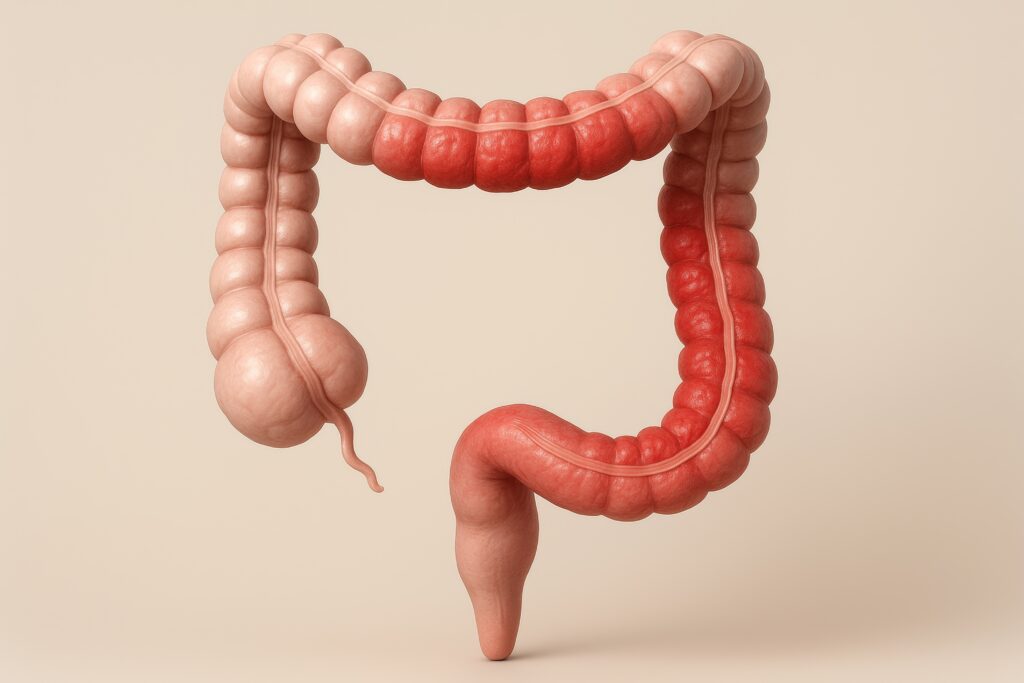
In this post, we review the most important signs of the disease and why a colonoscopy is usually the examination that confirms the diagnosis.
What is ulcerative colitis?
Ulcerative colitis is an autoimmune condition that causes inflammation and ulcers in the lining of the large intestine (colon). The syndrome typically starts in the rectum and can spread upwards through the entire colon.
The most common symptoms include:
- Frequent and urgent need to have a bowel movement.
- Painful abdominal cramps.
- Rectal bleeding (often mixed with mucus).
Scientific focus: Research shows that early diagnosis and treatment ("treat-to-target") are crucial to avoiding long-term damage to the bowel and reducing the risk of colectomy (removal of the colon).
Source: Ungaro et al., Lancet, 2017
Why is rectal bleeding a warning sign?
Although bleeding can be caused by harmless conditions such as haemorrhoids, in the case of ulcerative colitis, it is an indication that the lining of the bowel is so inflamed that ulcers have formed. Blood in the stool must be assessed by a doctor however long it has been present, and you should not wait four weeks. Four weeks is a threshold for when an altered bowel habit without blood should be investigated further with a bowel examination.
Acute severe colitis: when it is urgent
In rarer cases a flare becomes so violent that it requires admission to hospital. Many bloody stools a day together with fever, a racing heart, marked fatigue or feeling generally unwell are signs of acute severe colitis, and you should be assessed urgently at the hospital the same day. The Danish society guideline from DSGH uses the so-called Truelove and Witts criteria to define the condition and recommends admission [DSGH 2023].
In that situation a full colonoscopy is not the examination to start with. Instead, the hospital team performs a shorter endoscopic examination of the lower part of the colon (sigmoidoscopy) with biopsies, which can confirm the diagnosis, assess severity and rule out infection with, among others, cytomegalovirus. A full colonoscopy is advised against in acute severe colitis because of the risk of perforation, and corticosteroid treatment must not wait for the examination [DSGH 2023].
Source: DSGH (Danish Society for Gastroenterology and Hepatology). Akut svær colitis ulcerosa. Revised 30 January 2023. PDF, in Danish
The Diagnosis: How is a colonoscopy performed?
When a doctor suspects bowel disease, a colonoscopy allows the mucosa to be seen directly and biopsies to be taken. Many fear the procedure, but it is performed under safe conditions, often with pain relief or sedative medication.
What happens during the examination?
- Preparation: The bowel is emptied using a laxative the day before.
- Endoscopy: A thin, flexible tube with a camera is inserted via the rectum.
- Biopsies: The doctor takes small tissue samples of the mucosa. This is painless but essential for distinguishing ulcerative colitis from, for example, Crohn's disease or infections.
Why choose a colonoscopy?
It is the examination that lets the doctor see the inflammation directly and describe its severity with an endoscopic measure such as the Mayo score or UCEIS. The score describes the mucosa at that moment and does not decide treatment on its own; it is used together with symptoms, blood tests, stool tests and biopsies.
Mucosal healing is a central treatment target in ulcerative colitis, and it is assessed by endoscopy with biopsies. Blood tests and faecal calprotectin are used alongside it between check-ups.
Source: Boal Carvalho et al., J Crohns Colitis, 2016
Moving forward after your bowel examination
If your colonoscopy shows signs of ulcerative colitis, the next step will be an individual treatment plan. Today, many effective treatments exist - from medical suppositories and foams to biological drugs that suppress the immune system.
Remember: You are not alone. Reacting early to symptoms such as rectal bleeding means work-up and treatment can start sooner.
Treatment Strategy: From local treatment to advanced medicine
In Denmark, doctors work from the severity and extent of the disease, and the goal is always "steroid-free remission" - that is, a state where the bowel has healed without being dependent on corticosteroids. The treatment groups below are not a fixed ladder to be climbed in order; the specialist chooses according to disease severity, extent and the risk of a serious course.
First-line treatment (5-ASA)
For most people with mild to moderate ulcerative colitis, the first step is mesalazine (5-aminosalicylic acid, 5-ASA). Several mesalazine products are marketed in Denmark, for example Pentasa, Asacol and Mezavant, and they differ in strength, dosage form and release profile. Dose, dosing frequency and approved indication follow each product's summary of product characteristics and cannot be transferred between products.
- Local treatment: If the inflammation is located at the bottom of the bowel, suppositories or foam are used.
- Systemic treatment: Tablets are used if the disease is more widespread. Often, the two are combined for maximum effect.
Acute flare-ups (corticosteroids)
For moderate to severe symptoms or a lack of effect from 5-ASA, corticosteroids (e.g., Prednisolone) are used. They work quickly and effectively on the inflammation, but due to side effects, they are only used for short periods to "put out the fire".
Preventive immunomodulators
If the disease flares up every time steroid doses are tapered, Thiopurines (e.g., Imurel/Azathioprine) are often introduced. These agents help keep the immune system in check over the long term.
Scientific focus: Thiopurines are used only to keep the disease quiet, not to bring an active flare under control. In its July 2026 guideline, ECCO advises against thiopurine monotherapy for inducing remission but accepts thiopurine monotherapy as maintenance in selected patients. Treatment requires regular blood tests of the liver and white blood cell counts [ECCO 2026; Timmer et al., Cochrane Database Syst Rev, 2016].
Biological medicine and "small molecules"
If the above is not enough, the Danish healthcare system now offers advanced treatment. Biologics are given as an infusion (drip) at the hospital or as injections under the skin at home, while the so-called small molecules are taken as tablets. The groups are not a fixed ladder that must be climbed in order. In severe disease or at high risk of a serious course, the specialist may choose advanced treatment earlier.
| Type | Examples of preparations (Denmark) | How does it work? |
|---|---|---|
| TNF inhibitors | Infliximab (Remsima), Adalimumab (Humira), Golimumab | Blocks the signalling substance tumour necrosis factor (TNF), which drives the inflammation. |
| Integrin inhibitors | Vedolizumab (Entyvio) | Works specifically in the gut by "locking the door" for white blood cells. |
| Interleukin inhibitors (IL inhibitors) | Ustekinumab (Stelara) (IL-12/23), Guselkumab (Tremfya) and Mirikizumab (Omvoh) (IL-23) | Block interleukins, which are signalling substances between immune cells. Ustekinumab targets both IL-12 and IL-23, whereas guselkumab and mirikizumab target IL-23 alone. |
| JAK inhibitors and S1P modulators (small molecules) | Tofacitinib (Xeljanz), Upadacitinib (Rinvoq), Filgotinib (Jyseleca); Ozanimod (Zeposia), Etrasimod (Velsipity) | Tablet treatment. JAK stands for Janus kinase, an enzyme inside immune cells that JAK inhibitors block. S1P stands for sphingosine-1-phosphate, a signalling substance that controls lymphocyte trafficking; S1P modulators keep lymphocytes in the lymph nodes. |
Scientific focus: In July 2026 ECCO published a new guideline on the medical treatment of ulcerative colitis. It recommends each of the agents listed, anti-TNF agents, vedolizumab, ustekinumab, mirikizumab, guselkumab, JAK inhibitors and S1P modulators, for both induction and maintenance in moderate-to-severe disease, but sets no fixed order. The choice depends on disease severity, previous treatment, age, safety profile, other conditions, pregnancy plans and local availability, and ECCO advises against ranking the agents on the basis of indirect comparisons. After intravenous steroids for a severe flare, maintenance with thiopurines or 5-ASA alone is advised against.
Source: Gisbert JP, Chaparro M, Verstockt B, et al. ECCO Guidelines on Therapeutics in Ulcerative Colitis: Medical Treatment. J Crohns Colitis 2026;20(7):jjag066. PubMed. Surgical part: Adamina M, Kienle P, Chaparro M, et al. ECCO Guidelines on Therapeutics in Ulcerative Colitis: Surgical Treatment. J Crohns Colitis 2026;20(6):jjag072. PubMed
Why is follow-up important?
Treatment in Denmark is currently highly personalised. Using stool samples (Calprotectin) and bowel examinations, the doctor can adjust your medication precisely according to how your bowel is doing - even if you feel healthy.
See also
Inflammatory bowel disease - overview · Crohn's vs. ulcerative colitis
More on this topic at Kirurgen.dk
Category: Gastrointestinal