
Inflammatory bowel disease (IBD) – overview
Written and medically reviewed by Bahir Hadi, specialist in surgery, PhD
Inflammatory bowel disease (IBD): overview of ulcerative colitis and Crohn's disease
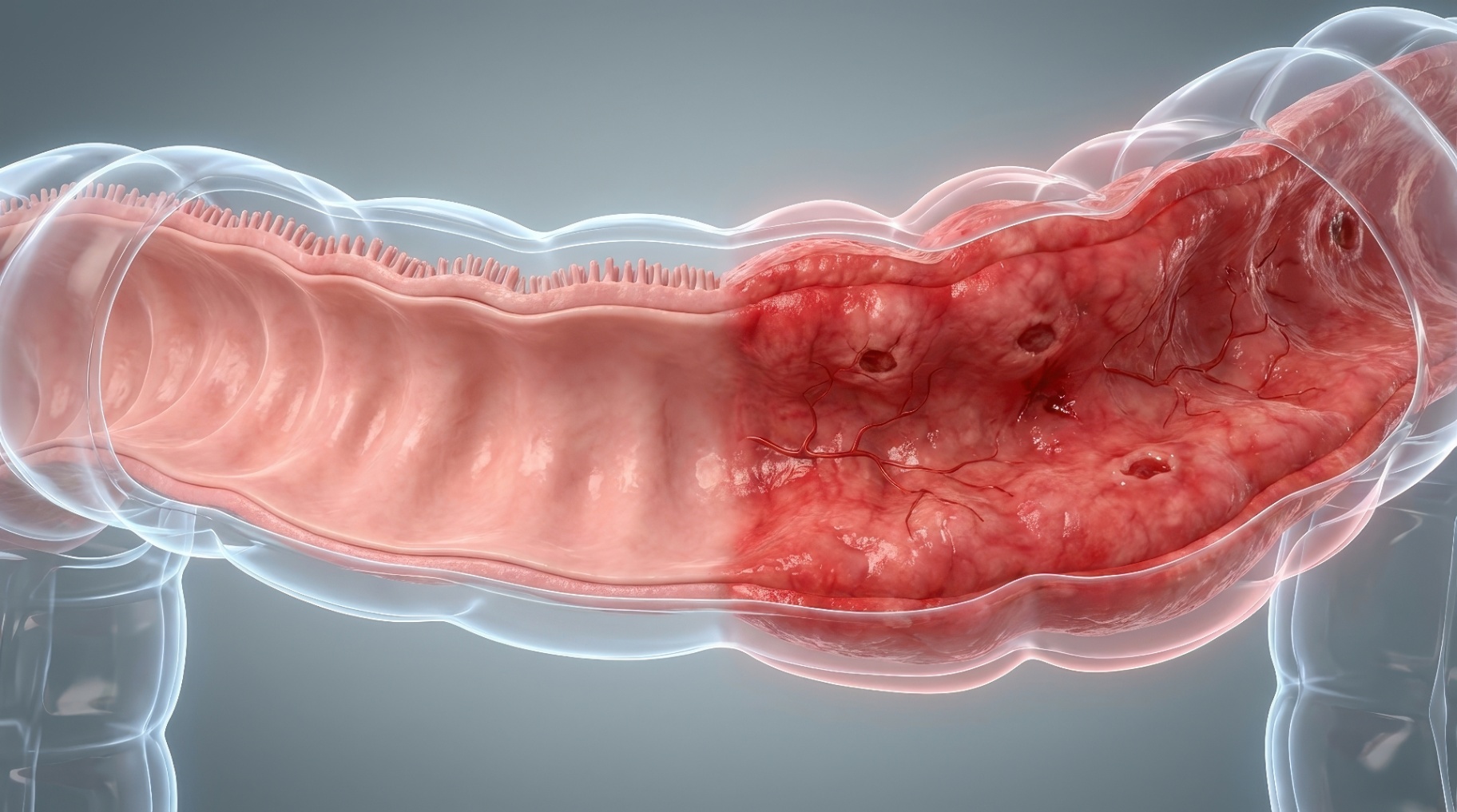
Inflammatory bowel disease (IBD) is the umbrella term for two autoimmune diseases causing persistent or relapsing inflammation of the digestive tract: ulcerative colitis (UC) and Crohn's disease (CD). In Denmark several tens of thousands of people live with IBD, and registry studies place the rate among the highest worldwide [1]. Onset is typically aged 15-35 but can occur at any age.
The two forms - at a glance
| Feature | Ulcerative colitis (UC) | Crohn's disease (CD) |
|---|---|---|
| Location | Colon only, from rectum upwards | Entire GI tract (mouth → anus) |
| Inflammation depth | Mucosa only | Whole bowel wall (transmural) |
| Distribution | Continuous | Patchy ("skip lesions") |
| Classic symptoms | Bloody diarrhoea, tenesmus | Abdominal pain, weight loss, fistulas |
| Complications | Toxic megacolon, colorectal cancer | Strictures, fistulas, abscesses |
| Smoking | Protective (paradoxical) | Worsens course |
| Surgery | Removing the colon and rectum removes the bowel the disease sits in, but possible sequelae such as pouchitis, frequent stools and problems outside the bowel remain | Not curative |
→ For the full comparison: Crohn's disease vs. ulcerative colitis.
Symptoms
Bowel symptoms:
- Chronic or bloody diarrhoea (>4 weeks)
- Abdominal pain, often cramping
- Tenesmus (painful urge to defecate)
- Rectal bleeding
- Black stool (rare, upper Crohn's)
- Weight loss, anorexia
Extraintestinal manifestations (seen in a proportion of patients with IBD):
- Joints (arthritis, sacroiliitis)
- Skin (erythema nodosum, pyoderma gangrenosum)
- Eyes (uveitis, episcleritis)
- Liver (primary sclerosing cholangitis, especially UC)
- Osteoporosis from corticosteroids
Alarm symptoms (acute):
- Severe rectal bleeding
- Fever >38.5 °C
- Signs of toxic megacolon (rare, life-threatening)
- Suspected perforation
Diagnosis
- History and clinical examination.
- Blood tests: haemoglobin (anaemia), CRP, white cells, albumin, ferritin, B12, folate.
- Faecal calprotectin - a sensitive marker of intestinal inflammation, used to judge whether symptoms are more likely IBD than IBS. It is not a diagnostic test on its own: the cut-off depends on the assay and the laboratory, the value can be raised by infection and NSAID use among other things, and a normal result does not rule out disease in someone with alarm symptoms.
- Stool studies - exclude infectious colitis (C. difficile, Salmonella, Shigella, Campylobacter).
- Colonoscopy with multiple biopsies - the central examination. Assesses extent, severity, morphology. In acute severe colitis requiring admission, a full colonoscopy is advised against because of the perforation risk; the hospital team instead performs a limited sigmoidoscopy with biopsies (DSGH, Akut svær colitis ulcerosa, revised 30 January 2023).
- Gastroscopy when upper Crohn involvement is suspected.
- MR enterography or capsule endoscopy for small-bowel assessment (especially Crohn's).
- CT abdomen in acute complications.
Treatment - stepwise
This is an outline of treatment principles, not a treatment plan. Drug choice depends on disease type (ulcerative colitis or Crohn's disease), location, extent, activity and severity. Doses, combination therapy, blood monitoring and treatment pauses are set and adjusted by the treating gastroenterologist.
Inducing remission:
- Mild-moderate UC: mesalazine (5-ASA). Rectal products (suppositories, enemas or foam) are used for proctitis and left-sided disease, oral modified-release products for more extensive disease. The products differ in strength, release profile and approved indication, so dose and route cannot be transferred from one product to another.
- Moderate-severe: systemic corticosteroids (prednisolone)
- Severe acute: IV corticosteroids, possibly ciclosporin or infliximab
Maintaining remission:
- UC: maintenance with mesalazine after medical assessment; product, strength and duration are decided individually
- CD: thiopurines (azathioprine) or methotrexate
- Biologics for severe or refractory disease: anti-TNF (infliximab, adalimumab), vedolizumab, ustekinumab, JAK inhibitors (tofacitinib, upadacitinib)
- "Treat-to-target" strategy where STRIDE-II sets endoscopic healing as the treatment target, with histological healing only an adjunctive measure in ulcerative colitis [2]
Surgery:
- UC: removing the colon and rectum removes the bowel the disease sits in and is considered for medical failure or dysplasia. If only the colon is removed, inflammation can persist in the retained rectum. That is not the same as being entirely well afterwards, since pouchitis and an altered bowel pattern occur
- CD: resection of complications (strictures, fistulas) - not curative. In a meta-analysis of population-based cohorts, the cumulative risk of a first intestinal resection was about 16% at 1 year, 33% at 5 years and 47% at 10 years, and the risk has fallen over recent decades. The figures come from population-based cohorts outside Denmark [3]
Monitoring and prevention
- Colorectal cancer screening: colonoscopy 8-10 years after disease onset, then every 1-5 years by risk.
- Vaccinations: the need for influenza, pneumococcal, HPV and hepatitis B vaccination, among others, is assessed individually before starting immunomodulatory or biologic therapy.
- Iron deficiency: haemoglobin and ferritin are monitored. Ferritin rises with inflammation and can therefore be normal or raised even when iron deficiency is present. Assessment may need additional iron markers, such as transferrin saturation, alongside CRP and the clinical picture. The choice between oral iron and intravenous iron depends on cause, severity, degree of inflammation, tolerance and response, and is made by the treating doctor. Iron treatment never replaces investigation of the cause of the deficiency.
- Bone density with chronic steroid use.
- Psychosocial support and dietitian.
Treatment at Kirurgen.dk
We offer colonoscopy for primary IBD work-up and surveillance, gastroscopy for upper symptoms, and collaborate with gastroenterology and surgical departments for complex patients. See also: Ulcerative colitis, Crohn's disease, Crohn vs. ulcerative colitis, Microscopic colitis.
References
- Lophaven SN, Lynge E, Burisch J. The incidence of inflammatory bowel disease in Denmark 1980-2013. Aliment Pharmacol Ther 2017;45(7):961-72.
- Turner D, Ricciuto A, Lewis A, et al. STRIDE-II: an update on the Selecting Therapeutic Targets in IBD (STRIDE) initiative. Gastroenterology 2021;160(5):1570-83.
- Frolkis AD, Dykeman J, Negrón ME, et al. Risk of surgery for inflammatory bowel diseases has decreased over time. Gastroenterology 2013;145(5):996-1006.
More on this topic at Kirurgen.dk
Category: Gastrointestinal