
Erysipelas of the leg
Written and medically reviewed by Bahir Hadi, specialist in surgery, PhD
Erysipelas of the leg: Symptoms, treatment and its connection to varicose veins
Erysipelas is an acute bacterial skin infection that most often affects the lower leg. It causes a sharply defined, bright red, warm, and painful area of skin, often with a fever. Erysipelas is common in patients with chronic venous insufficiency, varicose veins, and lymphoedema - and can recur repeatedly if the underlying cause is not treated.
What is erysipelas?
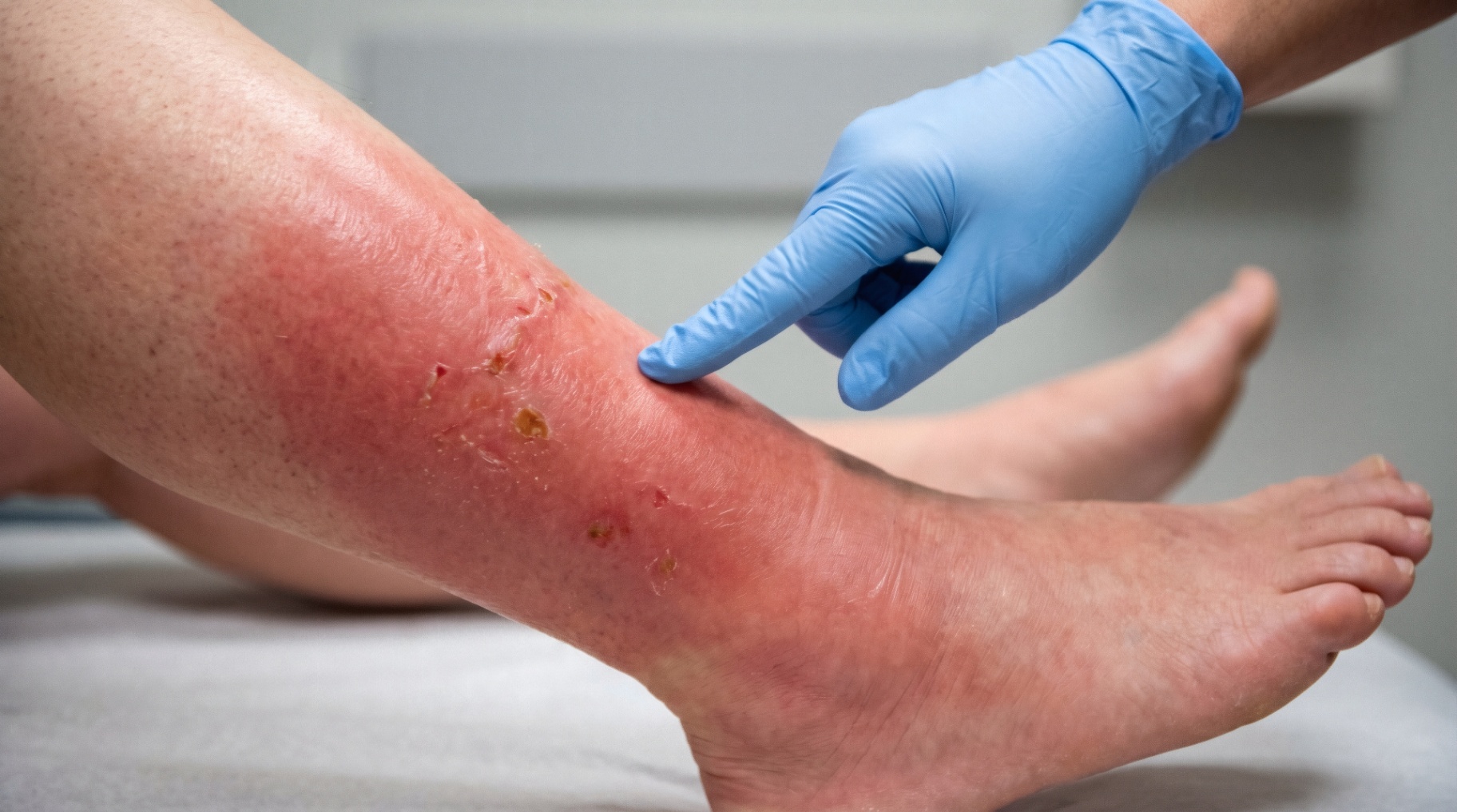
Erysipelas is an infection of the superficial skin layers and lymphatic vessels, most often caused by group A streptococci (Streptococcus pyogenes), and less commonly by staphylococci [1]. The bacteria enter through a small break in the skin - a fissure between the toes (athlete's foot), an insect bite, a wound, or venous eczema.
Symptoms
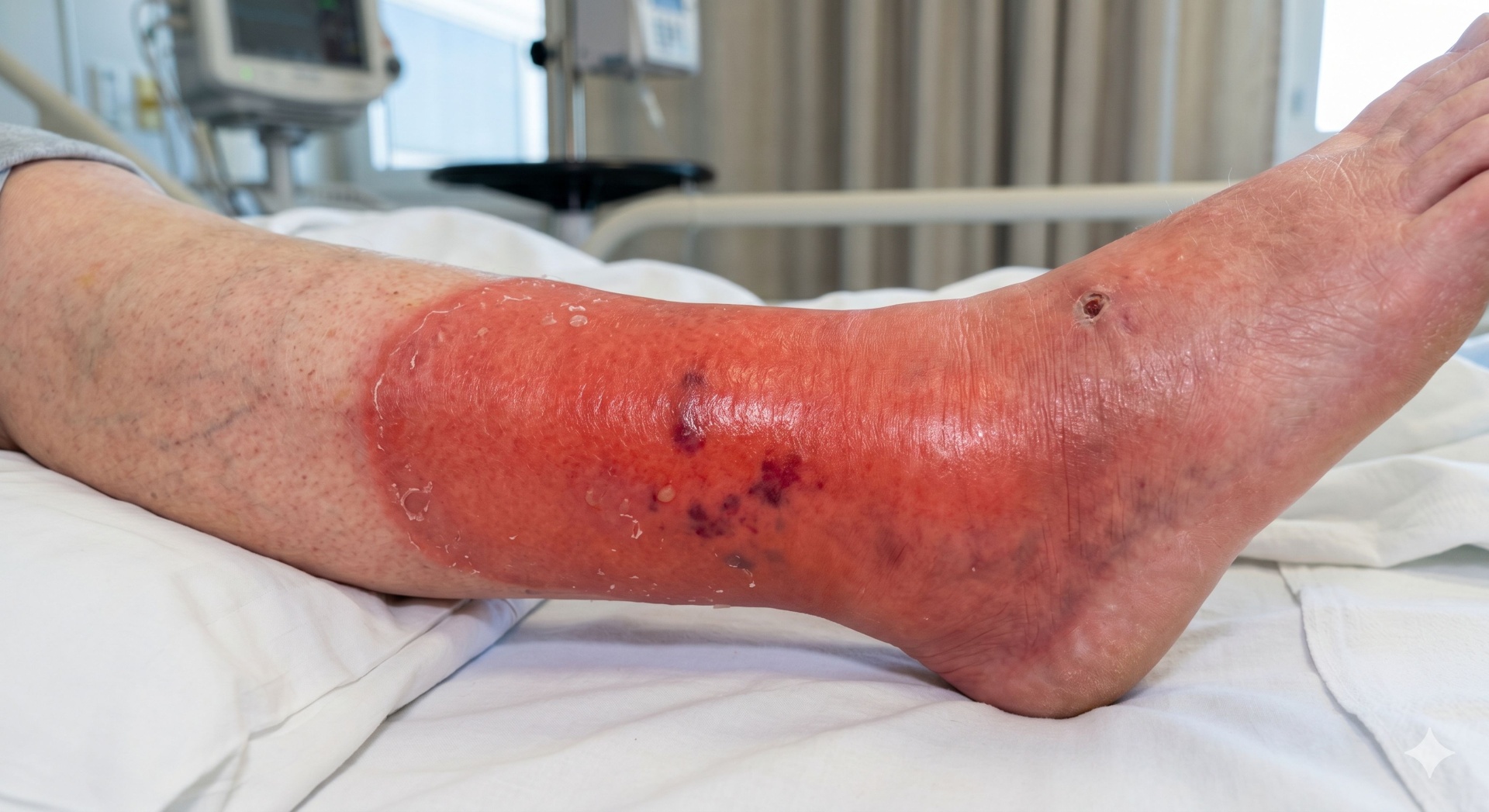
Erysipelas develops rapidly, often over a few hours:
- Sharply defined redness with "map-like" borders
- Warm, tender, and swollen skin
- Fever above 38.5°C, chills, and a general feeling of being unwell
- Swollen lymph nodes in the groin
- In severe cases: blisters, bullae, or skin necrosis
- It often starts in one foot or calf and spreads upwards
Unlike deep cellulitis, erysipelas is superficial and sharply demarcated.
Why are varicose veins a risk factor?
Patients with varicose veins, chronic venous insufficiency and lymphoedema have a clearly increased risk of erysipelas. How large the increase is varies widely between studies and depends on which venous condition is involved, so it cannot be reduced to a single figure [2,3]:
- Increased venous pressure damages the skin, causing microscopic cracks
- Lymphatic drainage is reduced → bacteria cannot be "flushed away"
- Venous eczema and athlete's foot provide entry points for bacteria
- A single episode further damages the lymphatic vessels, increasing the risk of another one
Lymphoedema, a damaged skin barrier and chronic swelling are associated with an increased risk of leg erysipelas in observational studies. Venous insufficiency may also be a contributing local risk factor, but estimates vary between studies, and these associations do not by themselves establish cause [2].
Source note for clinicians: the often quoted high odds ratio for lymphoedema (71.2) comes from a French hospital-based case-control study from 1999 with 167 inpatients and 294 controls, where the confidence interval ran from 5.6 to 908 [2]. The study is old, the population is hospital-selected, the confidence interval is very wide and the statistical uncertainty is large. The figure describes association with a current episode of erysipelas, not absolute risk, incidence, lifetime risk or cause, and it cannot be transferred to an individual patient's own risk.
Treatment
1. Antibiotics In Danish primary care, uncomplicated erysipelas is usually treated with penicillin V for 5-7 days. The choice of antibiotic, the route of administration and the length of treatment depend on the severity of the infection, its location, allergies, other illnesses and the clinical response. Longer treatment may be needed after medical assessment [4,6,7]. If you are allergic to penicillin, your doctor selects an alternative. Hospital treatment with intravenous antibiotics is considered when you are severely unwell, the infection is extensive, there are bullae, you are immunosuppressed, or tablets are not working. Dosing is always decided by the treating doctor.
If you are not improving after 2-3 days of treatment, or you get rapidly worse, contact a doctor again the same day. Erysipelas of the face, severe general illness, signs of sepsis or suspected necrotising infection needs emergency assessment.
2. Elevation and compression Elevate the leg above heart level as much as possible for the first few days. When the fever has subsided, the pain has eased and the skin tolerates it, compression therapy can be started to reduce the swelling (oedema). When that is varies from person to person and is agreed with the doctor; there is no single fixed waiting time.
3. Treating the entry point
- Athlete's foot is treated with antifungal medication
- Skin fissures are cared for with moisturiser
- Venous eczema is treated
- Venous ulcers are debrided
Recurrence - and how to prevent it
Erysipelas recurs in a substantial proportion of patients in the years after a first episode, particularly if predisposing factors are not addressed [5]. Prevention includes:
- Assess and treat underlying venous insufficiency and oedema. Endovenous laser therapy (EVLT) closes the diseased vein and lowers venous pressure. That is well documented for venous symptoms and ulcers, whereas the effect on the number of erysipelas episodes has not been settled in randomised trials
- Daily compression stockings for persistent oedema, with the compression class chosen according to the state of the leg and your arterial circulation
- Good skincare and use of moisturiser
- Prompt treatment of athlete's foot and skin fissures
- For repeated episodes, antibiotic prophylaxis may be discussed. It is not routine: it is reserved for selected patients after specialist assessment and must be reviewed regularly. In the PATCH I trial, which randomised 274 patients with at least two previous episodes to penicillin 250 mg twice daily or placebo for 12 months, 22 per cent in the penicillin group and 37 per cent in the placebo group had a recurrence during prophylaxis (hazard ratio 0.55; 95 per cent confidence interval 0.35 to 0.86). The effect faded after treatment stopped [5,7]
When to seek urgent medical attention
- A sudden, intensely painful, red, and warm area on your leg, accompanied by a fever
- Rapid spreading of the redness
- A general feeling of being unwell, nausea, or vomiting
- Suspicion of a deep infection (black or bluish skin, blisters, numb skin, severe pain that seems disproportionate to the redness)
Call 112 if the redness spreads rapidly with severe pain, bluish or black skin, confusion, a very fast pulse or low blood pressure. That can be a necrotising soft tissue infection or sepsis, which needs immediate hospital treatment.
Erysipelas is an acute condition that requires antibiotics - it will not go away on its own.
In summary
Erysipelas of the leg is not "just a skin irritation" - it is a bacterial infection that requires antibiotics and elevation. Venous insufficiency, oedema and a damaged skin barrier are described as risk factors, but a single episode of erysipelas does not in itself indicate a venous work-up. Whether to investigate depends on your symptoms and an overall medical assessment. Endovenous laser therapy treats venous disease on its own indication and should not be regarded as prevention of erysipelas.
References
- Stevens DL, et al. Practice guidelines for the diagnosis and management of skin and soft tissue infections: 2014 update by the IDSA. Clin Infect Dis 2014;59(2):e10-52.
- Dupuy A, et al. Risk factors for erysipelas of the leg: case-control study. BMJ 1999;318(7198):1591-4.
- Mokni M, et al. Risk factors for erysipelas of the leg in Tunisia: a multicenter case-control study. Dermatology 2006;212(2):108-12.
- Sundhedsstyrelsen. Rational antibiotic treatment in general practice. 2021.
- Thomas KS, Crook AM, Nunn AJ, et al. Penicillin to prevent recurrent leg cellulitis (PATCH I). N Engl J Med 2013;368(18):1695-703. PubMed
- Region Hovedstaden. Antibiotic guideline - skin and soft tissue infections. regionh.dk
- National Institute for Health and Care Excellence (NICE). Cellulitis and erysipelas: antimicrobial prescribing. NG141, 2019. nice.org.uk/guidance/ng141