
The myth of colon hydrotherapy: what do the official health authorities say?
Written and medically reviewed by Bahir Hadi, specialist in surgery, PhD
Published: 23 June 2026
Colon hydrotherapy: what does the evidence and the official health authorities say?
Abstract
Commercial colon irrigation, often marketed as colon hydrotherapy, is sold as a shortcut to more energy, better digestion and a stronger immune system. Healthy people, however, do not need colon irrigation to remove "toxins", waste products or old stool - the body already handles this. The U.S. National Center for Complementary and Integrative Health (NCCIH) concludes in its status report Detoxes and Cleanses: What You Need To Know that commercial cleansing regimens and mechanical colon irrigation lack scientific support, are unnecessary in healthy people, and can cause real harm.
1. Two very different things: medically indicated bowel preparation and commercial colon hydrotherapy
It is important to distinguish between two situations that are often blurred together in marketing:
- Medically indicated bowel preparation is used ahead of examinations such as colonoscopy, or as part of treatment for selected conditions, for example severe chronic constipation that has not responded to other measures, or neurogenic bowel dysfunction. This form of preparation follows a specific medical assessment, uses defined agents, and takes place under controlled conditions.
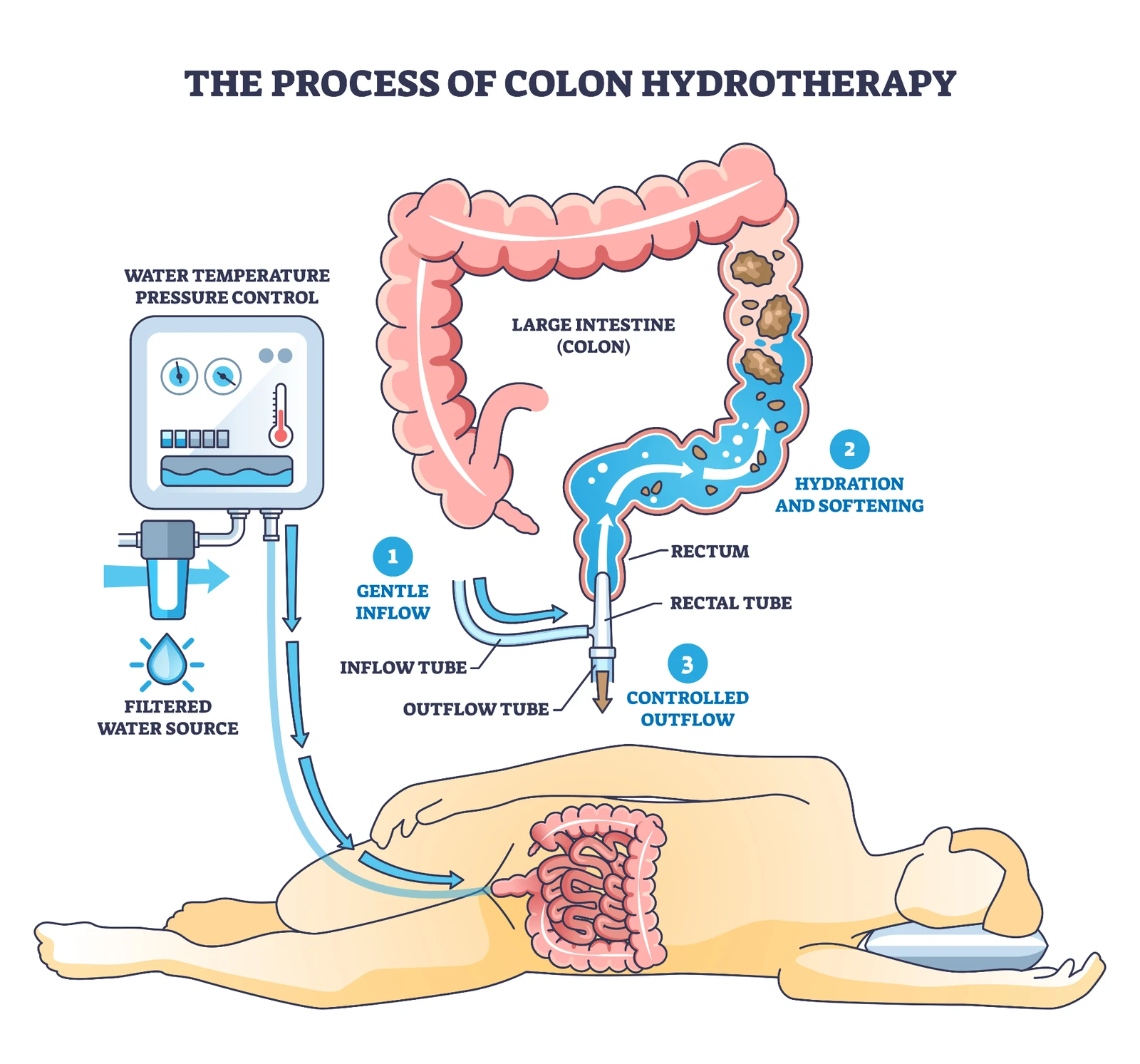
- Commercial colon hydrotherapy (colon irrigation offered at clinics, spas or for home use) is typically offered without a prior medical indication, often marketed with promises of "detoxification", weight loss or general health improvement. This form of irrigation is not a medically recognised treatment for healthy people.
2. The idea of "self-poisoning"
The marketing of colon irrigation often rests on an old theory called autointoxication, which claims that undigested food accumulates and rots in the colon and slowly poisons the body from within. Modern medicine abandoned this theory more than a century ago.
The body's own organs continuously handle waste removal:
- The liver and kidneys filter blood, process chemical substances and excrete waste through bile and urine.
- The gastrointestinal tract, whose lining continuously renews itself, removes by-products through stool.
There is no scientific evidence that healthy people accumulate "toxic plaques" on the bowel wall that require mechanical flushing.
3. What does the research show about health effects?
When NCCIH and independent researchers review the literature, the conclusion is that documentation is lacking: there are no randomised controlled trials (RCTs) demonstrating general health benefits of commercial colon hydrotherapy in healthy people.
The review identifies recurring methodological weaknesses in the studies that claim a positive effect:
- Few participants, lack of control groups, and rarely peer-reviewed.
- Positive single studies from commercial providers cannot be equated with consensus or robust evidence.
4. Risks of colon irrigation
The risks of colon irrigation should be described neutrally and without overstating their frequency, but they are documented in the literature and should be known before considering the procedure:
- Dehydration after larger fluid losses.
- Electrolyte disturbances, where imbalance in, for example, potassium and sodium can, in rare cases, affect heart rhythm.
- Infection, if the equipment is not adequately sterile.
- Damage to the intestinal lining.
- Bowel perforation, meaning tears or holes in the bowel wall, a rare but serious complication that may require emergency surgery.
Home use of strong laxatives or enemas marketed for "detox" purposes increases the risk of the same complications and should not be undertaken without prior medical assessment.
5. Other "detox"-related risks described in the literature
Colon irrigation is often marketed alongside other cleansing products. The NCCIH report describes, among other things:
- Extreme juice cleanses high in oxalate (for example spinach, beetroot, kale), which, combined with low calcium intake, have been linked in case reports to an increased risk of acute kidney injury (oxalate nephropathy).
- Unpasteurised, raw juices, which are rarely heat-treated and can therefore contain E. coli, Salmonella or Listeria - a risk particularly for pregnant women, older adults, small children and people with weakened immune systems.
- Repeated recalls by the U.S. FDA of cleansing products that illegally contained prescription medicines not listed on the label.
This article does not recommend specific products, recipes or home regimens; this section is included solely to describe the documented risk profile.
6. What supports normal bowel function?
There is no documented method to "cleanse" or "reset" a healthy person's bowel beyond ordinary healthy living. The measures generally highlighted by health authorities are the same ones that apply to health in general: a varied diet with adequate fibre, adequate fluid intake, regular physical activity, and attention to sleep and stress. These measures are not the same as colon irrigation and do not replace medical evaluation of symptoms.
See also the gut-brain axis, gut microbiome, probiotics and IBS, natural probiotics through food and chronic constipation.
When to see a doctor instead of a cleansing clinic
Many people who consider colon hydrotherapy actually have real digestive symptoms that deserve a proper work-up rather than an alternative treatment. Contact your GP or a gastrointestinal specialist if you have:
- Blood in your stool or bleeding from the rectum.
- A change in bowel habit lasting more than 4 weeks.
- Unintentional weight loss.
- Persistent abdominal pain.
- New GI symptoms after the age of 50.
- A family history of bowel cancer or inflammatory bowel disease.
Diagnostic work-up and treatment at Kirurgen.dk
We investigate gastrointestinal symptoms with colonoscopy, gastroscopy, sigmoidoscopy, coeliac screening and faecal calprotectin. Questions about referral, cover and price are clarified with the clinic or your GP before treatment; see contact.
Frequently asked questions about colon hydrotherapy
Does colon hydrotherapy help with fatigue, bloating or skin problems?
There are no randomised controlled trials documenting an effect of commercial colon irrigation on fatigue, skin issues, bloating or so-called "detoxification". The liver, kidneys and intestinal lining already handle waste removal in healthy people without the need for external flushing.
Are there "toxic plaques" on the bowel wall that need to be washed out?
No. That theory, called autointoxication, was abandoned by medicine more than 100 years ago. Colonoscopies in healthy people do not show accumulated plaques on the bowel wall.
Can colon hydrotherapy "reset" the gut after a course of antibiotics?
There is no evidence that colon irrigation benefits the gut microbiome after antibiotics. Irrigation may instead remove further bacteria, including beneficial species. Any rebuilding of the gut microbiome is generally best supported by an ordinary, varied diet.
Is colon hydrotherapy dangerous?
There are documented risks, including dehydration, electrolyte disturbances (which can, in rare cases, affect heart rhythm), infection from non-sterile equipment, damage to the intestinal lining and, rarely, bowel perforation requiring emergency surgery.
Who should never undergo commercial colon hydrotherapy without prior medical assessment?
People with inflammatory bowel disease (Crohn's, ulcerative colitis), diverticulitis, recent bowel surgery, severe heart or kidney disease, pregnant women, and patients with bleeding disorders or rectal bleeding of unknown cause should not undergo commercial colon irrigation without prior medical assessment.
Does colon hydrotherapy help with weight loss?
There is no evidence of an effect on fat mass. Any immediate drop in body weight after irrigation is due to loss of fluid and stool content and is temporary.
Are there any medical situations where bowel preparation is relevant?
Yes, but this refers to medically indicated bowel preparation under controlled conditions - not commercial colon hydrotherapy. Examples include bowel preparation before colonoscopy, management of severe neurogenic bowel dysfunction (for example after spinal cord injury), and selected cases of severe chronic constipation that have failed other measures. A small retrospective cohort study has also examined device-based colon hydrotherapy as a salvage attempt after inadequate bowel preparation for colonoscopy; that is a hospital indication and not an argument for commercial irrigation in healthy people [5].
What should I do instead if I have digestive symptoms?
Get a proper medical work-up. Symptoms such as a change in bowel habit lasting more than 4 weeks, blood in the stool, unintentional weight loss or persistent abdominal pain should be assessed by a doctor, who decides whether colonoscopy, gastroscopy or other tests are needed. They should not be addressed with irrigation.
References
- National Center for Complementary and Integrative Health (NCCIH). Detoxes and Cleanses: What You Need To Know. National Institutes of Health (NIH). nccih.nih.gov/health/detoxes-and-cleanses-what-you-need-to-know.
- Klein AV, Kiat H. Detox diets for toxin elimination and weight management: a critical review of the evidence. Journal of Human Nutrition and Dietetics. 2015;28(6):675-686. PMID: 25522674.
- Obert J, et al. Popular Weight Loss Strategies: a Review of Four Weight Loss Techniques. Current Gastroenterology Reports. 2017;19(12):61. PMID: 29124370.
- Jalanka J, Salonen A, Salojarvi J, Ritari J, et al. Effects of bowel cleansing on the intestinal microbiota. Gut. 2015;64(10):1562-8. PMID: 25527456
- Zhang D, Zhao C, Tao Y, Zhang J. Remedial colon hydrotherapy device enema as a salvage strategy for inadequate bowel preparation for colonoscopy: a retrospective cohort study. PLoS One. 2025;20(3):e0319493. PMID: 40106477
More on this topic at Kirurgen.dk
Category: Gastrointestinal