
Gut microbiome, probiotics and IBS
Written and medically reviewed by Bahir Hadi, specialist in surgery, PhD
Published: 28 July 2026
The gut microbiome, probiotics and irritable bowel syndrome: What does the evidence say?
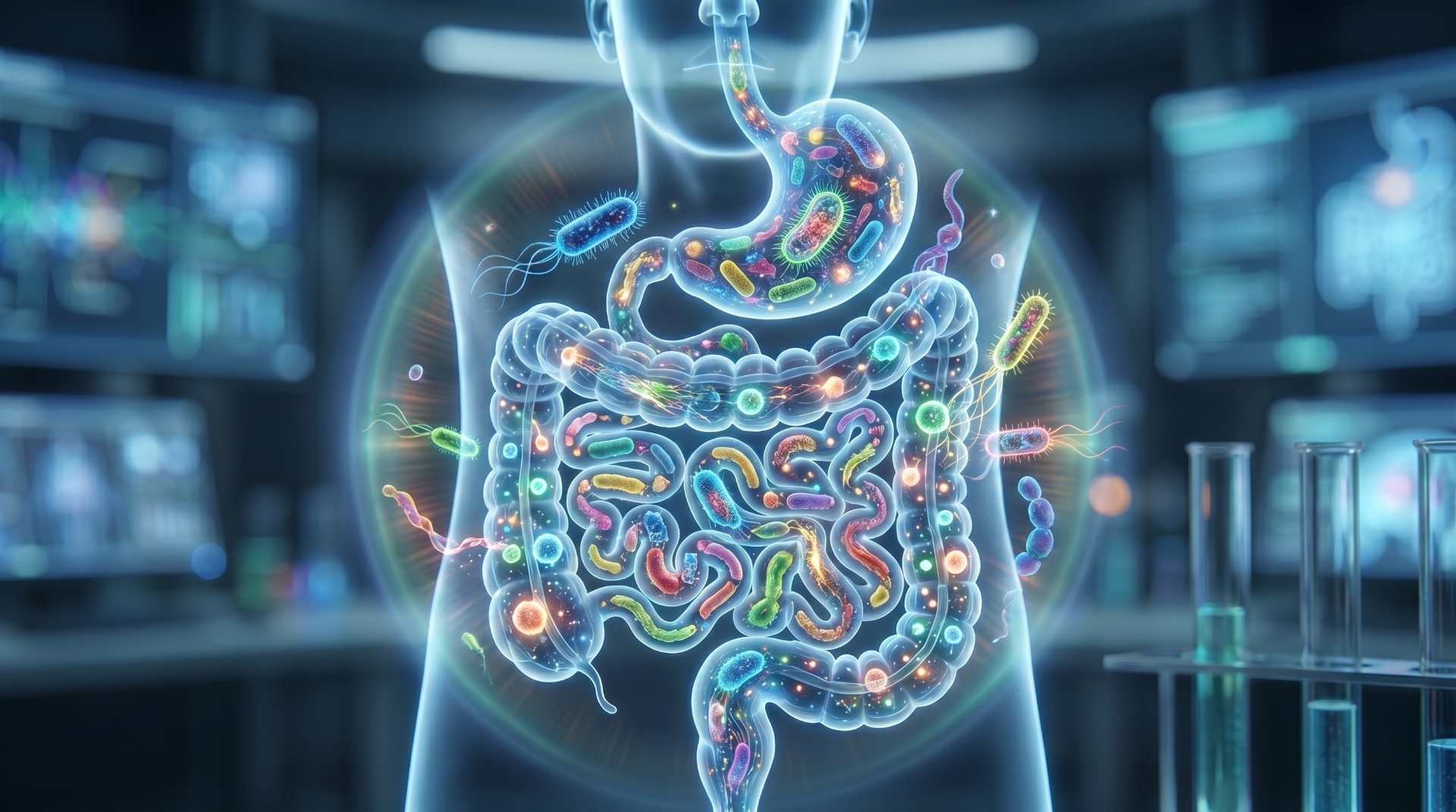
The gut microbiome holds on the order of 10¹³ micro-organisms. Revised estimates put that number roughly on par with the body's own cells, not ten times higher as previously assumed [1]. Research over the past 15 years has shown that the gut flora affects digestion, the immune system, metabolism and possibly also our mood, but much of this research is observational and shows association, not necessarily causation. What do we really know about probiotics, prebiotics and their role in irritable bowel syndrome (IBS)?
What is the gut microbiome?
The microbiome is as individual as a fingerprint and is influenced by:
- Method of birth (vaginal vs. caesarean section)
- Breastfeeding in the first few months
- Diet - especially fibre intake
- Antibiotics, particularly repeated courses
- Age, stress, exercise and sleep
There is no single, universally defined "healthy gut microbiome". The gut microbiota is immensely diverse, varies considerably between individuals and can fluctuate over time, especially during illness and early development [2]. High diversity is therefore a research target, not an established health norm.
IBS and the microbiome
Irritable bowel syndrome (IBS) is a common condition, but how common it is depends greatly on which diagnostic criteria and which population are studied [3]. In some patients, differences in the gut microbiome are seen compared with healthy individuals, but these differences are associations and not necessarily the cause of symptoms:
- Some studies find reduced diversity and lower levels of Bifidobacterium and Faecalibacterium prausnitzii in IBS patients compared with control groups [4]
- Increased intestinal permeability has been investigated as a possible mechanism ("leaky gut"), but this remains a research area and not an established clinical explanation or diagnosis [4]
- Some patients develop IBS symptoms after an acute gastrointestinal infection (post-infectious IBS); the proportion affected varies between studies and follow-up periods [5]
- Small intestinal bacterial overgrowth (SIBO) is found in a subgroup of patients
Probiotics: What works?
Probiotics are live microorganisms that, when administered in adequate amounts, can confer a health benefit on the host [6]. The effect is strain-specific - it is not enough to know whether a bacterium is a Lactobacillus or a Bifidobacterium. Evidence for one strain cannot be extrapolated to other strains of the same species, and a product without a stated strain designation cannot be linked to strain-specific documentation.
Disagreement between guidelines on IBS
The major gastroenterological societies assess the evidence differently:
- AGA (2020) recommends probiotics for IBS only within the framework of clinical trials, because the evidence overall is judged too weak and heterogeneous for a general recommendation [Su et al., Gastroenterology 2020]
- ACG (2021) suggests against probiotics for global IBS symptoms; the recommendation is conditional and based on very low quality evidence
- BSG (2021) by contrast concludes that probiotics as a group may be effective for global symptoms and abdominal pain, that no specific species or strain can be recommended, and that a trial of up to 12 weeks is reasonable, stopping if there is no improvement. The recommendation is weak and based on very low quality evidence. Findings for one strain cannot be transferred to others
The disagreement between the guidelines is not evidence of a class effect for probiotics or support for any particular product [17].
Studies of individual strains exist, for example Bifidobacterium infantis 35624 and Lactobacillus plantarum 299v, with reported symptom relief in IBS in specific trials [7,8]. This does not mean these strains are "the most well-documented" across all research or a general first choice - results from one or a few studies are not the same as consensus, and the effect cannot be extrapolated to other products or strains.
Multi-strain products have been studied in ulcerative colitis and pouchitis in individual studies [9], but this is not the same as documentation for IBS or general bloating, and we do not recommend specific brand names.
Systematic reviews (Ford et al. 2018) find an overall heterogeneous and moderate effect of probiotics in IBS, but the effect varies considerably between strains and studies, and there is no basis for a single overall figure that applies to probiotics as a group [10].
Where probiotics do not have a documented effect:
- As routine prevention in healthy individuals
- For weight loss
- As standard treatment for Crohn's disease, ulcerative colitis (apart from certain pouchitis studies) or general bloating
Probiotics are generally well tolerated in healthy individuals, but specific risks have been described in people with severe illness, significant immunosuppression, a central venous catheter or a compromised intestinal barrier. Talk to your doctor if this applies to you.
Prebiotics and diet
Prebiotics are fibres - including inulin, FOS and GOS - that can affect the composition of specific bacterial groups in the gut. It is an oversimplification to call them "food for the good bacteria": the effect depends on the substance, the dose, the individual's microbiome and the clinical situation, and an increase in, for example, bifidobacteria is not in itself proof of symptom improvement. In some IBS patients, large amounts of prebiotic fibres can worsen bloating and pain. There is no universal dose, and prebiotics do not "rebuild" the gut flora or repair the intestinal lining.
The low FODMAP diet has been studied in several randomised trials and is included in international guidelines (ACG 2021, BSG 2021) as a possible structured approach for IBS [11]. The diet is time-limited and carried out in three phases: a defined elimination phase, systematic reintroduction and finally a personalised long-term diet. The restrictive phase should not continue indefinitely, and tolerance for individual FODMAP groups varies greatly from person to person. We recommend guidance from a dietitian with gastroenterological experience, particularly in cases of underweight, a history of eating disorder, pregnancy or other conditions involving increased nutritional risk.
Generally worth considering:
- A varied fibre intake from several sources (oats, legumes, fruit, vegetables), adapted to the individual
- Fermented foods (yoghurt, kefir, sauerkraut, kimchi) as part of a varied diet - they are not automatically probiotic or low-FODMAP, and there is no documentation that they treat IBS or IBD
- Limited intake of highly processed foods [12]
Microbiome tests and "dysbiosis"
Commercial tests exist that analyse bacteria in stool samples and are marketed as revealing "dysbiosis" or recommending specific probiotics. "Dysbiosis" is not an independent clinical diagnosis but a loose term for changes in microbiome composition that are also seen in healthy individuals. Stool-based microbiome tests are not scientifically validated for diagnosing IBS, SIBO, bloating or food intolerance, and they cannot be used to select the "right" probiotic for an individual. Decisions on investigation and treatment should be based on clinical assessment, not on this type of test.
Faecal microbiota transplantation (FMT)
FMT is a recognised treatment for selected patients with recurrent Clostridioides difficile infection after standard treatment and under specialised medical supervision [13, AGA 2024]. In IBS, the evidence is mixed - some studies show an effect, others do not, and FMT is not a routine treatment for IBS [14]. There is a risk of transmitting infectious organisms, and the treatment requires validated donor and product control. We do not provide guidance on home FMT.
Practical advice
- If you are considering probiotics for IBS: talk to your doctor about a product with a documented strain and a defined trial period, for example 4 weeks, rather than expecting a universal effect
- Some strains (e.g. Lactobacillus rhamnosus GG or Saccharomyces boulardii) have been studied for reducing antibiotic-associated diarrhoea when used during and after courses of antibiotics [15]
- Eat a varied diet with a fibre intake adapted to you
- See a doctor if you have blood in your stool, unexplained weight loss, nocturnal diarrhoea or other alarm symptoms
References
- Sender R, et al. Revised estimates for the number of human and bacteria cells in the body. PLoS Biol 2016;14(8):e1002533.
- Lozupone CA, et al. Diversity, stability and resilience of the human gut microbiota. Nature 2012;489(7415):220-30.
- Sperber AD, et al. Worldwide prevalence and burden of functional gastrointestinal disorders, results of Rome Foundation Global Study. Gastroenterology 2021;160(1):99-114.
- Pittayanon R, et al. Gut microbiota in patients with irritable bowel syndrome - a systematic review. Gastroenterology 2019;157(1):97-108.
- Klem F, et al. Prevalence, risk factors, and outcomes of irritable bowel syndrome after infectious enteritis. Gastroenterology 2017;152(5):1042-54.
- Hill C, et al. The International Scientific Association for Probiotics and Prebiotics consensus statement on the scope and appropriate use of the term probiotic. Nat Rev Gastroenterol Hepatol 2014;11(8):506-14.
- Whorwell PJ, et al. Efficacy of an encapsulated probiotic Bifidobacterium infantis 35624 in women with irritable bowel syndrome. Am J Gastroenterol 2006;101(7):1581-90.
- Ducrotté P, et al. Clinical study: Lactobacillus plantarum 299v (DSM 9843) improves symptoms of irritable bowel syndrome. World J Gastroenterol 2012;18(30):4012-8.
- Mardini HE, Grigorian AY. Probiotic mix VSL#3 is effective adjunctive therapy for mild to moderately active ulcerative colitis: a meta-analysis. Inflamm Bowel Dis 2014;20(9):1562-7.
- Ford AC, et al. Systematic review with meta-analysis: the efficacy of prebiotics, probiotics, synbiotics and antibiotics in irritable bowel syndrome. Aliment Pharmacol Ther 2018;48(10):1044-60.
- Black CJ, et al. Efficacy of a low FODMAP diet in irritable bowel syndrome: systematic review and network meta-analysis. Gut 2022;71(6):1117-26.
- Valdes AM, et al. Role of the gut microbiota in nutrition and health. BMJ 2018;361:k2179.
- van Nood E, et al. Duodenal infusion of donor feces for recurrent Clostridium difficile. N Engl J Med 2013;368(5):407-15.
- Halkjær SI, et al. Faecal microbiota transplantation alters gut microbiota in patients with irritable bowel syndrome: results from a randomised, double-blind placebo-controlled study. Gut 2018;67(12):2107-15.
- Goldenberg JZ, et al. Probiotics for the prevention of pediatric antibiotic-associated diarrhea. Cochrane Database Syst Rev 2019;(4):CD004827.
- Su GL, et al. AGA Clinical Practice Guidelines on the Role of Probiotics in the Management of Gastrointestinal Disorders. Gastroenterology 2020;159(2):697-705.
- Vasant DH, Paine PA, Black CJ, et al. British Society of Gastroenterology guidelines on the management of irritable bowel syndrome. Gut 2021;70(7):1214-1240. PMID 33903147. doi.org/10.1136/gutjnl-2021-324598 - gut.bmj.com/content/70/7/1214
Read also
The Low FODMAP Diet for IBS · Chronic Inflammatory Bowel Disease (IBD) · Digestion and the Digestive Tract
Read also
More on this topic at Kirurgen.dk
Category: Gastrointestinal