
Symptoms of deep vein thrombosis
Written and medically reviewed by Bahir Hadi, specialist in surgery, PhD
Symptoms of a Blood Clot in the Leg (DVT): When Should You Seek Urgent Medical Attention?
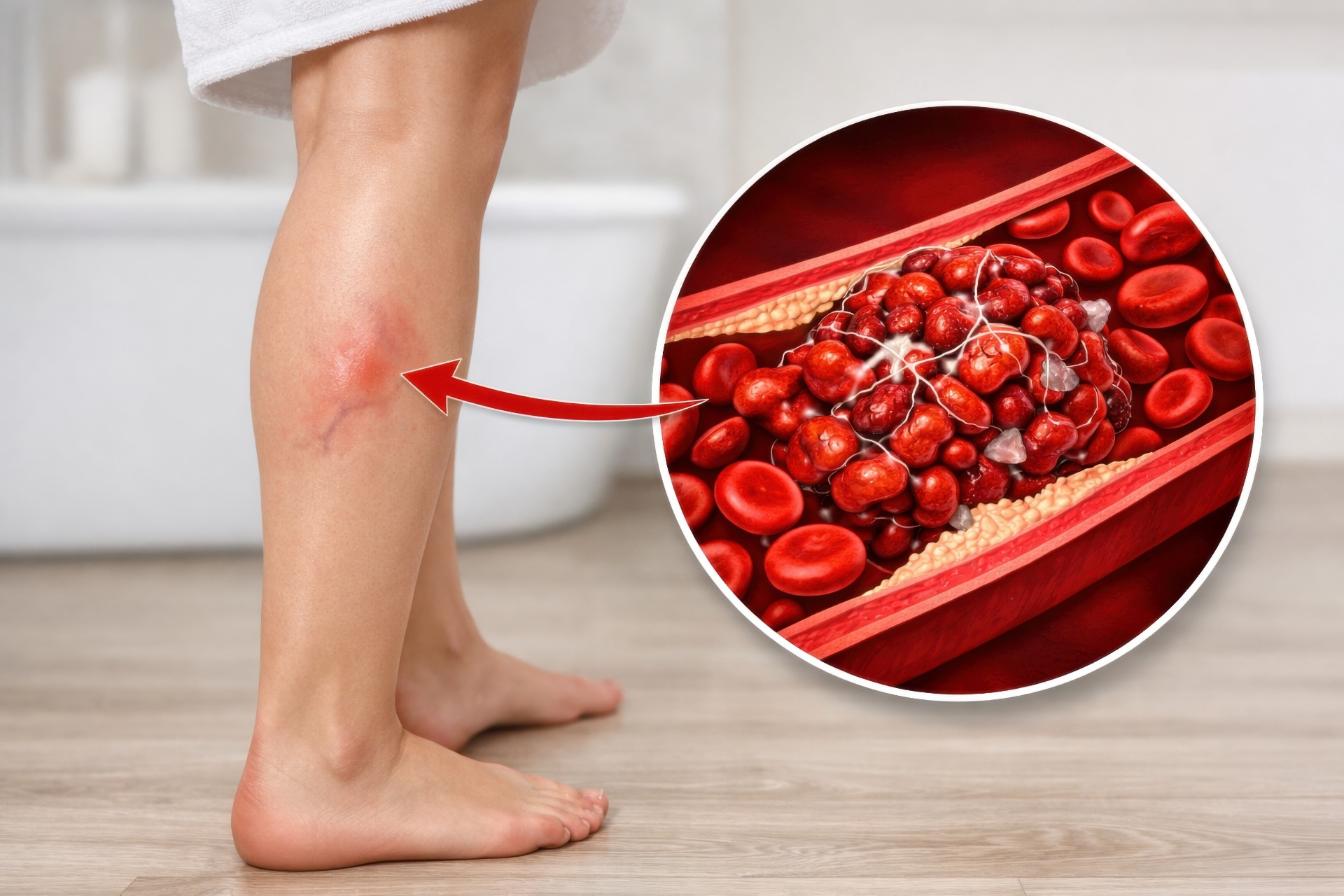
A blood clot in the leg - medically known as deep vein thrombosis (DVT) - is a serious condition where a blood clot forms in the deep veins, most often in the calf or thigh. The condition is dangerous because the clot can break loose and travel to the lungs (pulmonary embolism) [1]. If you suspect a clot in the leg, seek medical assessment the same day, and with signs of pulmonary embolism such as sudden breathlessness, chest pain or coughing up blood, call the emergency number.
The Classic Symptoms
Classic DVT presents with:
- Swelling of one leg (rarely both) - often the entire calf or the whole leg
- Pain or tenderness in the calf, especially with movement and on touch
- Warmth and redness in the swollen area
- Taut, shiny skin and visible superficial veins
- A feeling of "heaviness" and cramps
Some leg clots cause few or unclear symptoms, and a few cases are only discovered when a pulmonary embolism develops [2]. There is no reliable figure for how large that proportion is. Clinical suspicion therefore matters.
Pulmonary Embolism - Call 112
If the blood clot breaks loose and travels to the lungs, a pulmonary embolism occurs, with symptoms including:
- Sudden shortness of breath, often without exertion
- Chest pain, often worse on deep inspiration
- Cough, possibly with bloody sputum
- Palpitations or a fast pulse
- Fainting or a sudden drop in blood pressure
- Anxiety and a feeling that "something is wrong"
If you experience these symptoms - call 112 immediately. A pulmonary embolism is a life-threatening medical emergency.
How the Doctor Assesses the Suspicion
If a clot in the leg is suspected, the assessment happens urgently, the same day, with a doctor. The doctor combines your history, risk factors and an examination of the leg into an overall clinical assessment and then decides which tests are needed. That may be a blood test (D-dimer), an ultrasound scan of the deep veins of the leg, or both [8].
Some services use a structured scoring tool, the Wells score, to support that assessment. It is a tool for clinicians used alongside examining you. It is not a self-test, and there is no point threshold you can work out yourself or use to rule a clot out.
A raised D-dimer does not diagnose DVT - it also rises with infection, pregnancy, cancer, recent surgery and increasing age. Equally, a normal test does not by itself remove the suspicion if the clinical assessment points the other way.
Pregnancy and the postpartum period are handled as a separate urgent pathway together with the obstetric department, because the usual assessment tools cannot be applied in the same way [8,9].
Risk Factors
- Immobilisation: long-haul flights, bed rest, plaster casts
- Recent surgery (especially hip/knee, abdominal)
- Cancer and cancer treatment
- Pregnancy and the postpartum period
- Contraceptive pills, hormone therapy
- Previous DVT
- Hereditary thrombophilia (Factor V Leiden, protein C/S deficiency)
- Obesity and smoking
- Varicose veins and venous insufficiency are associated with superficial thrombophlebitis. Thrombophlebitis is a different condition from DVT, and a medical assessment decides which one is present [4]
Conditions Mistaken for DVT
Several conditions can look like DVT, among them muscle injury, calf cramps, a ruptured Baker's cyst, erysipelas or cellulitis, and chronic venous insufficiency. The symptoms overlap, and there are no simple features you can use yourself to tell them apart.
If in doubt: see a doctor the same day. The doctor assesses the clinical probability first and then decides whether a D-dimer test, an ultrasound scan or both are needed.
Treatment
DVT is treated with anticoagulation (blood-thinning medication). The drug, dose and duration are chosen acutely by the treating doctor. You should never select or adjust anticoagulation yourself, and the list below is not a treatment protocol.
The doctor takes into account, among other things:
- pregnancy and breastfeeding
- active cancer and ongoing cancer treatment
- kidney and liver function
- bleeding risk and previous bleeding
- other medicines and the risk of interactions
- Danish clinical practice and local protocols
The form and duration of treatment depend on the cause and on your overall situation, and they are reassessed over time by the treating doctor [8]. In pregnancy and the postpartum period, treatment is arranged together with the maternity unit and the relevant specialist.
Post-Thrombotic Syndrome - The Long-Term Complication
Some patients with DVT develop post-thrombotic syndrome: chronic swelling, heaviness, pain, and skin changes in the affected leg [5]. It is a possible late consequence of a clot and is not the same as primary varicose veins.
Compression stockings used to be recommended routinely to prevent post-thrombotic syndrome. The randomised SOX trial did not confirm this preventive effect [7], and NICE NG158 does not recommend elastic graduated compression stockings to prevent post-thrombotic syndrome or recurrent VTE after a DVT [8]. Stockings can, however, be used for symptoms such as swelling and heaviness after a DVT when the doctor finds it appropriate in the individual case [8].
In Summary
If you suspect a blood clot in the leg, see a doctor the same day. With sudden breathlessness, chest pain or coughing up blood, call 112.
If you have persistent swelling, heaviness, pain or skin changes after a DVT, a vascular surgical assessment may be relevant. It is not the case that everyone who has had a DVT routinely needs to be seen by a vascular surgeon.
References
- Heit JA. Epidemiology of venous thromboembolism. Nat Rev Cardiol 2015;12(8):464-74. PubMed
- Cohen AT, et al. Venous thromboembolism (VTE) in Europe. Thromb Haemost 2007;98(4):756-64.
- Wells PS, Anderson DR, Rodger M, et al. Evaluation of D-dimer in the diagnosis of suspected deep-vein thrombosis. N Engl J Med 2003;349(13):1227-35. PubMed
- Decousus H, et al. Superficial venous thrombosis and venous thromboembolism: a large, prospective epidemiologic study. Ann Intern Med 2010;152(4):218-24.
- Kahn SR. The post-thrombotic syndrome. Hematology Am Soc Hematol Educ Program 2016;2016(1):413-418. doi:10.1182/asheducation-2016.1.413
- Stevens SM, Woller SC, Kreuziger LB, et al. Antithrombotic therapy for VTE disease: second update of the CHEST guideline and expert panel report. Chest 2021;160(6):e545-e608. doi:10.1016/j.chest.2021.07.055
- Kahn SR, Shapiro S, Wells PS, et al. Compression stockings to prevent post-thrombotic syndrome: a randomised placebo-controlled trial (SOX trial). Lancet 2014;383(9920):880-888. DOI: 10.1016/S0140-6736(13)61902-9. PubMed
- National Institute for Health and Care Excellence. Venous thromboembolic diseases: diagnosis, management and thrombophilia testing (NG158). NICE 2020, updated 2023. nice.org.uk/guidance/ng158
- Kakkos SK, Gohel M, Baekgaard N, et al. European Society for Vascular Surgery (ESVS) 2021 Clinical Practice Guidelines on the Management of Venous Thrombosis. Eur J Vasc Endovasc Surg 2021;61(1):9-82. doi:10.1016/j.ejvs.2020.09.023