
Black stool (melena)
Written and medically reviewed by Bahir Hadi, specialist in surgery, PhD
Black stool (melena): When is it serious - and when do you need a gastroscopy?
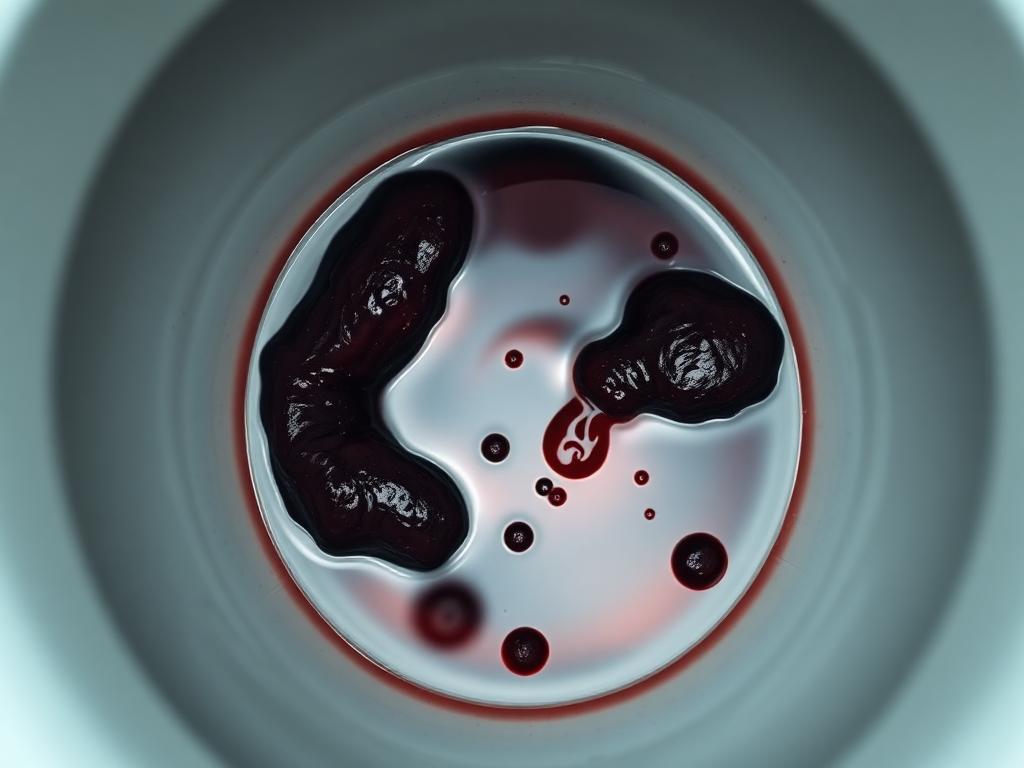
Black, tarry stool is medically called melena and is one of the classic alarm symptoms in the gastrointestinal tract. It is most often caused by bleeding from the upper gastrointestinal tract - oesophagus, stomach or duodenum - where blood is digested by gastric acid and bacteria and turns the stool black [1]. Gastroscopy is the central examination when upper gastrointestinal bleeding is suspected, although it does not always show the source. In acute upper gastrointestinal bleeding it is recommended within 24 hours of haemodynamic resuscitation [6].
Why does the stool turn black?
Blood has to remain in the gastrointestinal tract for a while before the stool turns black. How long that takes, and how much blood is needed, varies from person to person, and a normal stool colour does not rule out bleeding. Haemoglobin is converted to haematin and iron sulphide, which colours the stool shiny black and gives it a characteristic sweetish, foul-smelling odour.
The most common causes
| Source | Typical signs |
|---|---|
| Peptic ulcer | Epigastric pain, Helicobacter pylori, NSAID use |
| Erosive gastritis | Painkillers, alcohol, stress |
| Oesophageal varices | Liver cirrhosis, concurrent haematemesis (vomiting blood) |
| Acid reflux (GERD) with oesophagitis | Heartburn, painful swallowing |
| Mallory-Weiss tear | After forceful vomiting |
| Gastric cancer | Weight loss, loss of appetite, age >50 |
False melena (not bleeding) can be caused by iron supplements, liquorice, blueberries, activated charcoal and bismuth-containing products. Colour alone cannot reliably distinguish them, and dark stool in a person with risk factors should be treated as possible bleeding until clarified.
When to seek help - urgently?
Black, tarry stool is an alarm symptom. It must always be assessed by a doctor the same day - not "within a few days", and not at a pre-booked appointment in a specialist clinic.
Call 112 if you have:
- Collapse, fainting or near-fainting
- Bloody or "coffee-grounds" vomiting (haematemesis)
- Breathlessness, rapid pulse, pale and clammy skin
- Severe weakness or severe abdominal pain
Call 1813 (Capital Region of Denmark) or your regional out-of-hours service the same day for black stool without the above - even if you feel reasonably well. If you have known liver cirrhosis or a bleeding disorder, or take anticoagulants, contact them immediately.
Acute upper gastrointestinal bleeding is managed in hospital with circulatory stabilisation, blood tests, risk assessment and endoscopy at the appropriate time [3,5,6]. Outpatient transnasal gastroscopy in a clinic is not an alternative during an acute bleed.
ESGE 2021: ESGE recommends the Glasgow-Blatchford Score for pre-endoscopy risk stratification in acute upper gastrointestinal haemorrhage; patients with GBS ≤1 are at very low risk and can, in selected cases, be managed as outpatients [6].
The Glasgow-Blatchford Score is calculated by healthcare staff during the acute assessment before any endoscopy, after measuring blood pressure, pulse, haemoglobin and urea. NICE states that early discharge may be considered at a pre-endoscopy score of 0 (NICE CG141, recommendation 1.1.2) [5]. ACG describes a score of 0-1 as an example of very low risk where outpatient follow-up may be possible after clinical assessment [3]. The two thresholds come from different guidelines and should not be merged into one universal rule. The score is not a self-test tool and must never be used to delay an acute medical assessment of black, tarry stools.
If you have had a single episode of dark stool while taking iron supplements and are otherwise entirely well, you should still contact your GP - iron does not rule out concurrent bleeding.
How melena is investigated
- History: NSAIDs, anticoagulants, alcohol, iron supplements, previous peptic ulcer.
- Clinical examination: pulse, blood pressure, need for transfusion.
- Blood tests: haemoglobin, ferritin, INR, liver tests, urea (elevated in upper GI bleeding).
- Oral gastroscopy - the central investigation when upper GI bleeding is suspected. In acute bleeding it is performed in hospital, usually within 24 hours of stabilisation [2,6].
- Nasal gastroscopy - a variant that some people tolerate well and that is often done without sedation; tolerance and suitability vary from person to person. It is used for planned, non-acute investigation. It is not suitable for acute bleeding or for endoscopic haemostasis.
- Colonoscopy - considered if gastroscopy fails to show a source.
Treatment
Acute:
- Stabilisation with fluids and possibly blood transfusion
- IV proton pump inhibitor (PPI)
- Endoscopic haemostasis at gastroscopy: clips and thermocoagulation; adrenaline injection is never used alone but always combined with a second haemostatic modality [3,6]
- For oesophageal varices (dilated veins in the oesophagus - not the same as varicose veins in the legs): endoscopic band ligation and vasoactive therapy in hospital
Subacute and preventive:
- Eradication of Helicobacter pylori where an ulcer has been demonstrated. A Cochrane review found fewer ulcer recurrences after eradication than with acid suppression alone; the exact figures depend on population and follow-up time [4]
- Your doctor decides whether NSAIDs, aspirin or blood thinners should be paused, changed or combined with a PPI. Never stop prescribed medication on your own
- Reduce alcohol
- Oncological work-up for cancer-suspect findings
Treatment at Kirurgen.dk
We investigate clarified, non-acute upper gastrointestinal symptoms with outpatient oral and nasal gastroscopy after a GP referral. Questions about referral, cover and price are clarified with the clinic or your GP before treatment; see contact. If you currently have black stool, the acute pathway comes first - call 112 for life-threatening symptoms, otherwise the acute helpline (1813 in the Capital Region of Denmark, or your local out-of-hours service) as described above. See also our articles on Helicobacter pylori and peptic ulcer, GERD reflux and nasal vs. oral gastroscopy.
References
- Wilkins T, Khan N, Nabh A, Schade RR. Diagnosis and management of upper gastrointestinal bleeding. Am Fam Physician 2012;85(5):469-76.
- Barkun AN, Almadi M, Kuipers EJ, et al. Management of nonvariceal upper gastrointestinal bleeding: international consensus group. Ann Intern Med 2019;171(11):805-22.
- Laine L, Barkun AN, Saltzman JR, Martel M, Leontiadis GI. ACG clinical guideline: upper gastrointestinal and ulcer bleeding. Am J Gastroenterol 2021;116(5):899-917.
- Ford AC, Gurusamy KS, Delaney B, Forman D, Moayyedi P. Eradication therapy for peptic ulcer disease in Helicobacter pylori-positive people. Cochrane Database Syst Rev 2016;(4):CD003840. PubMed
- National Institute for Health and Care Excellence (NICE). Acute upper gastrointestinal bleeding in over 16s: management. Clinical Guideline CG141, 2012 (updated 2016). nice.org.uk/guidance/cg141
- Gralnek IM, Stanley AJ, Morris AJ, et al. Endoscopic diagnosis and management of nonvariceal upper gastrointestinal hemorrhage (NVUGIH): ESGE Guideline - Update 2021. Endoscopy 2021;53(3):300-332.
- Blatchford O, Murray WR, Blatchford M. A risk score to predict need for treatment for upper-gastrointestinal haemorrhage. Lancet 2000;356(9238):1318-21.
See also
More on this topic at Kirurgen.dk
Category: Gastrointestinal