
Levator Ani Syndrome: pelvic floor pain, symptoms and treatment
Written and medically reviewed by Bahir Hadi, specialist in surgery, PhD
Levator Ani Syndrome: When pelvic floor muscles cause pain
 chronic pain at the anus
Are you experiencing a constant feeling of heaviness or a dull, aching pain in the pelvic floor? Levator Ani Syndrome is a possible cause of chronic pain near the rectum. Since the symptoms can resemble other conditions, they are assessed individually by a doctor, who also considers whether a bowel examination is relevant.
What is Levator Ani Syndrome?
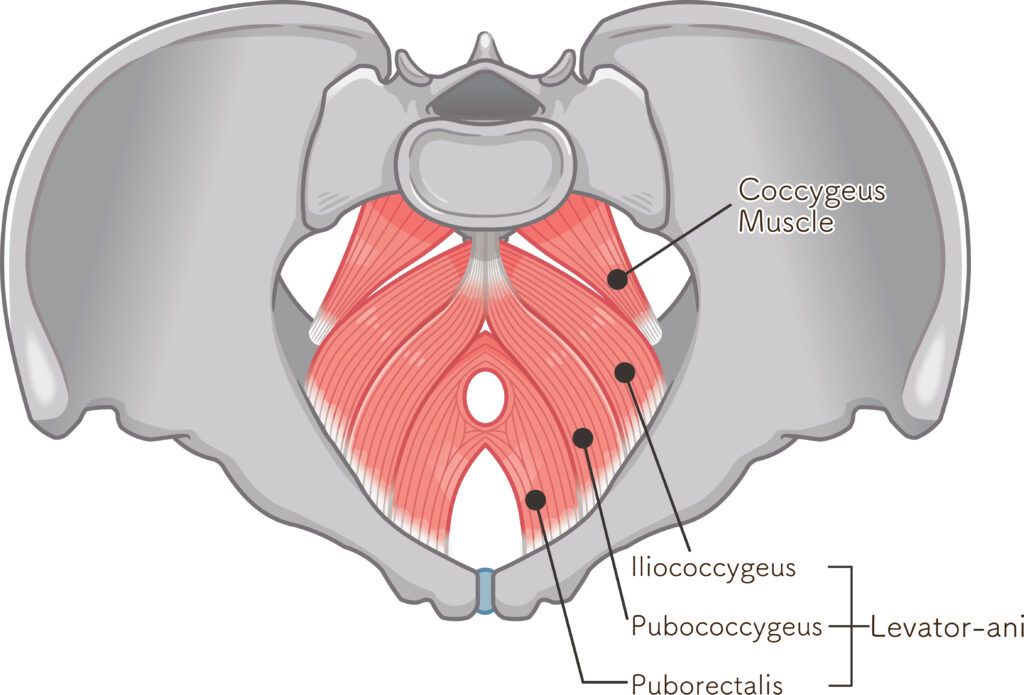
The levator ani is the large muscle group that forms the floor of the pelvis. In this syndrome, chronic tension or spasms occur in the muscles, resulting in pain that is often described as:
- A sensation of a "golf ball" in the rectum.
- A dull pain that worsens when sitting down for long periods.
- Pain that can last for hours or days.
Differential Diagnoses: What else could it be?
Levator ani syndrome is distinguished from other conditions by the nature and duration of the pain.
1. Proctalgia Fugax (Short-term cramps)
While Levator Ani involves long-lasting pain, Proctalgia Fugax is characterised by sudden, intense cramping episodes.
- Pain character: Lightning-fast, sharp stabs.
- Duration: Lasts from a few seconds to a maximum of 30 minutes.
- Distinction: If your pain disappears completely between episodes and typically occurs at night, it is likely Proctalgia Fugax.
2. Pudendal Neuralgia (Nerve pain)
In this case, the pain is caused by irritation of the pudendal nerve rather than the muscle itself.
- Pain character: Burning, electric, or stabbing pain that often radiates towards the genitals.
- Distinction: According to the Nantes criteria, it is characteristic of pudendal neuralgia that the pain typically does not wake the patient at night and is often relieved by sitting on a toilet seat, where pressure on the nerve is reduced. Levator Ani pain is often unchanged or worse in the same position. These are criteria that feed into an overall clinical assessment, not a self-test.
3. Colorectal Cancer (Serious causes)
Many patients rightly fear that pain in this area could be caused by colorectal cancer.
- Distinction: Cancer of the rectum rarely presents with pain as the only symptom. We look for "red flags" such as blood in the stool, unexplained weight loss, or changed bowel habits. Levator ani syndrome is a clinical diagnosis of exclusion, made after an individual assessment. Whether digital rectal examination, anoscopy, sigmoidoscopy/colonoscopy or other investigations are needed depends on age, symptoms, findings, alarm symptoms and screening status. Colonoscopy is performed only on its own clinical indication, not as a routine part of work-up for anorectal pain, and no examination offers 100% certainty.
How do we distinguish between the diagnoses clinically?
The clinical assessment may include:
- Digital Palpation (Finger examination): During this examination, the doctor checks for a tight, tender muscle (often on the left side) that may provoke the familiar pain upon pressure. Tenderness on rectal examination can support the classification of levator ani syndrome, but does not by itself confirm the diagnosis, which is made after an overall individual assessment.
- Endoscopic examination (Anoscopy/Proctoscopy): The examination can show local findings such as an anal fissure or haemorrhoids, which form part of the differential diagnosis.
- Colonoscopy: If there is suspicion of structural changes or colorectal cancer, and depending on age, findings, alarm symptoms and screening status, a colonoscopy may be relevant. It is performed only on its own clinical indication, not routinely for everyone with anorectal pain, and it does not offer 100% certainty.
Overview for quick distinction
| Diagnosis | Pain Duration | Pain Character | Typical Sign |
|---|---|---|---|
| Levator Ani Syndrome | Hours/Days | Dull, aching | Tenderness when pressing on the pelvic floor muscle |
| Proctalgia Fugax | Seconds/Minutes | Cramp-like, acute | Disappears quickly on its own |
| Pudendal Neuralgia | Constant (when sitting) | Burning, electric | Often relieved by standing up or sitting on a toilet |
| Serious illness | Progressive | Variable | Work-up (possibly incl. colonoscopy) depends on age, findings and alarm symptoms |
Here is a comparison between Pudendal Neuralgia and Levator Ani Syndrome based on clinical guidelines. The listed features are clinical characteristics that feed into the assessment, not a proven causal mechanism in themselves.
| Feature | Pudendal Neuralgia (PN) | Levator Ani Syndrome (LAS) |
|---|---|---|
| Possible contributing factors | Irritation or entrapment of the pudendal nerve has been described in connection with this condition. | Spasms or chronic tension in the levator ani muscle have been described in connection with this condition. |
| Pain character | Burning, electric, stabbing, or a "foreign body sensation" (e.g., a golf ball in the rectum). | Dull, aching pain or a feeling of heaviness/pressure in the pelvis. |
| Pain area | The distribution area of the nerve: Perineum, genitals, and anus. | Typically located in the anus and the lower part of the rectum. |
| Sitting position | According to the Nantes criteria, often worse when sitting and characteristically relieved by standing up or sitting on a toilet seat. | Can also be worsened by sitting, but is often more constant or fluctuating independent of position. |
| Diagnosis | Often based on the "Nantes criteria" and relief from a diagnostic nerve block. | Based on the Rome V criteria for anorectal disorders: chronic or recurrent anorectal pain, episodes lasting at least about 30 minutes, tenderness of puborectalis on clinical examination, and assessment of relevant structural and other causes. The criteria are a classification framework for the clinician, not a diagnosis in themselves and not a patient self-test. The Rome V chapter on anorectal disorders was published in 2026 and replaced Rome IV from 2016. Older notes and studies may still use the Rome IV wording, which is now only of historical interest [09]. |
Treatment of Levator Ani Syndrome
Treatment of levator ani syndrome is based on an individual medical assessment. In practice, largely non-invasive approaches are used, but the evidence is limited to a few small studies, and no given treatment can be promised to work for any individual patient.
A. Pelvic floor physiotherapy
Biofeedback
A probe is placed in the rectum to measure muscle activity, and the patient is trained to identify and consciously relax the levator ani muscle instead of contracting it. In a randomised trial of 157 patients, 87% reported adequate relief after biofeedback compared with 45% after electrogalvanic stimulation and 22% after massage. The effect was seen only in patients with tenderness on rectal examination; patients without that finding did not benefit from any of the three treatments, and the trial included no surgical comparison arm [01].
Manual techniques
Specialised physiotherapists can apply manual massage and stretching of the tense muscle. In the trial above, massage gave relief in 22% of patients with tenderness on rectal examination [01].
B. Electrical Stimulation
Electrogalvanic Stimulation (EGS): An electrode is placed in the rectum and delivers a low-voltage current. In the randomised trial by Chiarioni et al. (2010) in patients with levator ani syndrome and tenderness on rectal examination, EGS gave relief in 45% versus 87% after biofeedback, and EGS was not clearly different from massage (22%). On this basis, EGS has not been shown to be as effective as biofeedback [01].
C. Injection Therapy
Botulinum Toxin (Botox): Botox is injected into the tense muscle and blocks the release of acetylcholine, which in theory could produce temporary muscle relaxation. A small double-blind, placebo-controlled crossover trial in levator ani syndrome found no improvement in pain [10]. A few uncontrolled series describe relief. Botox therefore cannot be presented as a documented treatment for this condition.
There are no controlled trials of medical treatment or more advanced procedures specifically in levator ani syndrome. Prescribed medication should never be changed or stopped without prior agreement with the doctor.
3. Summary for Patients
Levator ani syndrome is a clinical diagnosis made after an individual medical assessment, once other causes of the pain have been considered. Tenderness on rectal examination can support the classification, but does not by itself confirm the diagnosis. Pelvic floor physiotherapy with biofeedback has been studied in a randomised trial in patients with levator ani syndrome and tenderness on rectal examination, where it gave better relief than electrogalvanic stimulation and massage. The evidence rests on few and small studies, however, and the effect has only been shown in patients with this finding on examination. Treatment is planned individually by the treating doctor.
References (Pubmed-based)
- Chiarioni G, Nardo A, Vantini I, Romito A, Whitehead WE (2010). Biofeedback is superior to electrogalvanic stimulation and massage for treatment of levator ani syndrome. Gastroenterology, 138(4), 1321-1329. [PMID: 20044997] (Randomised trial of 157 patients; relief in 87% after biofeedback, 45% after EGS and 22% after massage, only in patients with tenderness on rectal examination; no surgical comparison arm).
- Heah, S. M. et al. (1997). Biofeedback is effective treatment for levator ani syndrome. Dis Colon Rectum, 40(2), 187-189. [PMID: 9075755] (Uncontrolled case series describing pain relief after biofeedback in patients with levator ani syndrome; the design, without a control group, does not support comparison with other treatments).
- Carrington EV, Popa SL, Chiarioni G. Proctalgia Syndromes: Update in Diagnosis and Management. Curr Gastroenterol Rep. 2020;22(7):35. PMID: 32519087 (Overview of anorectal pain syndromes, including botulinum toxin in treatment-resistant cases and the limited evidence base).
- Hite, M., & Curran, T. (2021). Biofeedback for Pelvic Floor Disorders. Clin Colon Rectal Surg, 34(1), 56-61. [PMID: 33536850] (Provides a broader overview of biofeedback's role in pelvic floor disorders and Levator Ani Syndrome).
- Labat JJ, Riant T, Robert R, Amarenco G, Lefaucheur JP, Rigaud J. Diagnostic criteria for pudendal neuralgia by pudendal nerve entrapment (Nantes criteria). Neurourol Urodyn. 2008;27(4):306-10. PMID: 17828787 (Consensus criteria for pudendal neuralgia, including relief when sitting on a toilet seat as one of several clinical characteristics).
- Kaur J, Leslie SW, Singh P. Pudendal Nerve Entrapment Syndrome. In: StatPearls [Internet]. Treasure Island (FL): StatPearls Publishing. PMID: 31334992
- Bharucha AE, Trabuco E. Functional Anorectal Disorders. Gastroenterology. 2016;150(6):1431-42. doi: 10.1053/j.gastro.2016.02.046. PMID: 27144630.
- Antolak SJ Jr, Hough DM, Pawlina W, Spinner RJ. Anatomical basis of chronic pelvic pain syndrome: the ischial spine and pudendal nerve entrapment. Med Hypotheses. 2002;59(3):349-53. PMID: 12208168
- Rao SSC, Bharucha AE, Chiarioni G, et al. Anorectal Disorders. Gastroenterology. 2026. doi: 10.1053/j.gastro.2026.01.037. PMID: 41713710 (The Rome V chapter on anorectal disorders and the source of the diagnostic criteria for levator ani syndrome).
- Rao SS, Paulson J, Mata M, Zimmerman B. Clinical trial: effects of botulinum toxin on levator ani syndrome - a double-blind, placebo-controlled study. Aliment Pharmacol Ther. 2009;29(9):985-991. PMID: 19222415 (Placebo-controlled crossover trial showing no pain relief from Botox in levator ani syndrome).
More on this topic at Kirurgen.dk
Category: Anal surgery