
Low-FODMAP diet for IBS
Written and medically reviewed by Bahir Hadi, specialist in surgery, PhD
Low-FODMAP diet: structured dietary therapy for IBS
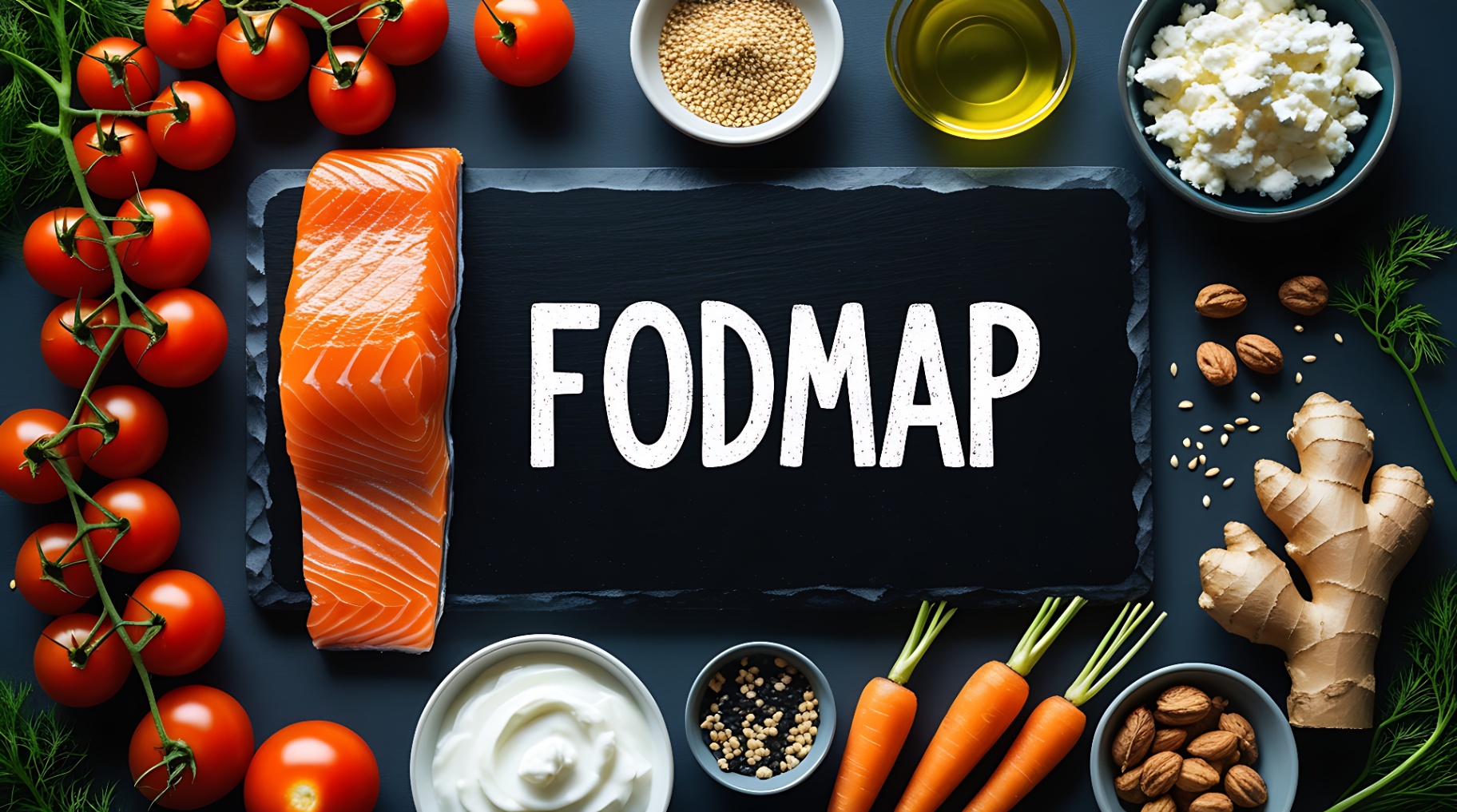
The low-FODMAP diet was developed at Monash University in Australia and appears as a dietary therapy for irritable bowel syndrome (IBS) in international guidelines. ACG 2021 words it as "a limited trial of a low FODMAP diet in patients with IBS to improve global symptoms" and grades it as a conditional recommendation with very low quality of evidence [4]. The diet targets symptoms. It does not treat a cause of IBS and it is not a cure. Studies show symptom relief in a proportion of patients, but the exact figure varies between study populations, outcome measures and comparator diets, so it cannot be reduced to a single universal percentage. Diet is one part of a wider plan, and EndoCap describes diet as part of IBS management. FODMAP stands for:
- Fermentable
- Oligosaccharides (fructans, GOS)
- Disaccharides (lactose)
- Monosaccharides (excess fructose)
- And
- Polyols (sorbitol, mannitol, xylitol)
These short-chain carbohydrates are poorly absorbed in the small bowel, draw water in, and are fermented in the colon → gas, bloating, pain and altered bowel habit.
Three phases - a time-limited process
The diet is carried out as a structured, time-limited process in three phases. AGA describes the process as restriction, reintroduction and personalisation, and states that the restriction phase should last no more than 4-6 weeks [5]. How each phase is organised is agreed individually, ideally with a dietitian:
| Phase | Purpose |
|---|---|
| 1. Restriction | A defined period of no more than 4-6 weeks where high-FODMAP foods are reduced while symptom response is assessed [5] |
| 2. Systematic reintroduction | One FODMAP group is tested at a time to identify individual triggers |
| 3. Personalised long-term diet | Only the foods/amounts the patient actually reacts to are limited going forward |
Important: This diet is a temporary, time-limited intervention - not a lifelong restrictive diet. The restriction phase should not continue indefinitely. Unnecessarily prolonged and extensive restriction may potentially affect fibre and certain nutrient intake, and the composition of gut microorganisms, but this does not mean clinical harm has been demonstrated for everyone who follows the diet for a limited, supervised period [2]. There are also no universal portion sizes or challenge doses; amounts are tested individually.
High vs low FODMAP examples
The lists below are examples, not exhaustive. Monash University continuously updates its database as new foods are tested, and FODMAP content can depend on portion size. Individual tolerance varies considerably between patients and between the different FODMAP groups.
| Category | Often high-FODMAP | Often low-FODMAP |
|---|---|---|
| Fruit | Apples, pears, mango, watermelon, cherries | Banana (unripe), kiwi, strawberries, blueberries, orange |
| Vegetables | Onion, garlic, cauliflower, asparagus, peas | Carrot, cucumber, spinach, bell pepper, potato |
| Grains | Wheat bread, rye bread, pasta | Oats, rice, quinoa, gluten-free bread |
| Dairy | Milk, cream, soft cheese, yogurt | Lactose-free milk, hard cheese, lactose-free yogurt |
| Legumes | Lentils, chickpeas, kidney beans | Limited amounts of firm tofu |
| Sweet | Honey, agave, sorbitol/xylitol gum | Sugar, maple syrup, dark chocolate |
What does the evidence show?
- Halmos et al. (Gastroenterology 2014) - a randomised controlled trial found a significant reduction in symptoms in IBS patients on low-FODMAP compared with a typical Australian diet over a defined study period [1].
- Staudacher & Whelan (Gut 2017) - a review of mechanisms and efficacy describes symptom reduction in a proportion of IBS patients, while also noting that the diet can reduce certain gut bifidobacteria during the restrictive phase [3].
- Mansueto et al. (J Clin Gastroenterol 2015) - also describes symptom benefit in patients with IBD in remission and coexisting IBS-like symptoms.
Low-FODMAP is not an established treatment for SIBO (small intestinal bacterial overgrowth) and is not a method for "restoring" the gut microbiome. Changes in microbiome composition during the diet remain a research area, and their clinical meaning for the individual patient is not yet established.
Who needs individual clinical assessment before starting?
- People with a current or previous eating disorder
- People at nutritional risk or with unintentional weight loss
- Children and pregnant women - only under dietitian supervision
- Patients without a confirmed IBS diagnosis - first have an assessment for coeliac disease, IBD, BAM and other relevant differential diagnoses, including SIBO
AGA advises against restrictive diets in people at risk of malnutrition, with an eating disorder or disordered eating, with food insecurity, or with uncontrolled psychiatric illness [5]. Low body weight alone is not automatically an absolute contraindication, but should always be part of an individual clinical assessment, ideally together with a dietitian with gastroenterology experience. There are limited data on selected biomarkers, but none is sufficiently validated to predict dietary response in routine use [5].
The guidelines differ
BSG describes the low FODMAP diet as a second-line dietary therapy for IBS that should be supervised by a trained dietitian, with FODMAPs reintroduced according to tolerance. The recommendation is weak and based on very low quality evidence [6].
On probiotics in IBS the guidelines point in different directions:
- ACG 2021 suggests against probiotics for global IBS symptoms. Conditional recommendation, very low quality of evidence [4].
- BSG 2021 concludes that probiotics as a group may be effective for global symptoms and abdominal pain, but that no specific species or strain can be recommended. A trial of up to 12 weeks is reasonable, stopping if symptoms do not improve. Weak recommendation, very low quality of evidence [6].
This disagreement is not evidence of a class effect for probiotics or support for any particular product.
Practical tips
- Use an up-to-date FODMAP source, e.g. the Monash University app - food lists change over time
- Dietitian supervision is recommended, particularly to avoid unnecessary or overly prolonged restriction
- Read ingredient labels - onion/garlic powder is found in many ready meals
- Personalisation is key - most people tolerate some FODMAP groups in certain amounts, which should be clarified during reintroduction rather than avoided permanently
Treatment and assessment at Kirurgen.dk
We assess relevant organic differential diagnoses (IBD, coeliac disease, BAM, SIBO) before dietary intervention - via colonoscopy, gastroscopy, blood tests and faecal calprotectin. No single test can exclude them on its own, and the extent of the work-up depends on the symptom pattern and risk. See also: IBS, Bloating, SIBO, Gut microbiome, probiotics and IBS.
References
- Halmos EP, Power VA, Shepherd SJ, Gibson PR, Muir JG. A diet low in FODMAPs reduces symptoms of irritable bowel syndrome. Gastroenterology 2014;146(1):67-75.
- Staudacher HM, Lomer MC, Farquharson FM, et al. A diet low in FODMAPs reduces symptoms in IBS and a probiotic restores Bifidobacterium species. Gastroenterology 2017;153(4):936-47.
- Staudacher HM, Whelan K. The low FODMAP diet: recent advances in understanding its mechanisms and efficacy in IBS. Gut 2017;66(8):1517-27.
- Lacy BE, Pimentel M, Brenner DM, et al. ACG Clinical Guideline: Management of Irritable Bowel Syndrome. Am J Gastroenterol 2021;116(1):17-44. PMID 33315591. doi.org/10.14309/ajg.0000000000001036
- Chey WD, Hashash JG, Manning L, Chang L. AGA Clinical Practice Update on the Role of Diet in Irritable Bowel Syndrome: Expert Review. Gastroenterology 2022;162(6):1737-1745.e5. PMID 35337654. doi.org/10.1053/j.gastro.2021.12.248
- Vasant DH, Paine PA, Black CJ, et al. British Society of Gastroenterology guidelines on the management of irritable bowel syndrome. Gut 2021;70(7):1214-1240. PMID 33903147. doi.org/10.1136/gutjnl-2021-324598 - gut.bmj.com/content/70/7/1214
More on this topic at Kirurgen.dk
Category: Gastrointestinal