
Helicobacter pylori breath test
Written and medically reviewed by Bahir Hadi, specialist in surgery, PhD
Helicobacter pylori breath test: a test for active H. pylori infection
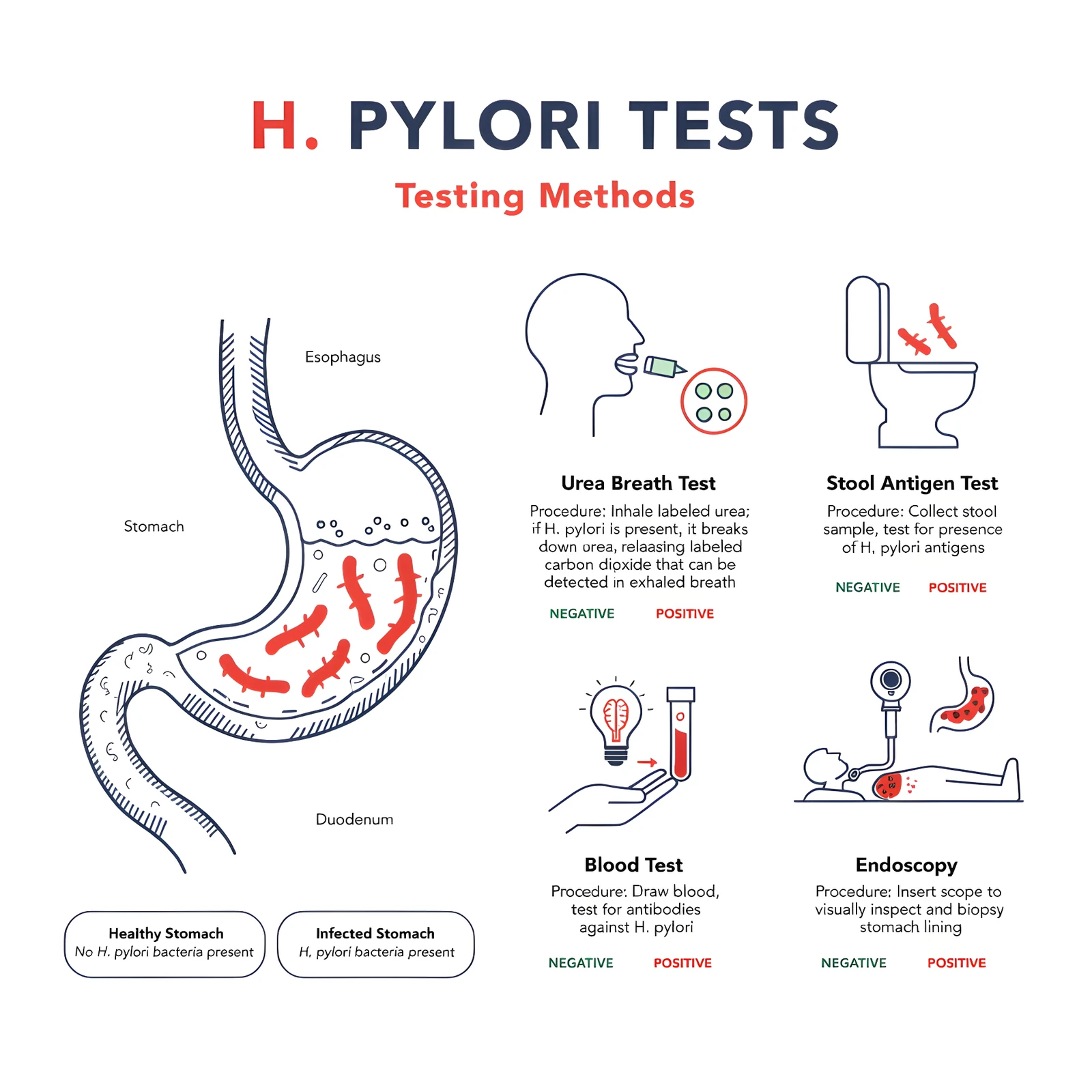
The Helicobacter pylori breath test (¹³C-urea breath test, UBT) is a validated non-invasive test for active Helicobacter pylori infection - the bacterium behind a large share of peptic ulcers and a major risk factor for gastric cancer. The proportion of ulcers caused by H. pylori has fallen in low-prevalence countries, and there is no single figure that covers all settings [1]. In a meta-analysis of 23 studies in adults with dyspepsia, pooled UBT sensitivity was 96% (95% CI 95-97%) and specificity 93% (95% CI 91-94%) [2]. The analysis pools ¹³C and ¹⁴C breath tests (14 studies with ¹³C, 9 with ¹⁴C), carries a moderate risk of bias and shows substantial unexplained heterogeneity. The figures are therefore not a specific performance estimate for the ¹³C test used at the clinic. These figures assume the test preconditions are met - fasting and a pause of PPI/PCAB and antibiotics before testing; if not met, the risk of a false-negative result increases. UBT is a validated option both for primary diagnosis and for confirmation after eradication treatment. The choice between breath test, stool antigen and gastroscopy depends on the clinical situation.
How does the breath test work?
- You exhale into a test bag (baseline).
- You drink a small volume of liquid containing ¹³C-labelled urea (non-radioactive).
- You wait 20-30 minutes.
- You exhale into a second test bag.
Principle: H. pylori produces the enzyme urease, which splits urea into CO₂ and ammonia. If the bacterium is present, your exhaled breath contains elevated ¹³CO₂ - measured by mass spectrometry or infrared spectrophotometry.
When is the breath test indicated?
The European Maastricht VI/Florence consensus [1] lists situations such as these where testing for H. pylori is relevant:
- Uninvestigated dyspepsia without alarm symptoms (test-and-treat). The age at which test-and-treat is preferred over gastroscopy is set locally and differs between countries; in Denmark it depends on the individual doctor's assessment and local guidance.
- Previous peptic ulcer without documented eradication
- First-degree relative with gastric cancer
- Iron-deficiency anaemia with no other explanation
- ITP (immune thrombocytopenia)
- Confirmation after eradication therapy, at a time set by your doctor
Whether a given indication applies to you is decided by the doctor investigating your symptoms.
With alarm symptoms such as difficulty swallowing, unintended weight loss, anaemia, persistent vomiting or signs of gastrointestinal bleeding, a breath test is not necessarily sufficient investigation. Gastroscopy is the central test here, and active bleeding belongs in acute hospital care.
Important - preparation
To avoid false-negative results:
| Substance | Washout period |
|---|---|
| Proton pump inhibitors (PPI/PCAB) - omeprazole, pantoprazole | Normally paused for at least 2 weeks before the test (ACG 2024 [4], NICE CG184 [6]) - only after agreement with the doctor who prescribed it |
| Antibiotics | Can cause a false-negative test. The timing relative to the test is set by the doctor who orders it |
| Bismuth compounds | Can cause a false-negative test. The American ACG review from 2024 states a 4-week pause for bismuth and antibiotics before the test of cure, against 2 weeks for acid-suppressing medicine [4]. The specific pause is agreed with the doctor who orders the test, and the clinic's own laboratory instruction may say otherwise |
| H2 antagonists and antacids | Shorter washout than PPI. ACG 2024 [4] describes that an antacid or an H2 antagonist may in some cases be used during the PPI pause. Always follow the written instruction from the laboratory and the agreement with your own doctor - never stop medication on your own |
| Fasting | At least 6 hours before |
Alternatives to the breath test
| Test | Pros | Cons |
|---|---|---|
| Breath test (UBT) | Simple, high accuracy, validated for follow-up | PPI washout required |
| Stool antigen test | Validated for both primary diagnosis and test-of-cure, no breath equipment needed | Accuracy depends on the assay type (monoclonal/polyclonal) and on the population; sample collection is inconvenient |
| Gastroscopy + CLO/biopsy | Direct visualisation + bacteriology | Invasive, more expensive |
| Serology (blood test) | Fast | Cannot distinguish active from past infection and must not be used as test-of-cure |
Treatment if positive
Treatment combines acid suppression with antibiotics, and the regimen is chosen individually by the doctor. The Danish DSGH guideline (revised 1 November 2024) keeps a 7-day clarithromycin-based triple regimen with a PPI as first-line treatment while clarithromycin resistance in Denmark stays low (below 15%), and recommends a 14-day second-line regimen after failure [8]. The American ACG guideline from 2024 recommends 14 days already in first line and advises against routine clarithromycin triple therapy, but that reflects US resistance patterns [4]. Previous macrolide exposure argues against clarithromycin in both guidelines. None of this is an instruction for self-treatment. Test of cure is recommended after eradication therapy [4]. It is done no earlier than 4 weeks after the antibiotics are finished, and PPI/PCAB are normally paused for at least 2 weeks before the test [4]. The exact timing and the pause are agreed with the treating doctor.
Eradication markedly reduces the risk of a new ulcer compared with acid suppression alone [3].
Follow-up after treatment
- Everyone treated with eradication therapy should have the result confirmed. Symptom relief does not document that the bacterium is gone [4].
- The check is done no earlier than 4 weeks after the antibiotics are finished [4]. For patients with peptic ulcer, NICE additionally advises retesting for H. pylori 6-8 weeks after treatment is started [6]; that applies to that group and does not replace the test-of-cure timing above.
- PPI/PCAB are normally paused for at least 2 weeks before the urea breath test and the stool antigen test [4], matching the NICE two-week washout [6]. Any pause is agreed with the doctor who prescribed the medicine and does not automatically apply to every patient.
- Antibiotics and bismuth-containing preparations can cause a false-negative result. NICE QS96 [7] states no antibiotics in the 4 weeks before a diagnostic test. The ACG review from 2024 states a 4-week pause for both antibiotics and bismuth before the test of cure [4]. The specific pause is agreed with the doctor who orders the test.
- Never stop prescribed medication without agreeing it with your doctor. Whether an H2 blocker or an antacid can be used during the pause is decided individually.
- Either the urea breath test or a validated stool antigen test can serve as test-of-cure. Serology cannot.
- If still positive, the doctor selects second-line therapy based on what you have already received and any susceptibility testing.
Testing at Kirurgen.dk
We offer ¹³C-urea breath testing in our outpatient clinic, both for primary diagnosis and post-treatment confirmation. If the doctor judges that gastroscopy is needed, it can be performed as oral or nasal gastroscopy. Timing is agreed on the basis of the clinical assessment. See also: Helicobacter pylori, Peptic ulcer, GERD, Black stool.
References
- Malfertheiner P, Megraud F, Rokkas T, et al. Management of Helicobacter pylori infection: the Maastricht VI/Florence consensus report. Gut 2022;71(9):1724-62.
- Ferwana M, Abdulmajeed I, Alhajiahmed A, et al. Accuracy of urea breath test in Helicobacter pylori infection: meta-analysis. World J Gastroenterol 2015;21(4):1305-14. doi:10.3748/wjg.v21.i4.1305 PubMed
- Ford AC, Gurusamy KS, Delaney B, Forman D, Moayyedi P. Eradication therapy for peptic ulcer disease in Helicobacter pylori-positive people. Cochrane Database Syst Rev 2016;(4):CD003840. PubMed
- Chey WD, Howden CW, Moss SF, et al. ACG Clinical Guideline: Treatment of Helicobacter pylori Infection. Am J Gastroenterol 2024;119(9):1730-1753. doi:10.14309/ajg.0000000000002968
- Lægehåndbogen, sundhed.dk. Helicobacter pylori infection. Danish clinical reference work, last revised 2025. sundhed.dk/sundhedsfaglig/laegehaandbogen
- NICE. Gastro-oesophageal reflux disease and dyspepsia in adults: investigation and management (CG184). Recommendations 1.4.2 and 1.7.4. nice.org.uk/guidance/cg184
- NICE. Helicobacter pylori in adults (QS96), quality statement 3: testing conditions. nice.org.uk/guidance/qs96
- Danish Society for Gastroenterology and Hepatology (DSGH). Helicobacter pylori infektion: Diagnostik og behandling. Revision 6.0, revised 01.11.2024 (in Danish). dsgh.dk (PDF)
The Danish Society of Gastroenterology and Hepatology guideline on ulcer disease and H. pylori dates from 2015 and has not been updated after ACG 2024. It should not be read as a current Danish recommendation without stating that date.
More on this topic at Kirurgen.dk
Category: Endoscopy